
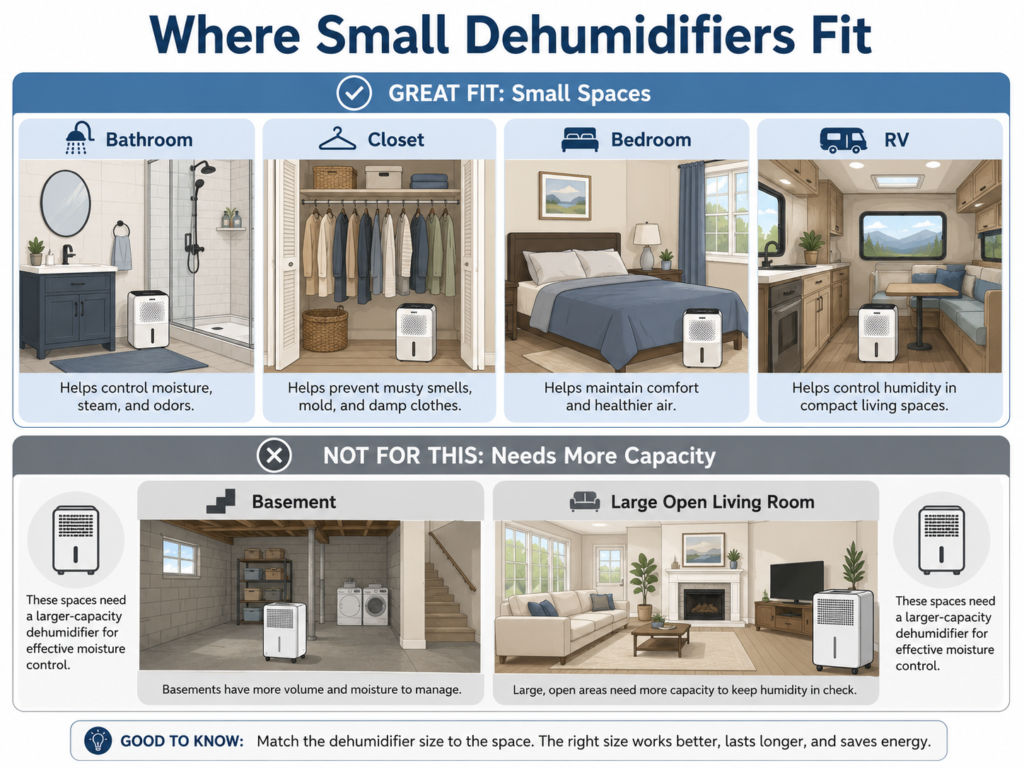
Small dehumidifiers can help in tight spaces where the humidity problem is mild, contained, and close to the unit. They make the most sense in bathrooms, closets, small bedrooms, laundry closets, pantry areas, and small storage spaces.
They are not the same thing as full-size portable dehumidifiers. A mini dehumidifier may collect water from the air, but that does not mean it can control a damp basement, large bedroom, apartment, open living area, or whole-house humidity problem.
The better question is not just how many square feet the listing claims. The better question is whether the space is small enough, enclosed enough, and mildly damp enough for a small dehumidifier to keep up.
Fast Answer: When a Small Dehumidifier Makes Sense
Before choosing a compact unit, check whether exhaust ventilation, drainage, leaks, or a poorly isolated space are the real issue. Small tanks and low rated removal may make a tiny unit suitable only for a limited moisture load. Use actual humidity readings and product output specifications; do not assume a miniature unit can dry a persistently wet bathroom or closet. Technical references: ENERGY STAR bath ventilation EPA moisture and mold.
A small dehumidifier makes sense when the damp area is limited and the moisture problem is light. Think of a bathroom after showers, a closet that feels slightly damp, a small storage area, or a bedroom corner where humidity runs a little high.
A small unit does not make sense when the humidity problem affects several rooms, the basement feels damp, the air smells musty, or the space is open to the rest of the house. In those cases, start by measuring the room with a humidity meter and then use the dehumidifier size calculator if the space needs a real portable unit.
Use a small dehumidifier when:
- The space is small and mostly enclosed.
- The dampness is mild, not severe.
- You only need help in one tight area.
- You can empty the tank regularly.
- You are not trying to dry a basement or open floor plan.
Step up to a larger unit when:
- The space is larger than one small room.
- The humidity problem affects multiple rooms.
- The area smells musty even after ventilation.
- The unit runs constantly but barely changes the room.
- The humidity stays high for days.
What a 35 Oz Small Dehumidifier Actually Means
The “35 oz” number usually describes the water tank size, not how much moisture the unit can remove from the air in a day. That distinction matters.
A tank size tells you how much water the unit can hold before it shuts off. It does not tell you whether the unit is strong enough for a room, basement, apartment, or larger living space.
Many small dehumidifiers use thermoelectric cooling instead of the compressor system found in larger portable dehumidifiers. That can make them quiet and compact, but it also limits how much moisture they can realistically remove.
For a closet, small bathroom, tiny storage area, or very small bedroom, that may be acceptable. For a larger room, apartment, or anything close to a true living zone, use the dehumidifier size chart by square footage instead.
Best Places to Use a Small Dehumidifier
Bathroom
A small dehumidifier can help in a bathroom when the room stays damp after showers and the exhaust fan does not clear the leftover moisture quickly enough. It is most useful after the room has already been ventilated.
Do not treat a mini dehumidifier as a substitute for a bathroom fan. It can help pull leftover moisture from the air, but it should not be the only moisture-control plan in a bathroom that regularly steams up. For bathroom-specific placement, electrical safety, and sizing limits, use the small dehumidifier for bathroom guide.
Closet
Closets are one of the better fits for small dehumidifiers because they are enclosed and have limited air volume. A mini unit can help if clothes feel damp, shoes smell musty, or stored items feel slightly humid.
Keep expectations realistic. A closet dehumidifier can help manage mild moisture, but it will not fix a wet wall, plumbing leak, exterior-wall condensation problem, or humidity coming from the rest of the house.
Bedroom
A small dehumidifier may help in a bedroom if the room is small, the door is usually closed, and the humidity problem is mild. It can be useful near a window, exterior wall, or corner that tends to feel damp.
For a larger bedroom, bedroom suite, or room that stays humid all day, a compact compressor dehumidifier is usually a better fit. A mini unit may be quiet, but quiet does not matter much if the machine cannot remove enough moisture.
Small Storage Areas
Small storage areas, pantry spaces, laundry closets, and utility nooks can be good fits when the dampness is light and local. These spaces are usually enclosed enough for a small unit to have a chance.
If stored items smell musty, boxes feel damp, or the area shares air with a larger humid room, measure the humidity before assuming a mini unit is enough.
When a Mini Dehumidifier Is Enough
A mini dehumidifier is enough when the problem is small, local, and not getting worse. The space should be mostly enclosed, and the unit should make a visible difference after running for a few days.
Use a humidity meter instead of guessing. If the room stays near a reasonable indoor humidity range after the unit runs, the small dehumidifier may be doing its job. If the room stays humid anyway, the unit is underpowered for the space.
| Situation | Small dehumidifier fit? | Better move |
|---|---|---|
| Closet feels mildly damp | Good fit | Use a mini unit and check humidity |
| Bathroom stays damp after showers | Possible fit | Use fan first, mini unit second |
| Small bedroom runs slightly humid | Possible fit | Measure RH before buying bigger |
| 500 sq ft room feels damp | Usually weak fit | Use a compact compressor dehumidifier |
| Basement smells musty | Poor fit | Use a basement-size dehumidifier |
| Whole home feels humid | Poor fit | Diagnose the larger humidity problem |
For the measurement side, use how to measure humidity in your home before guessing based on comfort alone.
What About RVs, Campers, and Boats?
RVs, campers, and boat cabins are small enclosed spaces, but the moisture problem changes depending on whether the space is occupied or stored. A small dehumidifier can help with mild dampness near the unit. It is not a replacement for ventilation, leak repair, drainage, or a larger compressor unit when condensation is heavy.
During occupied use
People add moisture through breathing, cooking, wet clothing, and showers. Use roof vents, bathroom exhaust, open windows, or other designed ventilation when conditions allow. A mini dehumidifier is a secondary tool for leftover moisture after the main source has been vented.
Run the unit only from a power source and outlet arrangement allowed by the manufacturer. Shore power or normal AC service is usually more practical than trying to operate a dehumidifier from batteries for long periods. Keep the unit stable, dry, and clear of bedding, cushions, cabinets, and blocked air openings.
During long-term storage
Storage is different because no one is present to empty a small tank or respond to an alert. Many mini units shut off when the tank fills, so they may stop working long before the storage period ends. A model without a safe continuous-drain option is a weak choice for unattended use.
Dry wet materials before closing the space, correct leaks, leave only the ventilation recommended for the RV, camper, or boat, and use an independent humidity meter or remote sensor to track conditions. Do not judge success by how much water appears in the tank. Judge it by whether the measured humidity stays under control.
| Mobile-space condition | Small-unit fit | Main limitation |
|---|---|---|
| Light dampness while occupied | Possible support tool | Ventilation must handle cooking, showers, and occupants first |
| Small closed cabin with shore power | Possible fit | Confirm safe placement, airflow, and tank access |
| Off-grid or battery-only use | Usually poor fit | Long runtimes create a continuing power burden |
| Long-term unattended storage | Often poor fit | Small tank may fill and shut the unit off |
| Heavy condensation or wet cushions | Poor fit | Dry the materials, find the source, and use stronger control if needed |
| Active leak or standing water | Wrong tool | Repair and dry the water source first |
For RVs, campers, and boats, check five things before buying: measured humidity, occupied versus storage use, available power, tank or drain access, and ventilation. If any of those make continuous operation unrealistic, a small dehumidifier is not a reliable storage plan.
When to Skip the Small Dehumidifier
Skip the small dehumidifier when the humidity problem is larger than one tight area. A mini unit is not a serious answer for damp basements, open-concept rooms, large bedrooms, or connected living spaces.
The warning sign is simple: the unit runs, but the room still feels humid. When that happens, the unit is not broken. It is probably just too small for the job.
Do Not Use a Mini Dehumidifier For:
- A damp basement
- A large open living area
- Several connected rooms
- Repeatedly wet windows, walls, or floors
- A whole-home humidity problem
- A room that stays humid even after several days of running the unit
If the problem is not limited to one small enclosed space, move to do I need a dehumidifier for my home? before buying a larger unit.
Small Dehumidifier vs Compact Compressor Dehumidifier
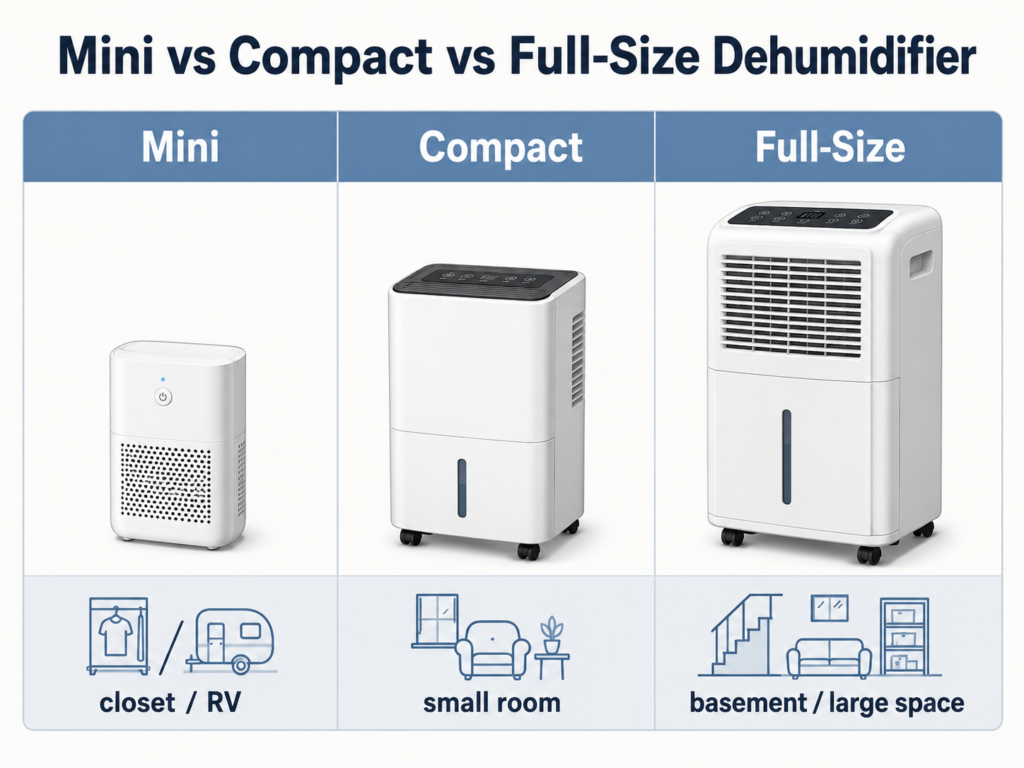
The biggest difference is capacity. A small thermoelectric dehumidifier is usually quiet, light, and easy to place. A compact compressor dehumidifier is larger, louder, and stronger.
For a closet, bathroom, or very small enclosed space, the small unit may be enough. For a real room, damp apartment area, or larger living zone, a compressor model usually gives you a better chance of actually lowering humidity.
| Type | Best for | Weakness |
|---|---|---|
| Mini / 35 oz dehumidifier | Closets, bathrooms, tiny enclosed spaces, light storage-area dampness | Low moisture removal |
| Compact compressor dehumidifier | Small rooms, bedrooms, offices, small apartments | Larger and louder |
| Full-size portable dehumidifier | Basements, large rooms, open areas | Needs more space and often drainage |
A small apartment is usually beyond mini-dehumidifier territory. Use the dehumidifier for apartment guide if the dampness affects the living space instead of one small closet, bathroom, or bedroom corner.
Product Guidance for Small Spaces
Use product links only after you understand the size of the problem. A small dehumidifier is a good product path when the space is tight and the dampness is mild. If the space is larger or the humidity is persistent, move up to a compact or full-size dehumidifier.
Disclosure: This page may include affiliate links. If you buy through those links, HumidityAtHome may earn a small commission at no extra cost to you.
As an Amazon Associate I earn from qualifying purchases.
| Small-space problem | Better product path |
|---|---|
| Closet, small bathroom, tiny bedroom corner, small storage area, or light RV/camper/boat dampness | Check Small Dehumidifiers for Tight Spaces on Amazon |
| Small bedroom, office, or apartment area that feels humid | Check Compact Dehumidifiers for Small Rooms on Amazon |
| Not sure whether the space is actually humid | Check Indoor Humidity Meters on Amazon |
Use the small dehumidifier path only when the dampness is local and mild. If the humidity affects a full room or connected living area, use the 500 square foot dehumidifier guide or the dehumidifier size calculator instead.
Placement Tips for Small Dehumidifiers
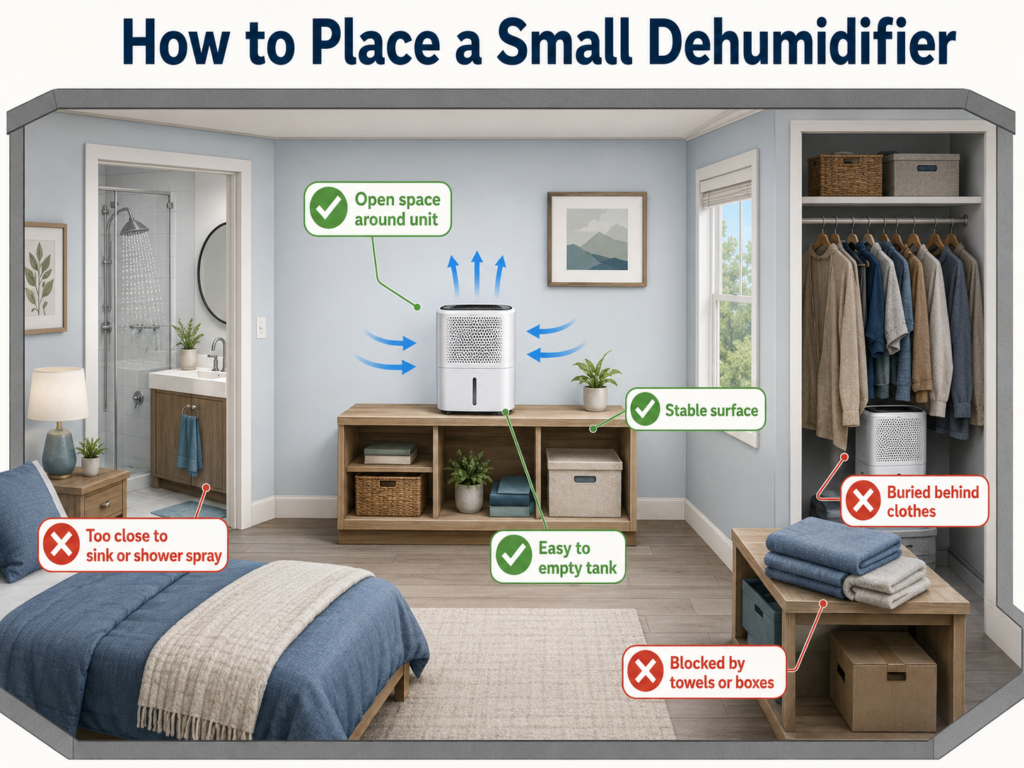
Small dehumidifiers need airflow around the unit. Do not bury one behind clothes, towels, boxes, or furniture and expect it to control the space.
Place the unit on a stable surface, away from direct splashing, and where you can empty the tank easily. In a closet, leave space around the intake and outlet. In a bathroom, keep it away from water contact and use it only where the outlet and placement are safe.
- Keep air openings clear.
- Use a flat, stable surface.
- Keep the unit away from direct splashing.
- Leave room around the intake and outlet.
- Empty the tank before it shuts off.
- Use a humidity meter to verify results.
What If the Space Is Bigger Than a Bathroom, Closet, or Small Bedroom?
Once the space gets larger, the small-dehumidifier logic breaks down. A mini unit may still collect some water, but that does not mean it is controlling the room.
For a connected living area or a room closer to 500 or 1000 square feet, use the dehumidifier for 500 square feet or the dehumidifier for 1000 square feet guide.
For a basement, use the basement dehumidifier size guide instead.
When to Choose a Mini Unit or a Compressor Dehumidifier
A small dehumidifier is a useful tool for mild humidity in a small enclosed space. It is a poor substitute for a real dehumidifier when the problem affects a full room, basement, open floor plan, or whole home.
For closets, small bathrooms, small storage areas, and light bedroom humidity, a mini unit can make sense. For anything closer to a true room or living zone, start with a compact compressor dehumidifier instead.
Next step: If the space is larger than a closet, bathroom, or tiny bedroom, use the 500 square foot dehumidifier guide or the dehumidifier size calculator.