
Quick answer: Choose humidifier size by the space you are actually trying to treat, not just by the size of the house. Use a portable humidifier for one room or one dry zone. Compare whole-house humidification when most rooms are dry every winter and the home has forced-air heat. Measure indoor humidity first, then size the humidifier to the room, apartment, large open space, or whole-home problem.
Choosing the right humidifier size matters more than choosing the biggest machine on the shelf.
A humidifier that is too small may run for hours without changing the room. A humidifier that is too large can push humidity too high, cause window condensation, and make the room feel damp instead of comfortable.
The right size depends on three things: the square footage you want to treat, how open or divided the space is, and how dry the air actually is.
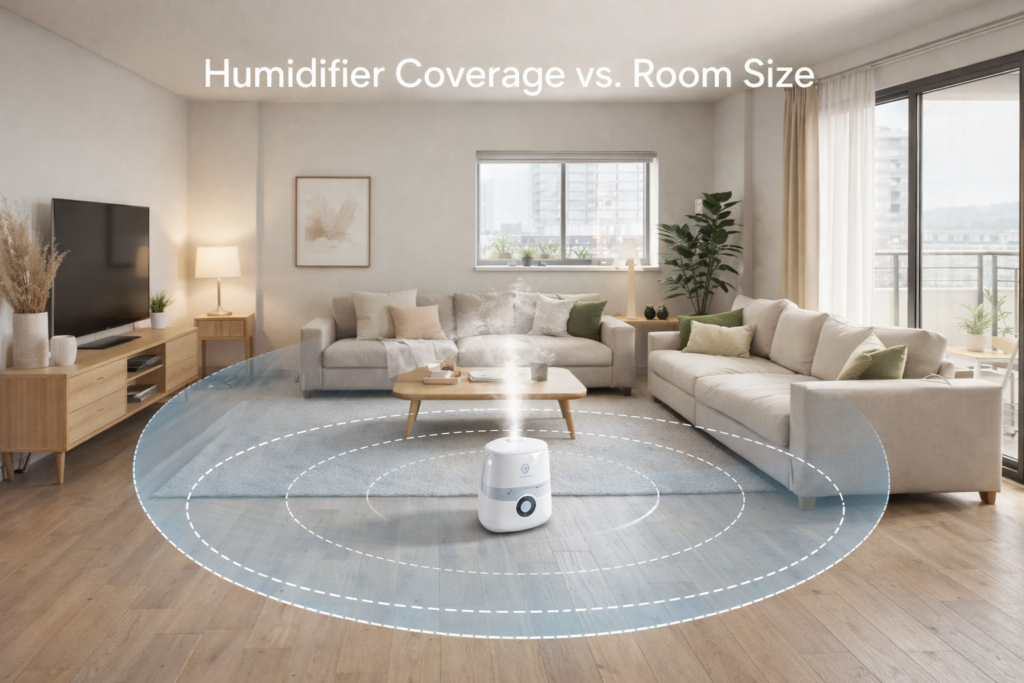
Start with the humidity reading, not the box rating
This guidance estimates a useful shopping category; it is not a formal humidification-load calculation. Outdoor weather, air leakage, indoor temperature, layout, and existing moisture sources influence the result. Use the humidifier size calculator as a starting point, then monitor RH and condensation in the rooms served. Technical references: EPA humidifier care ASHRAE Psychrometrics.
Before sizing a humidifier, check the room with a humidity meter. A room sitting at 22% RH is a different problem than a room sitting at 38% RH.
Most homes do not need an exact target number. They need to get out of the very dry range without creating condensation or damp surfaces.
| Indoor RH reading | What it usually means | Humidifier decision |
|---|---|---|
| Below 25% | Very dry indoor air | Humidification may help, but size carefully. |
| 25–30% | Dry enough to notice | A room-sized humidifier may be reasonable. |
| 30–40% | Often a practical winter range | Use controlled output and avoid oversizing. |
| 40–50% | Usually enough for many homes | Be cautious, especially in cold weather. |
| Above 50% | Too much for many winter homes | Do not add moisture without a clear reason. |
Measure first: If you do not know the current indoor humidity, start with how to measure humidity in your home. If you are not sure dry air is the problem, use do I need a humidifier for my home.
Portable vs whole-house sizing
Humidifier sizing starts with the type of humidifier. A portable unit and a whole-house unit solve different problems.
| Humidifier type | Best fit | How to size it |
|---|---|---|
| Portable humidifier | Bedroom, nursery, office, apartment, living room, or one dry zone | Size by the room or connected zone, not the whole house. |
| Multiple portable humidifiers | Several dry rooms or a divided home | Size each dry zone separately. |
| Whole-house humidifier | Most rooms are dry and the home has forced-air heat | Size by home square footage, heating system, climate, and installation conditions. |
| Whole-house plus spot units | Larger homes where baseline humidity helps but certain rooms stay dry | Use the HVAC system for baseline humidity and smaller units for problem rooms. |
The common mistake is using total home square footage when the actual problem is one bedroom or one office. The opposite mistake is buying one portable humidifier and expecting it to treat every room in a divided house.
For the larger comparison, see portable vs whole-house humidifier.
Portable humidifier size guide by room
For portable humidifiers, use the room or connected dry zone as the sizing area.
A 500 sq ft bedroom is a different job than a 500 sq ft open studio connected to a hallway and kitchen. Start with square footage, then adjust for layout.
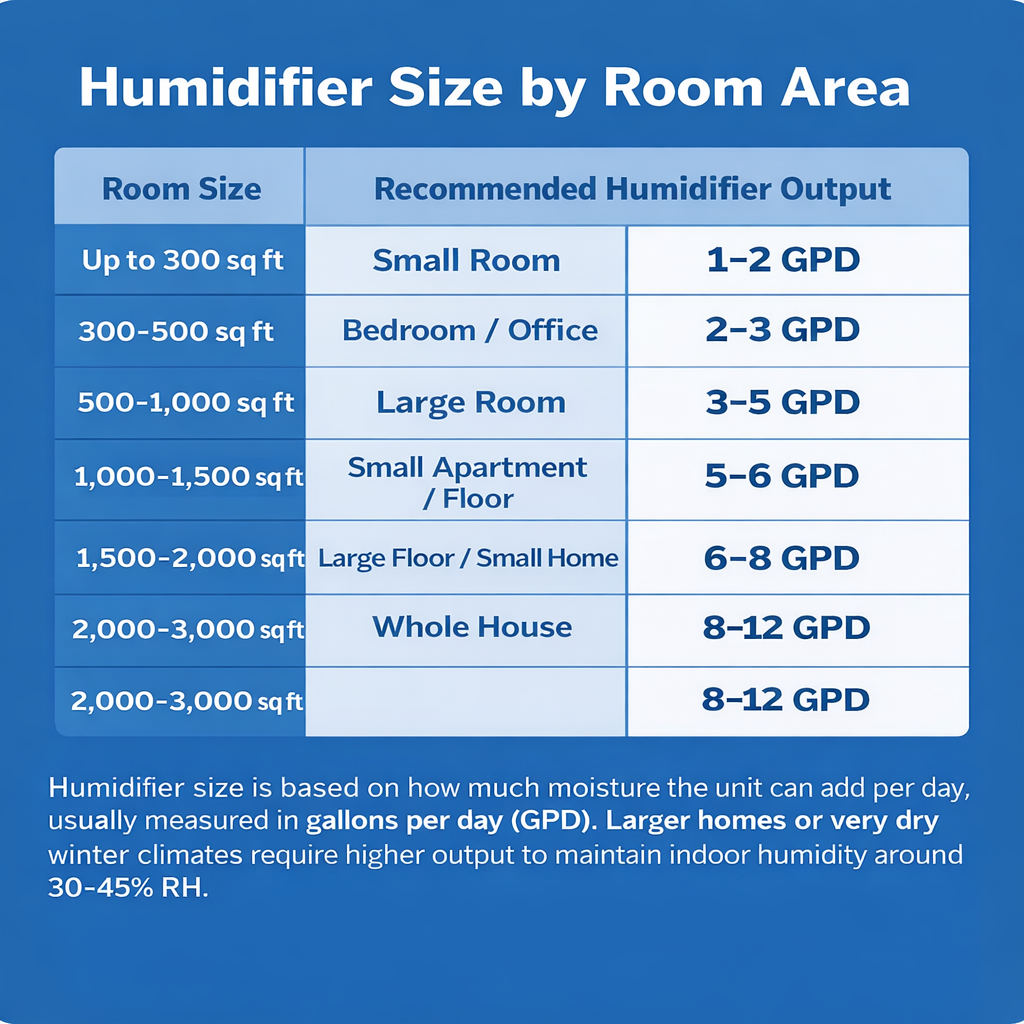
| Space size | Common spaces | Good starting point |
|---|---|---|
| Up to 300 sq ft | Small bedroom, nursery, small office | Small room humidifier with controlled output |
| 300–600 sq ft | Large bedroom, office, small studio, defined living area | Medium room humidifier rated near the actual room size |
| 600–1,000 sq ft | Open living room, larger studio, small open main area | Large room or high-output portable humidifier |
| 1,000–2,000 sq ft | Large open zone, apartment, open-concept area | High-capacity portable unit or multiple-zone planning |
| 2,000–3,000 sq ft | Large open home area or divided home | Compare one large unit, multiple units, or whole-house support |
For a faster reference, use the humidifier size chart by square footage. For a guided estimate, use the humidifier size calculator.
Disclosure: This page may include affiliate links. If you buy through those links, HumidityAtHome may earn a small commission at no extra cost to you.
Product paths by room size
Use these product paths after you decide the size of the space you are treating. The goal is to choose the room size first, then compare humidifiers that fit that job.
Small room product path: Use this for small bedrooms, nurseries, and small offices up to about 300 sq ft. Look for adjustable output, easy cleaning, auto shutoff, and quiet operation.
Medium room product path: Use this for larger bedrooms, offices, small studios, and defined rooms around 300–600 sq ft. Tank size, runtime, and cleaning access matter more here.
Large room product path: Use this for open living areas, larger studios, finished basement living spaces, or connected zones around 600–1,000 sq ft. Do not expect one unit to solve several closed rooms.
Common home-size starting points
If you are thinking about most of the home instead of one room, start with the closest square-footage guide. These pages explain when one large unit makes sense and when the home should be split into dry zones.
When one larger humidifier helps
Going one size larger can help when the dry space is open, connected, and hard to raise into a reasonable humidity range.
- The room has high ceilings.
- Doors stay open into nearby spaces.
- The room is close to the top of a humidifier’s rated range.
- Humidity stays below 30% RH after normal runtime.
- The unit runs constantly and the room still feels dry.
- The space is one open zone rather than several closed rooms.
For symptoms of an undersized unit, see what happens if a humidifier is too small.
When bigger does not solve the problem
Bigger is not always safer. A larger humidifier can over-humidify the area near the unit while distant rooms stay dry.
Do not size up blindly. If windows are wet, surfaces feel damp, or the room already feels heavy, adding more moisture can make the problem worse. If one room gets damp while another stays dry, the issue is probably distribution, not just humidifier size.
For oversizing warning signs, see what happens if a humidifier is too large.
Whole-house humidifier sizing
Whole-house humidifiers use a different sizing approach from portable units. They are typically compared by total home size, climate, heating system type, and how well the home holds humidity.
They make the most sense when dry air affects many rooms every winter and the home has central forced-air heat. Installation and setup matter as much as the equipment rating. Too much humidity in cold weather can create condensation in the wrong places.
Whole-house product path: Use this when dryness affects most of the home and you are comparing installed HVAC-connected humidifiers. This is not the same decision as buying one portable unit for a room.
Common sizing mistakes to avoid
Most humidifier sizing problems come from mismatched expectations, not broken equipment.
- Buying the smallest unit just to test the idea.
- Using total home square footage for a single-room problem.
- Expecting one portable unit to treat several closed rooms.
- Ignoring high ceilings, open stairwells, and connected spaces.
- Adding moisture without measuring humidity first.
- Oversizing even though windows are already showing condensation.
- Ignoring cleaning, refill, filter, and maintenance requirements.
Practical recommendation
Start with the smallest real problem area.
If one bedroom is dry, size the bedroom. If a studio apartment is dry, size the apartment as one connected space. If the whole home is dry every winter, compare a whole-house humidifier with multiple portable units.
Use humidity readings to confirm whether the unit is working. If the room near the humidifier improves but distant rooms stay dry, the answer may be better placement, multiple units, or whole-house support rather than one larger portable machine.
Size Humidification for the Dry Zone and Measure the Result
The right humidifier size depends on the actual dry space, not just the home’s square footage.
Use portable humidifiers for rooms, apartments, and defined zones. Use multiple units when the home is divided into separate dry areas. Compare whole-house humidification when most rooms are dry and the home has forced-air heat.
Measure first, size the real dry zone, and avoid pushing humidity high enough to create condensation.
Related next steps:
- How to measure humidity in your home
- Do I need a humidifier for my home?
- Humidifier size chart by square footage
- Humidifier size calculator
- What size humidifier for an apartment?
- Humidifier for 500–1,000 square feet
- Humidifier for 1,500–2,000 square feet
- Humidifier for 2,500–3,000 square feet
- Portable vs whole-house humidifier