
Written by B.D. Wolfe
For most 1,000 square foot spaces, start with a 35 to 50 pint dehumidifier.
Choose closer to 35 pints for an above-grade living area, open apartment, or connected space with mild to moderate humidity. Choose closer to 50 pints for a basement, laundry-adjacent area, musty space, divided layout, or room that stays above 55% relative humidity.
Square footage gives you the starting range. The final choice depends on measured humidity, temperature, layout, airflow, ceiling height, and whether the unit is serving an upstairs living area or a cooler basement.
Quick Answer: What Size Dehumidifier for 1,000 Sq Ft?
The suggested 35- or 50-pint class is a shopping range, not a guarantee of RH or daily water removal in a 1,000-square-foot space. Dampness, temperature, outside-air entry, and drainage affect the result. See the dehumidifier size calculator for the shared sizing method. Technical references: ENERGY STAR dehumidifiers ASHRAE Psychrometrics.
| 1,000 sq ft space | Starting capacity |
|---|---|
| Above-grade house area with mild humidity | 30 to 35 pint class |
| Open apartment or connected living space | 35 pint class |
| Regular dampness or uneven airflow | 35 to 50 pint class |
| Finished or unfinished basement | 40 to 50 pint class |
| Persistent RH above 60%, musty conditions, or several connected rooms | 50 pint class, plus moisture-source review |
Best general starting point: Use a 35-pint unit for a mildly humid upstairs or open living area. Use a 50-pint unit for a basement or space with recurring dampness.
Can One Portable Control This 1,000-Sq-Ft Zone?
One-portable rule: A 1,000-sq-ft dehumidifier works best when the damp air can circulate back to the machine. An open apartment, living zone, or basement family room is a better one-unit job than several closed rooms with the same total floor area.
35 Pints or 50 Pints? Let Moisture Load Decide
| 1,000-sq-ft condition | Starting direction |
|---|---|
| Mild above-grade dampness, open layout | Lower end of the 35–50 pint range |
| Regular seasonal dampness | 35–50 pint class |
| Basement, laundry load, or slow dry-down | Favor the upper end of the range |
| Closed rooms with uneven RH | Fix placement/zoning before simply buying larger |
| Active water source | Correct the source first |
If the Damp Air Cannot Reach the Machine, Capacity Alone Will Not Fix It
1,000 Sq Ft House, Apartment, and Basement Compared
A 1,000-square-foot number can describe very different spaces. The same pint recommendation does not apply equally to every layout.
| Type of space | What changes the load | Likely choice |
|---|---|---|
| Above-grade house area | Warmer surfaces, normal HVAC airflow, fewer below-grade moisture sources | 30 to 35 pint for mild conditions; 50 pint if several rooms remain damp |
| Open apartment or condo | Connected rooms may share air well, but closed bedrooms may not | 35 pint for one open zone; consider separate treatment for closed rooms |
| Finished basement | Cooler surfaces, concrete, below-grade moisture, limited air movement | 40 to 50 pint |
| Unfinished basement | Exposed masonry, storage, laundry, floor drains, greater moisture variation | 50 pint is usually the safer portable class |
| Divided lower level | Closed doors and walls limit air reaching the dehumidifier | 50 pint plus improved circulation or more strategic placement |
How Many Pints Do You Need?
Pint capacity describes how much moisture a dehumidifier can remove under standardized test conditions. It does not guarantee that the machine will control every 1,000-square-foot layout equally.
30 to 35 pint class
This lower range can work when the area is above grade, relatively open, and only mildly humid. It is more appropriate for a living area or apartment zone near the low-to-mid 50% RH range than for a damp basement.
35 to 50 pint class
This is the main range for 1,000 square feet. It provides more capacity for recurring humidity, connected rooms, moderate airflow problems, and changing weather without immediately moving into a larger specialty class.
50 pint class
Choose the higher end for a basement, laundry area, musty lower level, cooler room, or space that repeatedly stays above 55% RH. It is also the better starting class when faster dry-down is important after humid weather.
Do not choose from a box claim such as “covers up to 1,500 square feet” without checking the pint capacity, measured RH, room temperature, drainage options, and layout.
Measure Humidity Before Buying
A room that feels clammy is not always humid enough to require a larger machine. Measure the problem area instead of relying only on smell, comfort, or a thermostat in another room.
| Measured RH | What it means for sizing |
|---|---|
| Below 50% | A dehumidifier may not be needed unless a local surface or room problem exists. |
| 50% to 55% | Watch range. Confirm whether the condition persists before buying. |
| 55% to 60% | Lean toward the middle or upper end of the 35 to 50 pint range. |
| Above 60% | Use the higher-capacity path and inspect for an ongoing moisture source. |
Use How to Measure Humidity in Your Home for meter placement, stabilization, and room-to-room tracking.
When a 35 Pint Dehumidifier Is Enough
Stay near the lower end when most of these conditions apply:
- The space is above grade.
- Humidity is mildly elevated rather than consistently high.
- The layout is open.
- Air moves easily between the treated areas.
- There is no recurring musty smell.
- The space dries normally after rain or humid weather.
This is most often the upstairs living-area, apartment, office suite, or open-room version of a 1,000-square-foot problem.
When to Choose a 50 Pint Dehumidifier
Move toward the 50-pint class when one or more of these conditions apply:
- The area is below grade.
- RH regularly stays above 55%.
- The space smells musty.
- Laundry or wet clothing adds moisture.
- The layout includes several connected rooms.
- Airflow is weak or doors remain closed.
- The area dries slowly after rain.
- You want shorter dry-down time instead of continuous full-load operation.
A larger unit is not automatically better, but an undersized unit may run continuously without reaching the selected humidity level.
A 1,000 Sq Ft Basement Usually Needs More Capacity
A basement usually has a higher moisture load than the same square footage upstairs. Cooler air and surfaces, concrete, below-grade walls, stored materials, laundry, and weaker circulation all affect performance.
For a typical 1,000-square-foot basement, start in the 40 to 50 pint range. Choose the 50-pint class when the basement is musty, divided into rooms, partly unfinished, or repeatedly above 55% RH.
Use the dedicated Basement Dehumidifier Size guide for drainage, pump, hose routing, placement, finished versus unfinished areas, and persistent below-grade moisture.
Water-source warning: A dehumidifier controls moisture in the air. It cannot repair foundation leaks, plumbing leaks, poor grading, failed gutters, standing water, or bulk water entering through a wall or floor.
If RH stays high while the unit runs continuously, inspect the moisture source before assuming you only need more pint capacity.
Open Apartments and Connected Living Areas
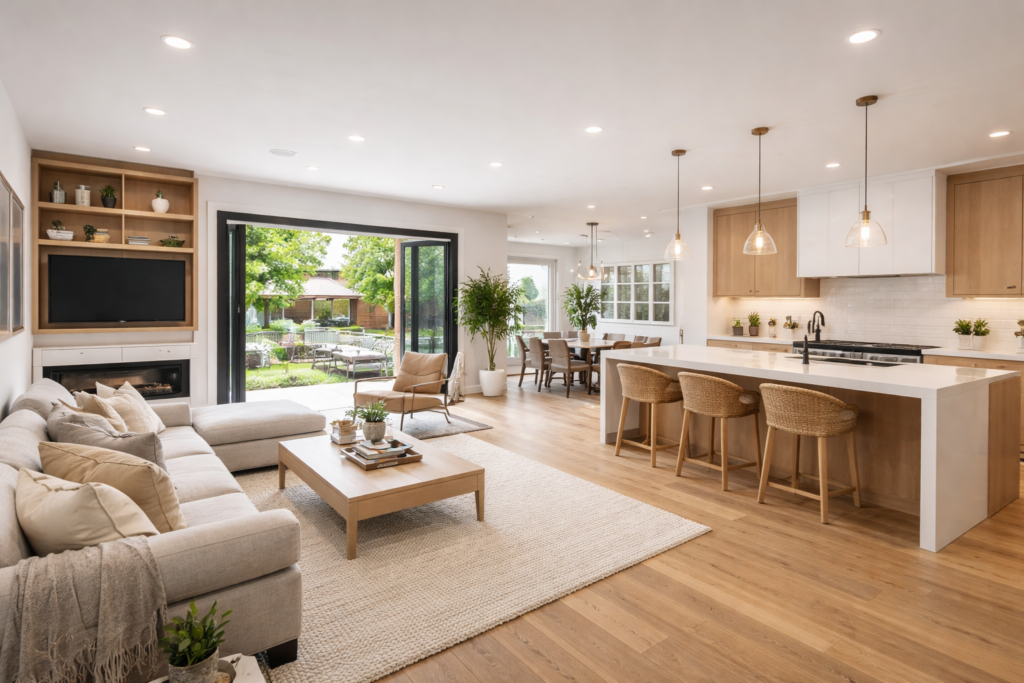
An open 1,000-square-foot apartment or living area may be easier to control than a divided basement because air can return to the dehumidifier more freely.
A 35-pint unit may be enough when humidity is mild and the layout is genuinely open. Move toward 50 pints when the apartment has closed bedrooms, a laundry area, weak circulation, or persistent RH above 55%.
One unit in the living room may not control a closed bedroom, office, or storage room. Opening doors or improving gentle air circulation can help, but it does not replace correct placement.
Ceiling Height, Temperature, and Airflow
Square-footage guidance generally assumes ordinary ceiling height and normal room temperatures.
| Condition | Effect on the choice |
|---|---|
| 9- or 10-foot ceilings | More air volume may justify moving toward the upper end. |
| Vaulted or open loft area | The unit may be treating considerably more air than floor area suggests. |
| Cool basement | Moisture removal may be slower and the space may feel clammy at moderate RH. |
| Closed doors | Air from separate rooms may not reach the unit. |
| Blocked or weak circulation | Placement and airflow may limit performance even when capacity is adequate. |
| Unit against a wall or furniture | Restricted intake or discharge can reduce effective airflow. |
Portable or Whole-House?
For one 1,000-square-foot living area, apartment, basement section, or connected zone, a portable compressor dehumidifier is usually the appropriate class.
A whole-house dehumidifier is a different system. It connects to ductwork and is chosen for the home’s total moisture load, HVAC layout, climate, and airflow rather than one room’s square footage.
For the broader decision process, use How Big of a Dehumidifier Do I Need for My Home?
Disclosure: This page may include affiliate links. If you buy through those links, HumidityAtHome may earn a small commission at no extra cost to you.
As an Amazon Associate I earn from qualifying purchases.
Product Paths for 1,000 Square Feet
30 to 35 Pint Class
Use for mild humidity in an above-grade, open, and reasonably well-circulated space.
Look for a humidistat, continuous drain option, washable filter, auto restart, and a clear water-level or full-bucket indicator.
40 to 50 Pint Class
Use for basements, laundry areas, recurring mustiness, divided spaces, weak airflow, or RH that stays above 55%.
Prioritize continuous drainage, auto restart, a clear humidistat, low-temperature operation where relevant, and practical filter access.
Indoor Humidity Meters
Use a humidity meter before buying when the decision is based only on comfort, odor, or condensation.
Tiny thermoelectric or mini dehumidifiers are not appropriate for a full 1,000-square-foot room, apartment area, or basement. They are intended for much smaller enclosed areas such as closets, cabinets, or storage nooks.
Compare Nearby Sizes
Closer to 500 sq ft
Use the smaller-space guide for one room, studio, bedroom suite, or compact finished area.
Closer to 1,500 sq ft
Use the larger-space guide for an open lower level, medium basement, or broader connected area.
Choose 35 or 50 Pints for the Actual 1,000-Sq-Ft Conditions
For most 1,000-square-foot spaces, choose a 35 to 50 pint dehumidifier.
Use a 35-pint class for a mildly humid, above-grade, open living area. Use a 50-pint class for a basement, laundry area, musty lower level, divided layout, or space that repeatedly stays above 55% RH.
The right size is not the smallest unit that advertises 1,000-square-foot coverage. It is the capacity class that matches the measured humidity, layout, temperature, airflow, and moisture source.