
Most homes need a dehumidifier between 20 and 70 pints per day. Square footage gives you the starting range. The actual moisture problem tells you whether to stay low, move higher, or stop pretending one portable unit can handle the whole house.
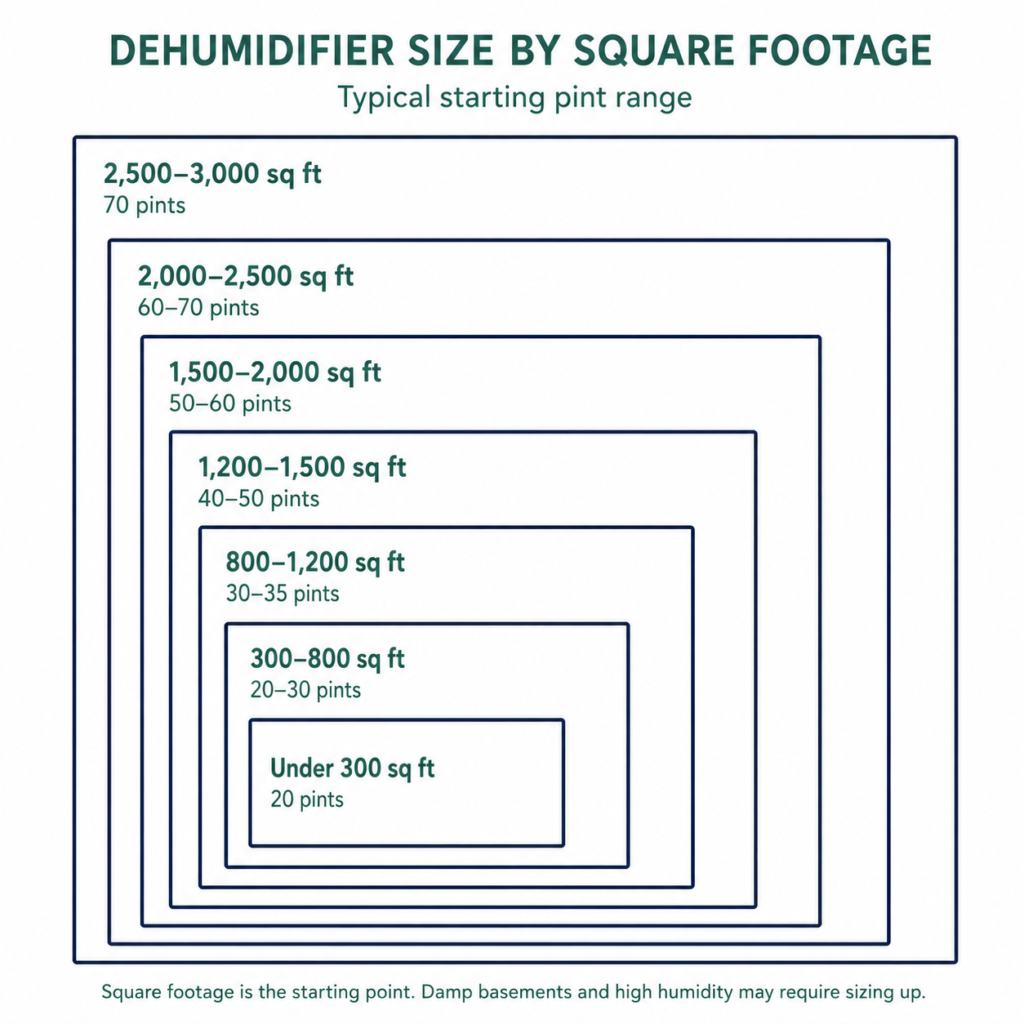
Use the chart below to choose a starting pint range. Then adjust for basement conditions, musty air, poor airflow, laundry moisture, and actual indoor humidity readings.
Quick Answer: Dehumidifier Size by Square Footage
For a normal above-grade room, start with the square footage range in the chart.
For a basement, damp lower level, musty room, or space that stays above 60% relative humidity, use the higher end of the range.
As a practical ceiling, most portable residential dehumidifiers top out around 70 pints per day. Once you are trying to dry a large basement, a whole level, or multiple connected rooms, placement, airflow, drainage, and possibly more than one unit start to matter.
- Mild dampness: lower end of the range
- Musty or below-grade space: higher end of the range
- Over 60% RH most of the time: size up
- Standing water, leaks, or seepage: fix the water problem first
Dehumidifier Pint Capacity by Square Footage
These pint classes are condition-dependent shopping ranges, not engineering moisture-load calculations. ENERGY STAR describes capacity using standardized test conditions, while real homes differ in temperature, dampness, air exchange, and water sources. The dehumidifier size calculator explains the simplified method behind the ranges. Technical references: ENERGY STAR dehumidifiers ASHRAE Psychrometrics.
Use this chart as the starting point. It is not a magic appliance vending machine. A dry 1,000 square foot living room and a damp 1,000 square foot basement do not need the same dehumidifier.
| Space size | Starting pint range | Best fit | Size up when |
|---|---|---|---|
| Under 300 sq ft | Mini unit for tiny enclosed spaces, or 20-pint range for real rooms | Closet, RV, small bathroom, storage area, very small bedroom | The space smells musty, has no airflow, or moisture returns quickly |
| Up to 500 sq ft | 22–35 pints | Bedroom, office, studio, small finished room, laundry-adjacent space | The room is damp often, below grade, or connected to a wet area |
| 500–1,200 sq ft | 30–35 pints | Larger room, small apartment, open finished area, small basement | The space starts above 60% RH or dries slowly after rain |
| 1,200–1,500 sq ft | 40–50 pints | Medium basement, open living area, damp lower level | Musty smell, poor airflow, cool surfaces, or regular dampness |
| 1,500–2,000 sq ft | 50–60 pints | Large basement, open floor plan, humid home zone | The unit will run often, the area is below grade, or moisture load is steady |
| 2,000–2,500 sq ft | 60–70 pints | Very large room, large lower level, heavy moisture area | The space is a basement, slab area, or large connected damp zone |
| 2,500–3,000 sq ft | 70 pints | Upper end of portable dehumidifier sizing | Consider airflow, drainage, placement, or more than one unit |
After you find the row, choose based on dampness, not ego. A slightly stronger dehumidifier is usually less annoying than one that runs all day and still loses.
For the deeper walkthrough, use the main guide: What Size Dehumidifier Do I Need for My Home?
How to Adjust the Chart
The chart gives you the range. The room decides where you land inside it.
Choose the lower end when
Use the lower end of the pint range when the space is above grade, mildly damp only during humid weather, well sealed, not musty, and usually under 55% RH once the air conditioner has run.
This is where people often overbuy. A bigger unit may remove moisture faster, but it can also be louder, warmer, larger, and more annoying than the room needs.
Choose the higher end when
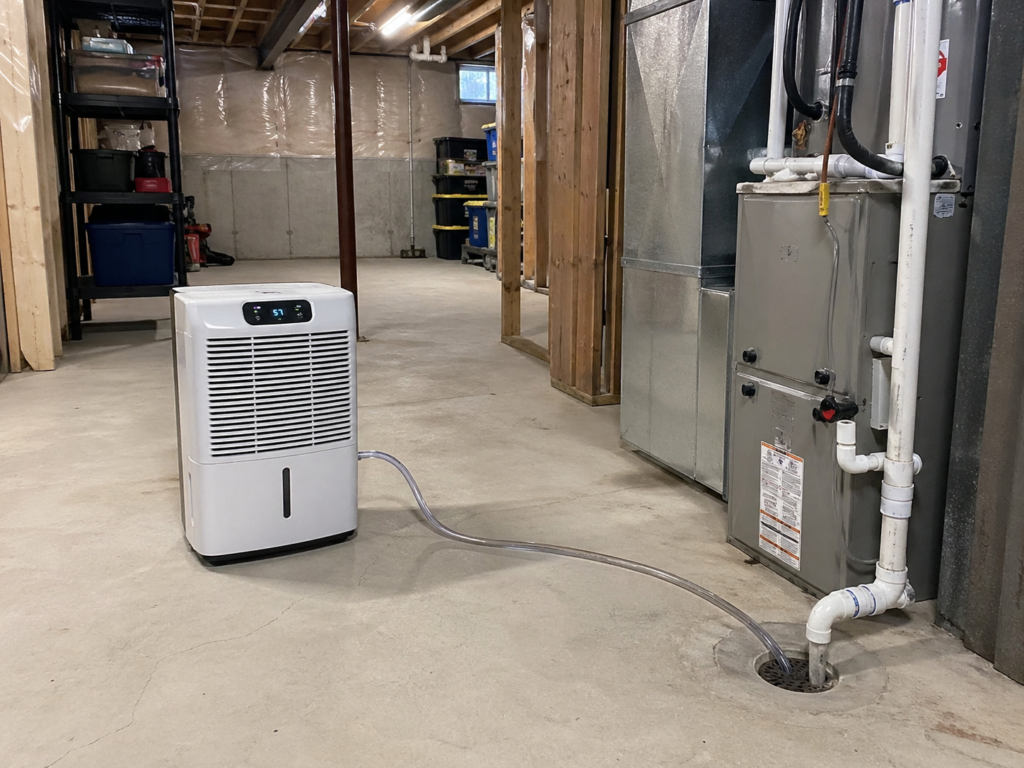
Move toward the higher end of the range when the space starts above 60% RH, smells musty, is below grade, has poor air movement, has cool concrete or slab surfaces, gets damp after rain, has laundry moisture, or makes a smaller unit run constantly.
A dehumidifier that runs nonstop and still cannot pull the space down near 50% RH is usually too small for the actual moisture load.
Size Up / Stay Smaller
Stay smaller when
The room is above grade, mildly damp, and already close to the target humidity range.
Size up when
The room is below grade, musty, poorly ventilated, or regularly above 60% RH.
Basement Adjustment
Basements usually need more capacity than above-grade rooms of the same size.
Concrete can release moisture slowly. Air movement is often weaker. Cooler surfaces make the space harder to dry. That combination means a basement can need a stronger dehumidifier than the square footage alone suggests.
If you are sizing a basement, start with the chart, then lean toward the higher pint range.
For basement-specific guidance, use: Basement Dehumidifier Size
Reality Check
A dehumidifier manages airborne moisture. It does not fix roof leaks, plumbing leaks, foundation seepage, drainage failures, or standing water. If water is getting in, fix that first. The dehumidifier can help with humidity after the water problem is controlled.
Measure First if You Are Guessing
If you do not know the room’s humidity, measure it before buying.
Comfort is a bad measuring tool. A room can feel clammy because humidity is high, airflow is poor, surfaces are cool, or the air conditioner is short cycling. A small digital humidity meter gives you a number instead of a hunch.
Measure First
Check the room for a few days. Measure in the problem area, not across the house in the nicest room.
| Reading | What it usually means | What to do |
|---|---|---|
| Under 40% RH | Usually not a dehumidifier problem | Look at dry-air guidance instead |
| 40–50% RH | Generally comfortable for many homes | A dehumidifier may not be needed |
| 50–55% RH | Watch range | Improve airflow or use a small/medium unit if dampness persists |
| 55–60% RH | Damp-leaning range | Consider a properly sized dehumidifier |
| Over 60% RH | Moisture problem is likely | Size toward the higher end and check for moisture sources |
For setup details, use: How to Measure Humidity in Your Home
How product paths are selected
These are researched product paths based on current manufacturer specifications, moisture load, drainage options, operating conditions, and fit for the space. We have not hands-on tested every model. Confirm current specifications, price, and availability before buying.
Product Paths by Pint Range
Disclosure: This guide may include affiliate links to products that fit the sizing or troubleshooting advice below. If you buy through those links, HumidityAtHome may earn a small commission at no extra cost to you.
Use the chart first. Then compare by pint range, not vague product labels like “large room,” “basement model,” or “high efficiency.” Those labels can mean different things from one listing to another.
Product Path: Digital Humidity Meter
Use this first when you do not know the room’s actual RH.
- Easy-to-read humidity display
- Temperature display
- Small size
- High/low memory if available
- Simple battery replacement
Product Path: 20–30 Pint Dehumidifiers
Use this range for smaller rooms, bathrooms, laundry-adjacent areas, offices, bedrooms, and mild dampness in compact spaces.
- Built-in humidistat
- Auto restart
- Washable filter
- Drain hose option if the unit will run often
- Noise level that fits the room
Product Path: 35–50 Pint Dehumidifiers
Use this range for larger rooms, small apartments, medium damp spaces, and rooms where the lower range may run too often.
- Continuous drain option
- Built-in humidistat
- Easy bucket access
- Washable filter
- Capacity matched to dampness, not just square footage
Product Path: 50–70 Pint Dehumidifiers
Use this range for large damp areas, basements, open lower levels, and rooms that stay humid even after normal HVAC use.
- Continuous drain
- Pump option if no floor drain is nearby
- Strong airflow
- Auto restart
- Serviceable filter
- Practical bucket handling if you cannot drain continuously
Product Path: Basement and Larger-Capacity Dehumidifiers
Use this path when the space is a serious basement, crawlspace, large lower level, or damp area where drainage and runtime matter more than small-room convenience.
- Continuous drain or pump support
- Capacity suited to damp conditions
- Good filter access
- Durable basement-oriented setup
- Clear installation and drainage requirements
The right unit is not always the largest one on the page. It is the one large enough to pull humidity down without running nonstop, but not so oversized that it becomes louder, warmer, and more intrusive than the room requires.
When a Portable Dehumidifier Is Not Enough
Most plug-in residential dehumidifiers top out around 70 pints per day. That is usually the upper practical range for one portable unit in one large area.
A single portable unit may struggle when the home has multiple levels, rooms are separated by closed doors, the basement is large and divided, air cannot circulate back to the unit, moisture is entering faster than the unit can remove it, or the space needs continuous drainage but has no good drain path.
Whole-house dehumidifiers and HVAC-integrated systems are sized differently. Do not size those from this chart alone.
Related Dehumidifier Sizing Guides
Use these only when they match your situation. This is the short list, not a link junk drawer.
Small and medium spaces
For a custom estimate, use the Dehumidifier Size Calculator.
Final Recommendation
Use the chart to narrow the pint range. Then adjust based on actual humidity, room type, and how hard the space is to dry.
If the space is mildly damp and above grade, the lower end of the range may be enough. If the space is a basement, starts above 60% RH, smells musty, or has poor airflow, move toward the higher end.
The goal is not to buy the biggest dehumidifier possible. The goal is to buy enough capacity that the unit can pull humidity down and cycle normally instead of running nonstop.