
For most residential basements, start in the 30-to-50-pint dehumidifier range. The right size depends on more than square footage. Basement temperature, measured humidity, musty odor, airflow, laundry, drainage, and how quickly moisture returns all change the answer.
Use a 20-to-30-pint unit only for a smaller basement with mild seasonal humidity. Move toward 40 to 50 pints when the basement is below grade, regularly damp, musty, slow to dry, or repeatedly above about 55% RH.
If the basement is very large, heavily divided, connected to a crawlspace, or quickly becomes humid again after the unit stops, stop solving the problem by adding pint numbers. Airflow, drainage, moisture entry, multiple units, or basement-focused equipment may matter more.
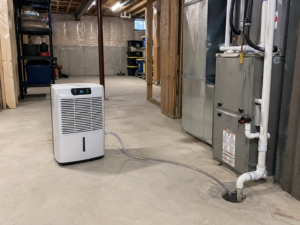
Quick Answer: What Size Dehumidifier for a Basement?
| Basement condition | Practical starting class |
|---|---|
| Small basement with mild seasonal humidity | 20 to 30 pint |
| Average basement with recurring dampness | 30 to 40 pint |
| Musty, humid, unfinished, or laundry-adjacent basement | 40 to 50 pint |
| Large basement or persistent high humidity | 50 pint portable class |
| Very large, divided, crawlspace-connected, or rapid-rebound basement | Review multiple-unit, basement-focused, or ducted equipment |
A practical operating target for many basements is around 45% to 50% RH. Check the result with a separate humidity meter and make sure the far end of the basement remains below roughly 55% RH rather than trusting only the sensor beside the machine.
Basement Dehumidifier Size Chart
Use square footage to establish the starting class, then adjust for the actual basement conditions. A 700-square-foot basement at 52% RH with open airflow is a different job from a 700-square-foot basement at 65% RH with musty storage and damp concrete.
| Basement size and condition | Starting class | Practical judgment |
|---|---|---|
| Up to 500 sq ft, mildly humid, no musty odor | 20 to 30 pint | Reasonable when humidity is seasonal and air circulates easily. |
| 500 to 1,000 sq ft with recurring dampness | 30 to 40 pint | Common starting range for a compact basement without active water intrusion. |
| 1,000 to 1,500 sq ft, musty, cool, or partly divided | 40 to 50 pint | Lean higher when concrete, storage, laundry, or poor airflow add moisture load. |
| 1,500 to 2,000 sq ft or persistently above 55% RH | 50 pint | Use the upper portable class and plan for continuous drainage. |
| Over 2,000 sq ft, several rooms, connected crawlspace, or rapid humidity rebound | Serious equipment review | Air distribution and continuing moisture entry may matter more than another jump in portable capacity. |
If your basement falls between rows, choose based on dampness and operating conditions rather than square footage alone. The basement is allowed to disagree with the appliance box.
Measure Basement Humidity Before Buying
Before comparing pint ratings, look for seepage, foundation or wall leaks, failed sump or drainage systems, and wet building materials. These can keep supplying moisture regardless of the dehumidifier size. Once liquid-water entry is addressed, use measured basement RH, temperature, and operating conditions to choose a capacity range. Technical references: UMN basement moisture EPA moisture and mold.
Basement comfort is a poor measuring tool. Cool air and concrete can make a room feel damp even when the humidity reading is not especially high.
Measure More Than One Spot
- Measure in the basement itself, not at the upstairs thermostat.
- Check the main open area and the dampest corner or closed room.
- Keep the meter away from the dehumidifier intake and discharge.
- Allow the meter to stabilize before recording the result.
- Track morning and evening readings for several days.
- Notice what happens after rain, laundry, and humid outdoor weather.
Use How to Measure Humidity in Your Home for the complete measurement method.
What the Basement RH Reading Means
| Basement RH | What to do |
|---|---|
| Below about 45% | A lower dehumidifier setting may be unnecessary unless you have a specific storage or material requirement. |
| 45% to 50% | A practical operating range for many basements. |
| 50% to 55% | Watch the pattern and check whether the increase is temporary or concentrated in one area. |
| 55% to 60% | Review sizing, runtime, placement, drainage, airflow, and moisture sources. |
| Above 60% | Lean toward the upper portable range and investigate why the basement is carrying that much moisture. |
The goal is not to make the basement desert-dry. It is to bring persistent dampness under control without running more equipment than the space needs.
Why Basements Need Different Sizing
A basement does not behave like an above-grade bedroom or living room with the same floor area.
Basement moisture load can increase because of:
- Concrete walls and slab floors
- Cooler below-grade surfaces
- Limited natural air circulation
- Laundry and wet storage
- Outside air entering around doors, windows, and rim joists
- Foundation or drainage problems
- Closed utility, storage, office, or finished rooms
Lean Toward the Upper Range When
- The basement is partly or fully below grade.
- The space smells musty.
- RH repeatedly remains above about 55%.
- Laundry, storage, or utility equipment adds moisture.
- The basement dries slowly after rain.
- Humidity rebounds quickly after the machine stops.
- Several rooms depend on one centrally located unit.
Finished, Unfinished, Open, and Divided Basements
The floor plan changes the job because a dehumidifier can only remove moisture from air that reaches it.
| Basement type | What changes the decision | Practical approach |
|---|---|---|
| Open unfinished basement | Air circulates relatively well, but exposed concrete and ground contact may increase moisture load. | Use measured RH and lean toward 40 to 50 pints when the area is regularly damp. |
| Finished basement | Drywall, carpet, furniture, and storage can create several microclimates. | Measure both the occupied area and near cooler exterior surfaces. |
| Divided basement | Walls and closed doors restrict humid air from reaching one machine. | Improve circulation, adjust placement, or consider more than one controlled zone. |
| Basement with laundry | Wet clothing and frequent washing add intermittent moisture. | Lean toward the upper range and make sure the dryer vents correctly outdoors. |
| Basement connected to crawlspace | The crawlspace may add moisture without sharing enough airflow for one portable unit. | Measure each space separately and use crawlspace-specific guidance when that is the main source. |
For a compact lower level, see What Size Dehumidifier for a Small Basement?. For occupied lower levels, use the Finished Basement Dehumidifier Size Guide.
Temperature and Airflow Matter
Basements often run cooler than the rest of the house. Standard compressor dehumidifiers can remove less moisture as conditions get cooler, and some units may cycle through defrost more often.
If your basement commonly drops below roughly 65°F, check the manufacturer’s operating-temperature range and defrost capability before choosing the machine.
| Condition | What happens |
|---|---|
| Cool basement | Moisture removal may slow and frost or defrost cycling may become more important. |
| Blocked intake or discharge | The machine repeatedly dries the air immediately around itself. |
| Closed rooms | Humid air may never reach the dehumidifier. |
| Long basement | The near end can reach the setpoint while the far end remains damp. |
| Open doors and gentle circulation | Can improve air exchange between connected areas. |
Keep the intake and discharge clear. Do not bury the machine between storage boxes and then blame the pint rating.
Drainage Matters as Much as Pint Capacity
A basement dehumidifier can remove enough water that bucket-only operation becomes the weakest part of the setup. When the bucket fills, the unit normally stops until someone empties it.
| Drainage method | Use it when | Main limitation |
|---|---|---|
| Collection bucket | The basement is checked frequently and no drain is available. | The machine stops when the bucket fills. |
| Gravity drain hose | A floor drain, sump, or lower drain point is nearby. | The hose needs a reliable downhill path without kinks or high spots. |
| Built-in pump | Water must move upward to a sink, standpipe, or higher drain. | Pump lift and hose-routing limits vary by model. |
| External condensate pump | Your preferred dehumidifier drains by gravity but the available drain is higher. | Adds another powered component that must be maintained. |
| Permanent or specialty drainage | The basement needs dependable unattended operation. | Installation and service access become part of the equipment decision. |
Continuous drainage does not increase the dehumidifier’s pint rating. It simply lets the unit keep working instead of stopping because the bucket is full.
A Dehumidifier Does Not Fix Water Intrusion
A dehumidifier removes moisture from the air. It does not repair plumbing leaks, foundation seepage, standing water, roof leaks, failed gutters, poor grading, wet drywall, or an improperly vented clothes dryer.
If water is actively entering the basement, correct that source first. Dehumidification can help control the remaining airborne moisture after the water problem is under control.
If the source is unclear, start with Too Much Moisture in Your Home.
Ready to Choose a Basement Dehumidifier?
Once you know the capacity range, use the Basement Dehumidifier Buying Guide to compare drainage, pump options, controls, operating temperature, airflow, and the features worth paying for.
Portable Dehumidifier or Serious Basement Equipment?
Most ordinary residential basements do not need specialty equipment. A correctly sized portable unit with good airflow and reliable drainage is the right starting point for many homes.
A Portable Unit Is Usually Enough When
- The basement is one open or mostly connected area.
- There is no active water intrusion.
- RH can be pulled toward 45% to 50% and maintained.
- Air from the damp areas can reach the machine.
- A gravity drain or practical pump arrangement is available.
- The unit cycles normally after the basement reaches the setpoint.
Review Serious Equipment When
- The basement is larger than about 2,000 square feet and regularly damp.
- Several closed rooms or long airflow paths remain humid.
- The basement is connected to a damp crawlspace.
- Humidity rebounds rapidly after a properly sized portable unit stops.
- Cool operating conditions are a recurring problem.
- You need reliable continuous operation, specialty drainage, or ducted air distribution.
A higher price tag does not make specialty equipment the better answer for an ordinary basement. Move into that class when the basement conditions justify the additional capacity, drainage, airflow, service, and installation requirements.
Disclosure: This guide may include affiliate links to products that fit the basement sizing guidance below. If you buy through those links, HumidityAtHome may earn a small commission at no extra cost to you.
As an Amazon Associate I earn from qualifying purchases.
Basement Dehumidifier Product Paths
Choose the product class only after using the size chart, measured RH, basement layout, temperature, and drainage requirements. These are different jobs, not a staircase where the most expensive machine automatically wins.
30 to 40 Pint Portable Dehumidifiers
Use this class when: The basement is smaller or moderately damp, airflow is reasonable, and there is no major continuing moisture source.
Look for a built-in humidistat, washable filter, auto restart, and a gravity-drain connection if the unit will run regularly.
40 to 50 Pint Portable Dehumidifiers
Use this class when: The basement is average to large, below grade, musty, regularly damp, laundry-adjacent, or slow to dry.
Prioritize continuous drainage, auto restart, useful humidistat controls, practical airflow, and an operating-temperature range that fits the basement.
Serious Basement and Specialty Dehumidifiers
Use this path when: The basement is large, cool, persistently damp, divided, crawlspace-connected, difficult to drain, or clearly beyond what one portable machine can control.
Compare continuous-drain capability, pumps, low-temperature performance, filter access, serviceability, ducting options, installation requirements, and whether the equipment can actually move dry air through the affected space.
Do not use this route merely because the basement is below grade. This is the higher-cost path for conditions that have earned it.
When One Dehumidifier Is Not Enough
A single large portable unit is not automatically better than two properly placed units. When a basement is long, divided, or full of closed rooms, air movement can become the limiting factor.
| What you observe | Better response |
|---|---|
| The area beside the machine reaches the setpoint but the far end stays humid | Improve circulation, change placement, or consider another controlled zone. |
| The unit runs continuously and the whole basement remains above target | Verify sizing, temperature, drainage, and continuing moisture entry. |
| Closed rooms remain musty | Measure them separately rather than assuming the central unit controls them. |
| Humidity rebounds rapidly after shutdown | Look for continuing moisture load before simply buying a larger portable unit. |
| A crawlspace is connected to the basement | Evaluate the crawlspace as its own moisture zone. |
For a connected crawlspace, use Crawlspace Dehumidifier Size rather than treating the crawlspace as free bonus square footage for the basement machine.
Choose Basement Capacity With Drainage and Airflow in Mind
For most residential basements, start with a 30-to-50-pint dehumidifier.
Use 20 to 30 pints only for a smaller basement with mild seasonal humidity. Use 30 to 40 pints for an average basement with recurring dampness. Move toward 40 to 50 pints when the basement is larger, musty, below grade, laundry-adjacent, slow to dry, or repeatedly above about 55% RH.
Set the operating target near 45% to 50% RH and verify the result with a separate meter in more than one location. Continuous drainage often matters as much as capacity because a machine sitting beside a full bucket is removing exactly zero pints per day.
When the basement is very large, heavily divided, connected to a crawlspace, or quickly becomes humid again after a correctly sized portable unit stops, review the moisture source, airflow, multiple-unit placement, or basement-focused equipment instead of simply chasing a larger pint rating.