
For 500 square feet, skip the tiny-unit trap.
Written by B.D. Wolfe
A 500 square foot space is where small dehumidifier advice starts to break down. It may sound like a small area, but 500 square feet can be a studio apartment, a large bedroom suite, a home office, a finished room, or a laundry-adjacent space.
For most real 500 square foot rooms, a mini dehumidifier is too small. A compact compressor dehumidifier is usually the better starting point if the space actually feels humid, damp, or musty.
The right size depends less on square footage alone and more on how the space behaves. A mildly humid upstairs office does not need the same dehumidifier as a cool basement room, a studio apartment, or a laundry-adjacent area.
Fast Rule
- Mild humidity: 20–30 pint range
- Damp often: 35-pint range
- Musty or basement-like: 50-pint range
- Tiny enclosed spot: mini unit only
Quick Answer: What Size Dehumidifier for 500 Square Feet?
A 500-square-foot recommendation is a capacity-class starting point, not proof that a tiny thermoelectric unit and a compressor dehumidifier remove comparable amounts of water. Check rated daily removal, room temperature, and drainage needs. The dehumidifier size calculator explains the broader sizing method; fix liquid-water sources separately. Technical references: ENERGY STAR dehumidifiers ASHRAE Psychrometrics.
For 500 square feet, use a compact compressor dehumidifier for most rooms. A 20–30 pint range can work for mild humidity. A 35-pint range is the safer middle choice when the room feels damp often. A 50-pint unit makes sense when the space is musty, cool, laundry-adjacent, basement-like, or slow to dry out.
A mini dehumidifier only makes sense when the problem is limited to a tiny enclosed part of the 500 square feet, such as a closet, small bathroom, or storage nook. It should not be treated as the main dehumidifier for the full room.
If you are not sure whether the space is truly humid, measure first. A room that feels uncomfortable is not always a dehumidifier problem.
First Decide: Mini Device or Compressor Dehumidifier?
| 500-sq-ft condition | Better equipment class |
|---|---|
| Tiny closet or enclosed storage spot with light moisture | Small supplemental device may be enough |
| Bedroom, office, studio, or normal room with measurable dampness | Compressor dehumidifier |
| Bathroom that remains damp after ventilation | Diagnose ventilation first; use compressor capacity only if RH stays high |
| Musty small basement room or laundry-adjacent space | Compressor dehumidifier with drainage option |
| Active leak or standing water | Fix the moisture source before relying on a dehumidifier |
For 500 Sq Ft, Choose the Equipment Class Before the Pint Rating
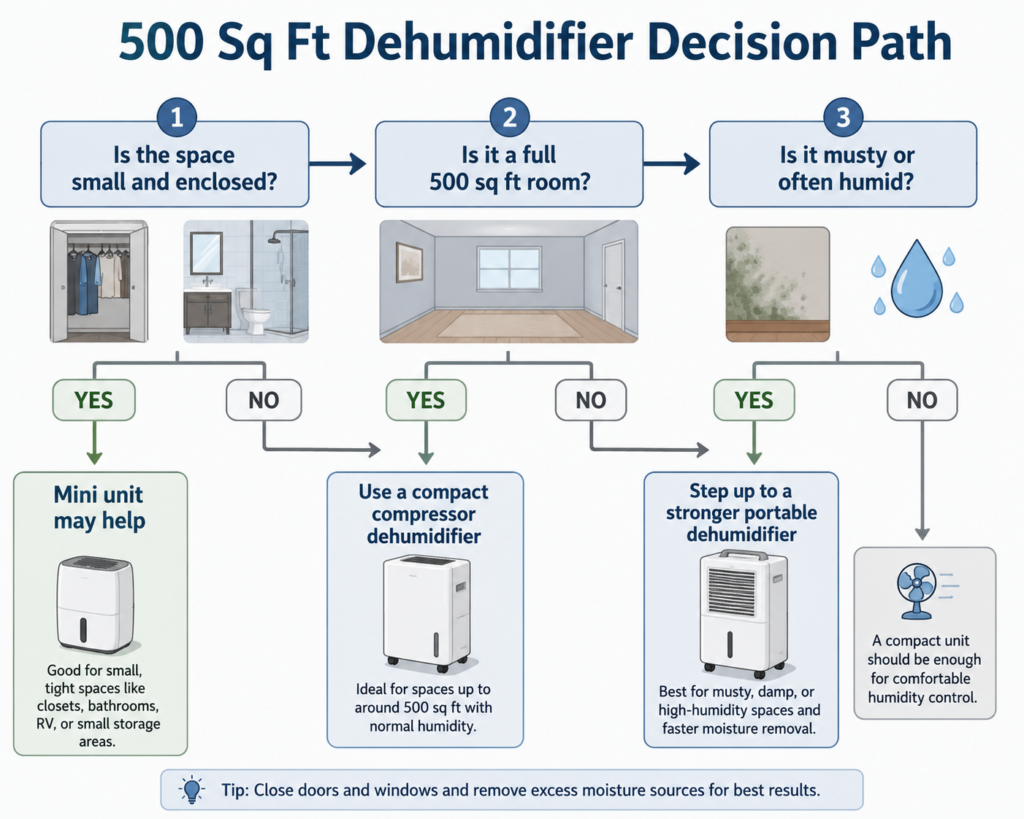
500 Sq Ft Dehumidifier Size Chart
Use this as a practical starting point. The right choice depends on moisture level, room layout, airflow, temperature, and whether the space has a steady moisture source.
| 500 sq ft condition | Better starting size | Best fit |
|---|---|---|
| Slightly humid, no musty smell | 20–30 pint range | Bedroom, office, small finished room |
| Humid often or slow to dry out | 35-pint range | Studio, bedroom suite, bonus room |
| Light musty smell or humidity returns quickly | 35-pint range | Larger room, apartment zone, laundry-adjacent area |
| Cool, damp, over slab, or basement-like | 50-pint range | Small basement room, slab room, recurring dampness |
| Closet, small bathroom, or tiny enclosed area | Mini unit may help | Only for the small enclosed spot, not the full 500 sq ft |
For broader comparisons, use the dehumidifier size chart by square footage. For a guided estimate, use the dehumidifier size calculator.
Do not size by square footage alone
A 500 square foot upstairs office, studio apartment, laundry-adjacent room, and small basement room can all need different dehumidifier sizes. Square footage starts the decision. Moisture load finishes it.
Why 500 Square Feet Is a Transition Size
A 500 square foot room sits between two categories. It is larger than the tiny spaces where mini dehumidifiers make sense, but smaller than the large open areas where bigger portable units become the default.
That is why this size causes bad purchases. A mini unit may look right because the room “isn’t that big,” but it usually cannot remove enough moisture from the full space. On the other side, buying the largest portable dehumidifier for a mildly humid bedroom may create more noise, heat, and tank-emptying than the room needs.
The practical answer is usually in the middle. Start with a real compressor dehumidifier, then move stronger only when the room has musty air, poor airflow, slab moisture, laundry moisture, or basement-like behavior.
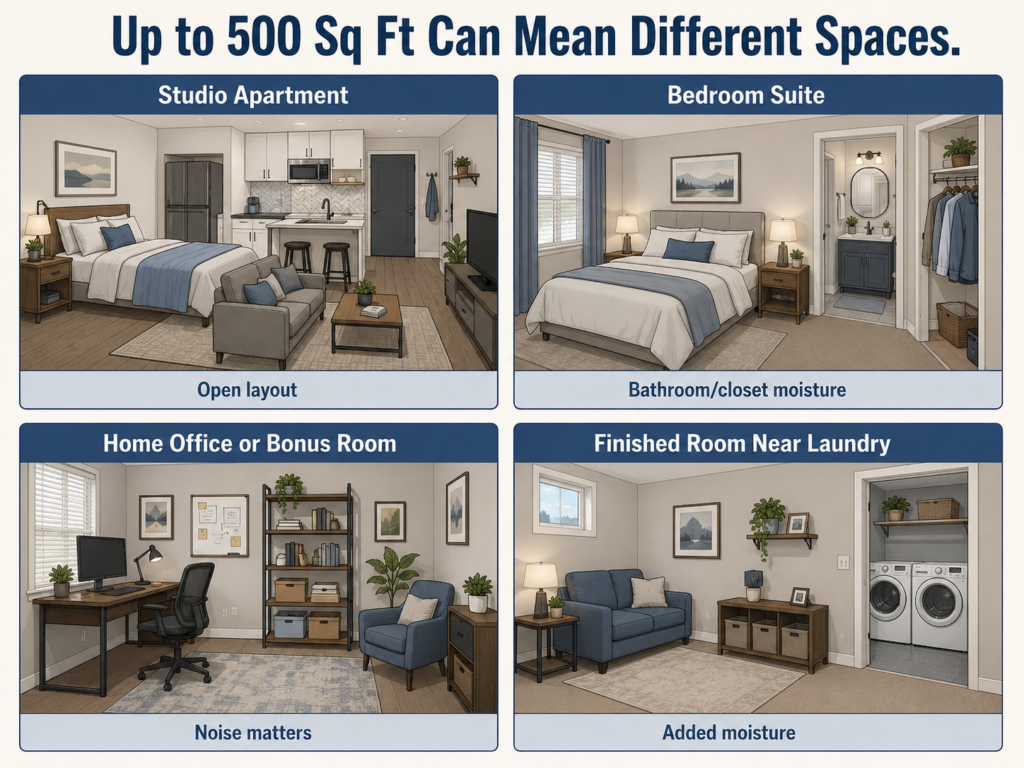
Common 500 Sq Ft Spaces
Studio apartment
A studio apartment often behaves like one connected zone. The sleeping area, kitchen, and living space may all share the same air.
A mini dehumidifier is usually the wrong choice for this layout. Use a compact compressor dehumidifier if the whole apartment feels humid. Move stronger if cooking moisture, poor ventilation, or humid outdoor air keeps raising the humidity.
For apartment-specific layout issues, use dehumidifier for apartment.
Bedroom suite
A bedroom suite can need more dehumidifier than a plain bedroom because the bathroom and closet may add moisture. A small closet unit can help inside the closet, but it will not control the whole suite.
If the bedroom, closet, and bathroom all feel damp, use a compact compressor dehumidifier for the room. Step up if the bathroom stays humid after showers or the closet smells musty.
Home office or bonus room
A home office or bonus room often has a comfort problem rather than a severe moisture problem. In that case, noise and ease of emptying matter.
A 20–30 pint range may be enough if the room is only slightly humid and does not smell musty. A humidity meter is useful here because the room may feel uncomfortable for reasons that are not only humidity.
Laundry-adjacent room
A laundry-adjacent room can need more capacity than square footage suggests. Damp clothes, dryer vent problems, frequent washing, or poor air movement can add moisture faster than a small unit can remove it.
If the room feels humid after laundry cycles or smells musty, treat it as a higher-moisture space. A 35-pint or 50-pint range is more realistic than a mini unit or the smallest compressor model.
Small basement room
A 500 square foot basement room is not the same as a 500 square foot upstairs room. Basement air is often cooler, slower-moving, and more affected by concrete, ground moisture, or seepage.
For a single small basement room, this guide can help. If the space is part of a larger basement, use basement dehumidifier size instead.
Mini vs Compact vs Full-Size at 500 Sq Ft
The most important distinction at 500 square feet is product class. A mini dehumidifier, compact compressor dehumidifier, and larger portable dehumidifier are not just different sizes of the same thing. They solve different problems.
| Product class | Best use around 500 sq ft | Main caution |
|---|---|---|
| Mini dehumidifier with reservoir | Closet, small bathroom, tiny enclosed section | Usually too weak for the full 500 sq ft |
| Compact compressor dehumidifier | Mildly humid bedroom, office, studio, finished room | May struggle if the space is musty or damp often |
| Mid-size compressor dehumidifier | Regular dampness, bedroom suite, apartment zone | Better balance for many real 500 sq ft spaces |
| Larger portable dehumidifier | Basement-like room, laundry-adjacent room, damp slab area | More noise, heat, and water removal to manage |
Mini units belong in small enclosed areas. If that is your situation, use small dehumidifiers for bathrooms, closets, and bedrooms.
For the full 500 square feet, start with a compressor unit.
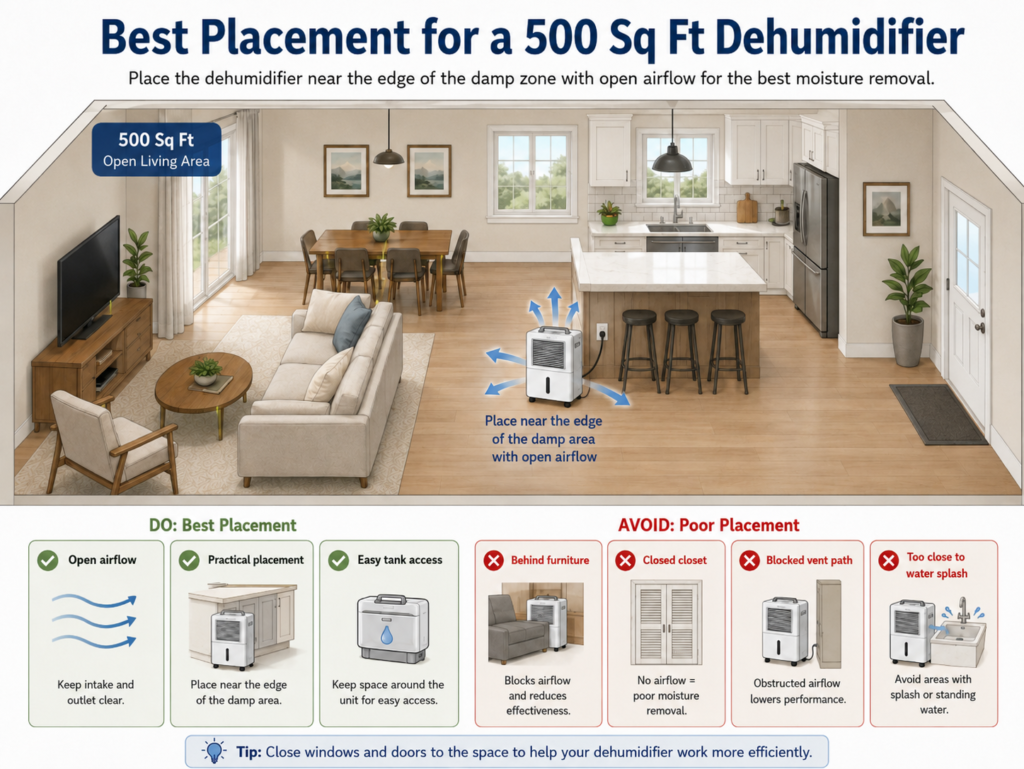
Placement Matters in a 500 Sq Ft Room
A properly sized dehumidifier can still underperform if it is placed badly. The unit has to reach the damp air.
Do not hide it behind furniture, inside a closed closet, tight against a wall, or in a blocked laundry alcove. If the unit is meant to control more than one connected area, keep interior doors open enough for air to move.
Better placement
- Place the unit near the dampest part of the room when possible.
- Keep open space around the air intake and outlet.
- Keep interior doors open if the connected area matters.
- Check humidity away from the unit, not directly beside it.
Avoid
- Blocked corners
- Closed closets
- Tight wall placement
- Direct splashing or wet floor areas
- Do not trust the box claim alone
How product paths are selected
These are researched product paths based on current manufacturer specifications, moisture load, drainage options, operating conditions, and fit for the space. We have not hands-on tested every model. Confirm current specifications, price, and availability before buying.
Product Path for a 500 Sq Ft Space
Disclosure: This page may include affiliate links. If you buy through those links, HumidityAtHome may earn a small commission at no extra cost to you.
At 500 square feet, do not buy only from the square-foot claim on the box. Match the product class to the moisture problem.
Measure First
Use this if the room feels damp but you have not confirmed the actual humidity level. Knowing before you buy is key to solving your issues the first time.
Tiny Enclosed Spots
Use this only for closets, small bathrooms, or storage nooks inside the larger space. Do not use a mini unit for the full 500 square feet.
Mild Humidity
Use this for bedrooms, offices, studios, and finished rooms where the space is humid but not musty or basement-like.
Regular Dampness
Use this for damp rooms, bedroom suites, apartment zones, and spaces where humidity returns quickly after the unit shuts off.
Musty, Cool, Basement-Like, or Laundry-Adjacent
Use this when the space is slow to dry out, smells musty, sits over slab, behaves like a basement room, or gets moisture from laundry activity.
Do not send yourself straight to the smallest product that claims 500 square feet. A 500 square foot bedroom, studio, laundry-adjacent room, and small basement room are not the same moisture problem.
When 500 Sq Ft Is Really a Bigger-Space Problem
Sometimes the room where you notice humidity is not the full problem. A 500 square foot room may be connected to a hallway, kitchen, bathroom, closet, basement, or open living area.
If humid air keeps moving into the room, one small dehumidifier may not solve the issue. You may need to size the connected zone instead of only the room where the symptoms show up.
- The room opens into other spaces.
- Doors stay open most of the day.
- The apartment or main level feels humid, not just one room.
- The basement affects the room above it.
- The humidity returns quickly after the unit shuts off.
- Several rooms have the same damp feel.
If the area is closer to a connected living zone, use dehumidifier for 1000 square feet instead. If you are still deciding whether a dehumidifier is the right fix, use do I need a dehumidifier for my home?.
Common Mistakes With 500 Sq Ft Dehumidifiers
The first mistake is treating a mini unit like a room dehumidifier. A mini dehumidifier may collect water, but that does not mean it is controlling the full 500 square feet.
The second mistake is ignoring the room type. A dry upstairs office and a musty basement room may have the same square footage, but they do not have the same moisture load.
The third mistake is buying the biggest unit without thinking about noise, heat, and where the water will go. Bigger can be useful in damp spaces, but it is not automatically better for a bedroom or office.
Avoid these mistakes
- Do not size by square footage alone.
- Do not confuse reservoir size with moisture-removal capacity.
- Do not expect one unit to control several closed rooms.
- Do not hide the unit where airflow is blocked.
- Do not skip measurement if the room feels damp but looks dry.
- Do not ignore a recurring moisture source.
Related Dehumidifier Sizing Guides
Use these if your space is larger, connected to other rooms, or acting like a basement instead of a normal room.
Choose the Dehumidifier Class for Your 500-Sq-Ft Space
For 500 square feet, a mini dehumidifier is usually too small unless the problem is limited to a closet, RV, small bathroom, or tiny enclosed section. Most real 500 square foot rooms need a compact compressor dehumidifier.
Use a 20–30 pint range for mild humidity, a 35-pint range for regular dampness, and a 50-pint range when the room is musty, basement-like, laundry-adjacent, over slab, or frequently humid.
The right choice is not the smallest unit that claims 500 square feet. It is the unit class that matches how the room actually behaves.