
A 2,000 square foot dehumidifier decision is where sizing becomes a layout problem, not just a capacity problem.
For most 2,000 square foot spaces, start in the 50–60 pint range. Use the lower end when the space is open, mildly humid, above grade, and easy to circulate. Use the higher end when the area is below grade, musty, humid-climate, divided into rooms, or slow to dry after rain.
At 2,000 square feet, a portable dehumidifier can still be the right answer. But the space has to behave like one connected zone. A strong unit in the wrong location can leave distant rooms, corners, and lower-level areas feeling damp.
Quick Answer: What Size Dehumidifier for 2,000 Square Feet?
Two thousand square feet may include rooms that do not share air well, so useful capacity depends on zoning as well as floor area. Outdoor relative humidity is also temperature-dependent; wetter incoming air can increase the moisture load even when the indoor RH reading seems steady. See the dehumidifier size calculator for the starting method, not a guaranteed outcome. Technical references: ENERGY STAR dehumidifiers ASHRAE Psychrometrics.
For a 2,000 square foot basement, lower level, open main floor, or connected living zone, a 50–60 pint dehumidifier is the best starting range.
- 50 pint range: mild humidity, open above-grade space, good airflow
- 50–60 pint range: normal dampness, connected rooms, seasonal humidity
- 60 pint range: basement, lower level, musty air, laundry moisture, or humid climate
- 60+ pint or multi-zone planning: divided layout, poor airflow, heavy moisture, or slow dry-down
2,000 Sq Ft Dehumidifier Size Chart
Use this table as the starting point. Then adjust for dampness, airflow, basement conditions, ceiling height, and whether one unit can actually reach the whole problem area.
| 2,000 sq ft condition | Better starting size | Why |
|---|---|---|
| Open above-grade space, mild humidity, good airflow | 50 pint range | The space is large, but the moisture load is not severe and air can reach the unit. |
| Normal dampness, connected rooms, seasonal humidity | 50–60 pint range | This gives enough capacity for a larger connected zone without jumping straight to whole-house planning. |
| Basement, lower level, musty air, or laundry moisture | 60 pint range | Cooler surfaces, concrete, laundry moisture, and weaker airflow usually raise the load. |
| Divided layout, poor airflow, heavy moisture, or slow dry-down | 60+ pint range or multi-zone planning | The issue may be layout, airflow, or a moisture source, not only square footage. |
A 2,000 square foot space sits above the 1,500 sq ft dehumidifier guide, where one large-zone portable unit is usually still a straightforward answer. It sits below the 2,500 sq ft dehumidifier guide, where multi-unit planning and airflow strategy become harder to ignore.
Why 2,000 Square Feet Is the Transition Point
A 2,000 square foot space is often too large to treat like a simple room and too small to automatically jump to a whole-house answer.
That might mean a large finished basement, open main level, small single-story home, basement plus connected rooms, or a large lower level with hallways and partial room separation.
This is where layout starts competing with pint rating. A 60 pint dehumidifier can remove more moisture than a smaller unit, but it cannot fix closed doors, blocked airflow, disconnected rooms, or damp areas that air never carries back to the machine.
At 2,000 square feet, the best answer is usually a larger portable dehumidifier only when the space behaves like one connected zone. If the dampness is spread across separated areas, the problem may require better placement, fans, multiple units, or a different system approach.
Measure Before You Buy
If you have not measured indoor humidity, do that before choosing a unit. A 2,000 square foot main floor sitting near 52% RH needs a different answer than a lower level that stays above 60% RH and smells musty.
Measure near the unit location and at the far side of the problem area. If distant rooms stay higher than the area near the dehumidifier, airflow may be the real limit.
When One Portable Unit Can Still Work
A single portable dehumidifier can still make sense for 2,000 square feet when the space is mostly open and air can move back to the unit.
- The space is one connected zone.
- Doors usually stay open.
- The humidity problem is mild to moderate.
- The unit can drain continuously or be emptied easily.
- Air can circulate from distant areas back to the unit.
- The far side of the space improves after the unit runs.
In that case, a 50–60 pint portable unit is usually the practical starting point.
When to Size Up or Rethink the Layout
Consider the larger end of the range, or a multi-zone approach, when the dehumidifier has to fight more than one connected air space.
- Relative humidity stays above 55–60% RH.
- The area includes basement or lower-level space.
- Rooms farther from the unit stay damp.
- The layout has doors, hallways, or partial room separation.
- Ceilings are higher than standard.
- The unit would need to run constantly to keep up.
- The space is humid-climate or slow to recover after rain.
A slightly larger unit operating with margin is usually more stable than one running nonstop. But at 2,000 square feet, do not assume more pints solve every problem. If the air cannot reach the machine, placement and airflow matter as much as capacity.
Moisture Load Changes the Size
Square footage assumes average indoor conditions. Real homes are messier than that. A dry 2,000 square foot main floor and a damp 2,000 square foot basement are not the same dehumidifier problem.
Moisture load increases when:
- The space includes basement square footage.
- Outdoor humidity is consistently high.
- The area smells musty.
- Air movement is limited.
- The space includes concrete walls or slab flooring.
- Humidity rises quickly after the unit shuts off.
- One area feels damp while another feels normal.
If several of these apply, lean toward the higher capacity range.
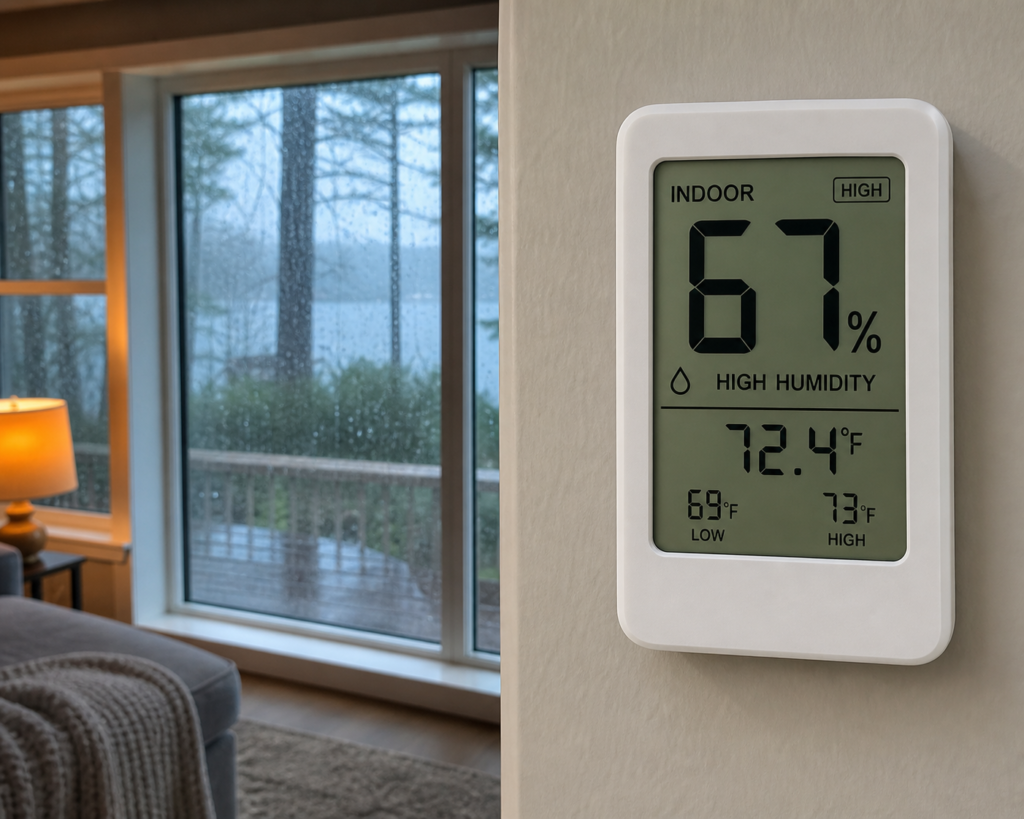
If you are still determining whether excess moisture is the real issue, start with the too much moisture in your home overview.
Basement, Climate, and Ceiling Height Adjustments
If any portion of the 2,000 square feet is below grade, assume a higher moisture load. Concrete surfaces can release moisture slowly over time, and limited ventilation allows humidity to accumulate.
In most basement scenarios at this size, the 60 pint range is the safer starting point. If the basement is divided into finished rooms, storage areas, or mechanical spaces, airflow and placement become part of the decision.
Climate can also push a normal 2,000 square foot space toward the higher end of the range. In humid regions, the dehumidifier keeps fighting new moisture from outdoor air, air leaks, doors opening, and damp lower levels.
Ceiling height matters too. Standard sizing assumes normal ceilings. If ceilings are 9–12 feet, the dehumidifier is treating more air than the square footage suggests. Open stairwells, vaulted ceilings, and connected rooms can also make one portable unit work harder.
For basement-specific guidance, use basement dehumidifier size. For climate-specific guidance, see dehumidifier for humid climate.
Portable vs Whole-House at 2,000 Square Feet
At 2,000 square feet, a portable dehumidifier can still be the right answer, but the space needs to behave like one connected zone.
A large-capacity portable dehumidifier can work for open main levels, large finished basements, single-zone applications, and connected rooms with decent airflow.
If you are trying to manage humidity across an entire multi-level home, separated bedrooms, closed rooms, or distant areas with poor air movement, a whole-house or multi-unit approach may be more appropriate.
The first question is simple: can one properly placed dehumidifier control the whole problem area?
If yes, a high-capacity portable unit may be enough. If no, the issue may be layout, air movement, or whole-house humidity rather than pint rating.
Product Paths for 2,000 Sq Ft Spaces
Use the sizing guidance first. Then shop by capacity range, drain options, and how the space is laid out.
Disclosure: This page may include affiliate links. If you buy through those links, HumidityAtHome may earn a small commission at no extra cost to you.
50–60 Pint Dehumidifiers
Use this range for open 2,000 square foot spaces with mild to moderate humidity and decent airflow.
Look for a built-in humidistat, washable filter, continuous drain option, auto restart, and enough capacity for the actual layout.
60 Pint Dehumidifiers with Drain Options
Use this path for basements, musty lower levels, laundry moisture, humid-climate spaces, or areas that dry slowly after rain.
Look for continuous drain, clear humidistat controls, auto restart, easy filter access, and a setup that can run without constant bucket emptying.
High-Capacity Dehumidifiers for Large Damp Areas
Use this path when the layout is divided, distant rooms stay damp, or one standard large unit may not control the full problem area evenly.
Look for higher capacity, drain hose support, pump options if needed, and enough airflow for the actual layout.
Indoor Humidity Meters
Use this before buying if you are guessing from comfort, smell, or condensation instead of an RH reading.
Look for an easy-to-read RH display, temperature display, and small size so you can compare readings across the full 2,000 square foot area.
At 2,000 square feet, avoid choosing only by the “covers up to” number on the product listing. A unit that works in one open area may struggle in a divided layout.
Reality Check
A dehumidifier manages airborne moisture. It does not solve roof leaks, foundation water intrusion, plumbing leaks, drainage failures, or standing water.
If humidity remains high despite continuous operation, the issue may involve outside air infiltration, poor air movement, or an active moisture source.
Equipment controls indoor conditions. It does not replace structural repairs.
More Sizing Help
Use these next if 2,000 square feet is not quite the right fit:
Smaller large-zone space
If the area is closer to a finished basement, large apartment, or open connected zone, use the 1,500 sq ft guide.
Larger upper-limit space
If the area is closer to a very large connected zone, open lower level, or divided large space, move up to the 2,500 sq ft guide.
Not sure yet?
If you are comparing several sizes or zones, use the full chart or calculator before choosing a product class.
Choose Capacity and Airflow for a 2,000-Sq-Ft Zone
For most 2,000 square foot spaces, choose a 50–60 pint dehumidifier. Use the 50 pint range only for mild humidity in an open, easy space. Use the 60 pint range when the area is damp, below grade, humid-climate, or spread across multiple connected rooms.
At 2,000 square feet, airflow matters almost as much as capacity. A good portable dehumidifier can work, but only if the air in the problem area can actually reach the unit.