
Size a Dehumidifier by Floor Area and Dampness
Square footage is a starting point, not a complete moisture-load calculation. Dampness, room temperature, outdoor-air leakage, and water entering the space can change how much capacity is useful. Use the dehumidifier size calculator as a planning estimate, then check actual indoor readings after installation. Technical references: ENERGY STAR dehumidifiers ASHRAE Psychrometrics.
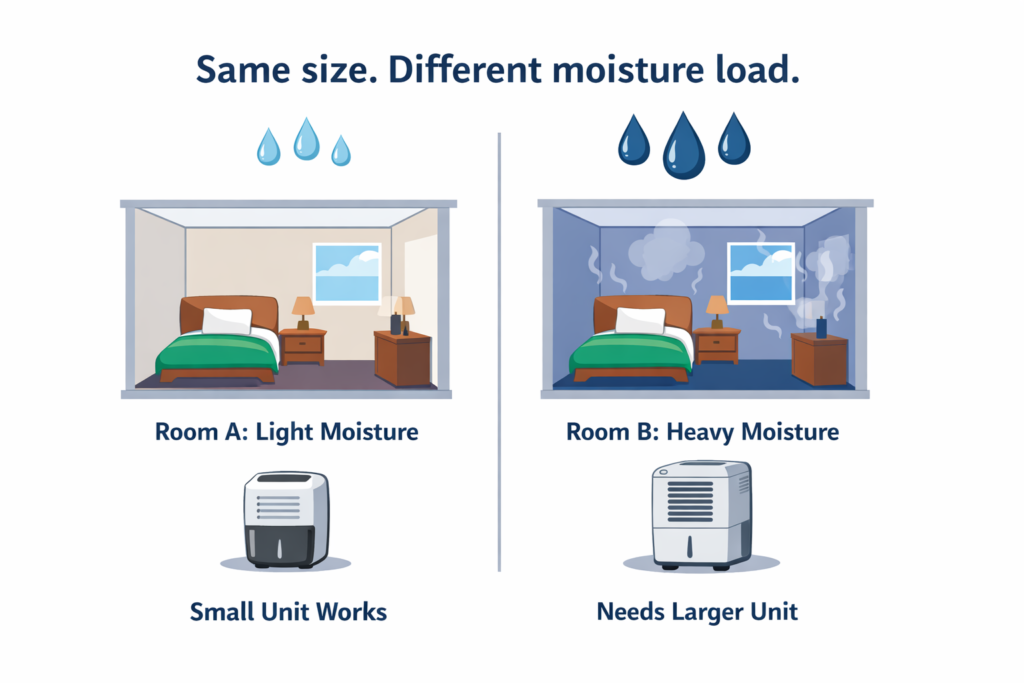
The right dehumidifier size depends on the amount of moisture the unit has to remove, not just the size of the room. Square footage gives you a starting point. Dampness, basement conditions, airflow, ceiling height, laundry moisture, and actual humidity readings decide whether you should move up.
Most homes land somewhere between a 20-pint and 70-pint dehumidifier. Small rooms often start around 20 to 30 pints. Medium damp spaces usually need 35 to 50 pints. Large basements, open lower levels, and persistently humid areas often need 50 to 70 pints or more.
If the space smells musty, feels clammy, has condensation, or keeps reading above about 55% to 60% relative humidity, size up.
Fast Rule
- Small room: 20–30 pints
- Medium damp room: 35–50 pints
- Large damp basement: 50–70 pints
- Very wet space: fix the moisture source too
Quick Answer: What Size Dehumidifier Do I Need?
For a small room or mildly damp area, start around 20 to 30 pints. For a larger room, apartment zone, or moderately damp basement, start around 35 to 50 pints. For a large basement, open lower level, or space that stays damp, start around 50 to 70 pints.
If the space is musty, below grade, poorly ventilated, or above 60% RH for long periods, choose the larger option. Undersizing is the mistake that usually leads to constant runtime and slow drying.
Ready to Choose a Dehumidifier?
If you already know the size of the space and how damp it is, these capacity ranges give you a practical place to start shopping. Choose the larger range when the room is musty, below grade, poorly ventilated, or regularly above about 55% to 60% relative humidity.
Disclosure: HumidityAtHome may earn a commission from qualifying purchases made through affiliate links, at no extra cost to you.
20–30 Pints
Best starting range for: bedrooms, offices, smaller rooms, and mild dampness.
35–50 Pints
Best starting range for: larger rooms, moderate dampness, musty spaces, and many finished lower levels.
50–70 Pints
Best starting range for: large damp rooms, basements, open lower levels, and persistent humidity.
Not sure which range fits? Use the size chart or calculator above before buying. A larger unit is not a substitute for fixing leaks, standing water, or another continuing moisture source.
Start With the Space You Are Trying to Dry
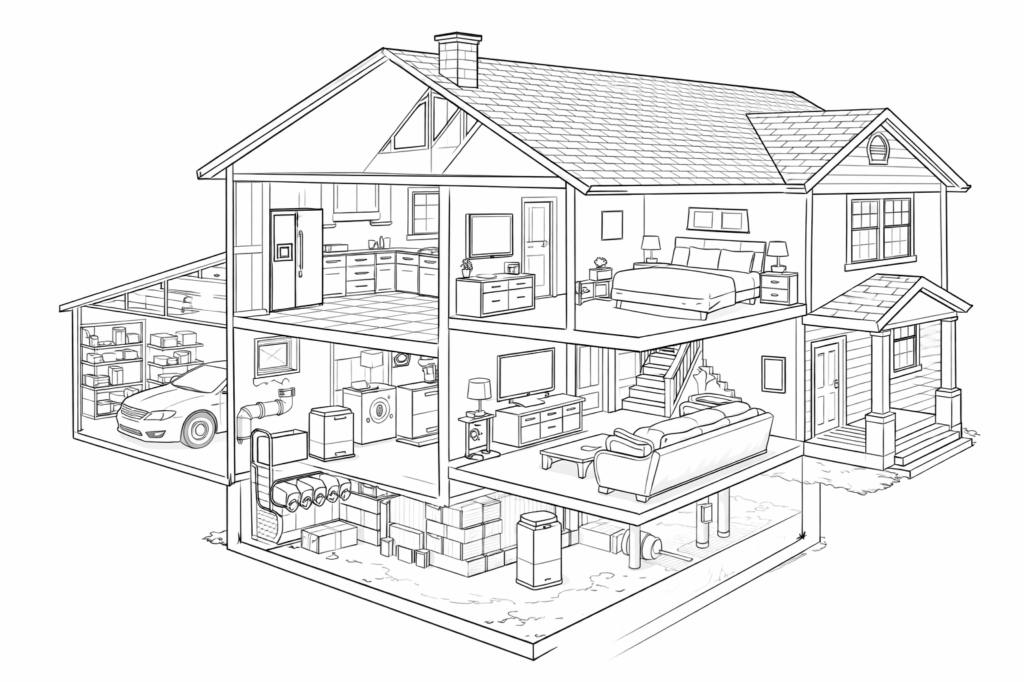
Do not size the dehumidifier for the whole house unless the whole house is actually the problem. Size it for the space where moisture is building up: basement, bedroom, laundry area, apartment zone, crawlspace-adjacent room, or open lower level.
| Space or situation | Usual starting range | Move higher when |
|---|---|---|
| Closet, RV, small bathroom, or tiny enclosed area | Small-space unit or 20-pint range for real rooms | The area smells musty or stays damp after use |
| Bedroom, office, laundry-adjacent room, or space up to 500 sq ft | 20–30 pints | The room is musty, poorly ventilated, or often above 55% RH |
| Larger room, small apartment zone, or connected space around 500–1,200 sq ft | 30–50 pints | The area is open, humid, or has poor airflow |
| Basement, finished lower level, or damp storage area | 50–70 pints | The basement is below grade, cool, musty, or above 60% RH |
| Large open lower level or serious dampness problem | 70 pints or larger-capacity basement setup | The unit will run often, drain continuously, or fight steady moisture |
For a faster square-footage lookup, use the Dehumidifier Size Chart by Square Footage. For a guided estimate, use the Dehumidifier Size Calculator.
What the Pint Rating Means
The number on a dehumidifier tells you how many pints of moisture it can remove from the air in 24 hours under standard test conditions. A 30-pint unit can remove up to 30 pints per day. A 50-pint unit can remove up to 50 pints per day.
That number is moisture-removal capacity. It is not a promise that the unit will handle every room of a certain size. A 1,000 square foot dry living area and a 1,000 square foot musty basement can need very different equipment.
A properly sized dehumidifier should pull humidity down, cycle on and off, and maintain a steady level without running nonstop. If it runs constantly and the room still feels damp, it may be undersized, poorly placed, or fighting a moisture source that needs attention.
Dehumidifier Size by Square Footage
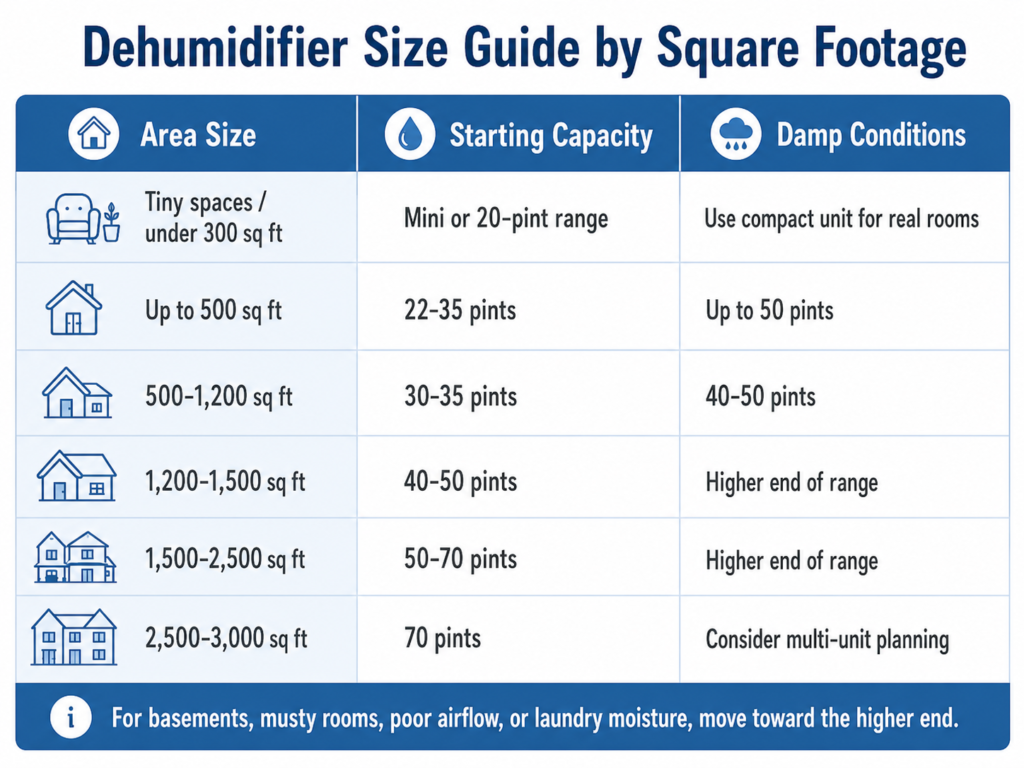
Square footage is the easiest starting point. Use it to get close, then adjust for actual humidity, dampness, airflow, and basement conditions.
| Area | Starting pint range | Common use |
|---|---|---|
| Under 300 sq ft | Small-space unit or 20-pint range | Closets, RVs, small bathrooms, tight storage areas |
| 300–500 sq ft | 20–30 pints | Small rooms, bedrooms, offices, laundry-adjacent rooms |
| 500–1,000 sq ft | 30–50 pints | Larger rooms, small apartments, open finished areas |
| 1,000–1,500 sq ft | 40–50 pints | Moderate basements, open lower levels, damp living zones |
| 1,500–2,500 sq ft | 50–70 pints | Large basements, humid lower levels, open floor plans |
| 2,500–3,000 sq ft | 70 pints or larger-capacity setup | Large open areas, heavy dampness, serious basement use |
These are starting ranges, not hard limits. A tall ceiling, open stairwell, finished basement, poor airflow, laundry moisture, slab moisture, or steady outdoor humidity can push the need higher.
When to Size Up
When the choice is close, size up. A slightly larger unit usually has a better chance of pulling humidity down quickly, cycling off, and keeping up during damp weather.
Size up when
- The room smells musty
- Humidity stays above 55% to 60% RH
- The space is a basement or lower level
- There is poor airflow or closed-off storage
- There is laundry, shower, or utility moisture nearby
- The current unit runs constantly and does not catch up
Stay smaller when
- The room is small and only mildly damp
- You only need occasional moisture control
- The space is quiet-sensitive
- The unit will sit near normal living or sleeping areas
- The humidity problem is brief and recovers quickly
- Space is limited
Oversizing within reason is usually safer than undersizing. But a large unit still needs good placement, airflow, and a practical way to drain the water.
Basements Change the Sizing Answer
Basements often need more dehumidifier capacity than the same square footage on a main floor. Cooler surfaces, concrete, below-grade walls, stored items, poor airflow, and steady ground moisture can all add load.
Serious basement moisture needs more than a pint number
If the basement stays wet, smells musty, has visible water, or needs daily bucket emptying, sizing is only part of the problem. You also need to think about drainage, pump options, airflow, placement, and whether water is entering the space.
For basement-specific sizing, use Basement Dehumidifier Size. If you are past sizing and ready to think through drainage and features, use How to Buy a Dehumidifier for a Basement.
Drainage Matters More Than Most People Expect
A bucket-only dehumidifier may work in a small or mildly damp space. It gets old fast when the bucket fills every day. In basements, laundry areas, utility rooms, and humid lower levels, drainage can matter as much as pint capacity.
| Drainage option | Use when |
|---|---|
| Bucket | The space is small, mildly damp, or only used occasionally |
| Gravity drain | You have a nearby floor drain and the unit can drain downward |
| Built-in pump | Water needs to move upward, across a distance, or into a sink/drain line |
A correctly sized dehumidifier can still become the wrong fit if emptying the bucket turns into a daily chore.
Product Path by Capacity Range
Disclosure: This page may include affiliate links. If you buy through those links, HumidityAtHome may earn a small commission at no extra cost to you.
Use the sizing guidance first. Then shop by capacity range, drainage needs, noise expectations, and where the unit will sit. Avoid choosing only from vague labels like “large room” or “basement model.” Those labels vary by product listing.
Measure First
Use this if the room feels damp but you have not confirmed the actual humidity level.
20–30 Pint Range
Use this for smaller rooms, mild dampness, bathrooms, bedrooms, and laundry-adjacent spaces.
35–50 Pint Range
Use this for larger rooms, moderate dampness, musty spaces, and many finished lower-level areas.
50–70 Pint Range
Use this for large damp rooms, basements, humid lower levels, and open spaces that need more drying power.
Serious Basement or Continuous Drain Setup
Use this when the basement is persistently damp, needs continuous draining, needs a pump, or feels beyond a basic small-room unit.
Related Dehumidifier Sizing Guides
Use these when you already know the space you are trying to dry.
Final Recommendation
If you are between two sizes, choose the larger one. For most damp rooms and basements, the safer range is usually 35 to 50 pints or 50 to 70 pints, not the smallest unit that technically mentions your square footage.
Square footage gets you close. Moisture load determines whether you are right. Measure the humidity if you are not sure, size up for musty or basement conditions, and make sure the drainage plan fits how often the unit will run.