
Written by B.D. Wolfe
For most 1,500 square foot spaces, start with a 45 to 50 pint dehumidifier.
Use the lower end only when the area is above grade, open, mildly humid, and easy to circulate. Choose a 50-pint class for a basement, lower level, divided layout, laundry-adjacent area, musty space, or room that repeatedly stays above 55% relative humidity.
At 1,500 square feet, capacity is only part of the decision. The dehumidifier also has to move dry air through a larger zone and receive humid air back from the far side of the space.
Quick Answer: What Size Dehumidifier for 1,500 Square Feet?
A 1,500-square-foot estimate assumes the unit can exchange air with the area being served. Closed rooms, moisture entering the building, and the ability to drain continuously may change the practical choice. See the dehumidifier size calculator for the planning method; real-home removal can differ from rated capacity. Technical references: ENERGY STAR dehumidifiers ASHRAE Psychrometrics.
| 1,500 sq ft condition | Starting capacity |
|---|---|
| Above-grade house area with mild humidity | 40 pint class |
| Large apartment or open living zone | 45 to 50 pint class |
| Normal recurring dampness or connected rooms | 45 to 50 pint class |
| Finished or unfinished basement | 50 pint class |
| Heavy moisture, divided rooms, or humidity that returns quickly | 50 pint class plus airflow and moisture-source review |
Best general starting point: Use a 45-to-50-pint unit for a large above-grade zone. Use a 50-pint unit for most 1,500-square-foot basement applications.
At 1,500 Sq Ft, Capacity and Drainage Are One Decision
Sustained-load rule: A 45–50 pint portable may have enough capacity for many 1,500-sq-ft zones, but the setup still fails if the bucket fills and the machine stops. For basements and recurring dampness, choose capacity and drainage together.
When to Stay Near 40 Pints and When to Favor 50
| Condition | Direction |
|---|---|
| Mild, above-grade, open 1,500-sq-ft zone | 40-pint class can be reasonable |
| Typical recurring dampness | 45–50 pint class |
| Basement, laundry, cool surfaces, or mustiness | Favor 50 pints plus continuous drainage |
| Long or divided layout | Check airflow and far-side RH before buying larger |
| Bucket fills before the space stabilizes | Add a reliable drain path; capacity alone is not the problem |
For a 1,500-Sq-Ft Basement, Plan for Runtime, Not Just the Label
1,500 Sq Ft House, Apartment, and Basement Compared
A 1,500-square-foot number can describe an entire small house, a large apartment, an open main floor, a finished basement, or a lower level divided into several rooms.
| Type of space | What changes the load | Likely starting class |
|---|---|---|
| Single-story house or main living area | Warmer surfaces, HVAC circulation, open doorways, and above-grade construction | 40 to 50 pint |
| Large open apartment | One connected zone may share air well, but closed bedrooms may not | 45 to 50 pint |
| Open main floor | Large air volume and longer distance between the unit and far side of the space | 45 to 50 pint |
| Finished basement | Cooler surfaces, concrete, below-grade moisture, and limited natural airflow | 50 pint |
| Unfinished basement | Exposed masonry, laundry, storage, drains, and greater moisture variation | 50 pint |
| Divided lower level | Walls and closed doors prevent humid air from reaching one centrally placed unit | 50 pint plus circulation or placement changes |
Why 1,500 Sq Ft Is Different From 1,000 Sq Ft
The 1,000-square-foot decision is often about whether a portable unit has enough moisture-removal capacity. At 1,500 square feet, air distribution becomes just as important.
A properly sized unit may still struggle when it sits at one end of a long floor plan, behind furniture, in a utility room, or outside several closed rooms. The far side of the space can remain humid even while the air around the machine reaches the selected setting.
This is why the 1,500-square-foot page should not be treated as the 1,000-square-foot guide with a larger number. The space is more likely to include:
- Several connected rooms
- Longer airflow paths
- More exterior wall area
- Higher total air volume
- Multiple moisture sources
- Different temperatures across the zone
If the actual area is closer to 1,000 square feet, use the Dehumidifier for 1,000 Square Feet guide.
How Many Pints Do You Need?
40 pint class
Use this lower range only when the space is above grade, relatively open, mildly humid, and supported by normal HVAC airflow.
This may fit a large apartment, main-floor living area, or finished above-grade zone that stays near the low-to-mid 50% RH range and dries normally after humid weather.
45 to 50 pint class
This is the main recommendation for 1,500 square feet. It provides more capacity for a larger air volume, connected rooms, changing weather, longer airflow paths, and recurring dampness.
50 pint class
Choose a 50-pint unit for a basement, lower level, laundry area, musty space, cooler room, humid climate, or area that repeatedly stays above 55% RH.
The higher capacity can also provide faster recovery after rain, open windows, laundry activity, or a period when the HVAC system was not running.
When one larger portable unit may not be enough
Do not automatically keep increasing pint capacity when the real problem is layout.
A second unit, improved circulation, or different placement may work better when:
- The space is divided into several closed rooms.
- The dehumidifier cannot be placed near the center of the zone.
- One end of the space stays damp while the other end reaches the target.
- The area spans more than one floor.
- Airflow between the problem areas is weak.
Measure Humidity Before Buying
A large space that feels clammy is not always humid enough to justify a 50-pint machine. Measure the area instead of relying only on comfort, odor, or a thermostat in another room.
| Measured RH | What it means for a 1,500 sq ft space |
|---|---|
| Below 50% | A dehumidifier may not be needed unless one local room or surface has a moisture problem. |
| 50% to 55% | Watch range. Confirm whether the condition lasts before buying. |
| 55% to 60% | Use the middle or upper end of the 45-to-50-pint range. |
| Above 60% | Use the 50-pint path and inspect for an ongoing moisture source. |
| Large room-to-room differences | Placement, airflow, and closed doors may matter more than added pint capacity. |
Use How to Measure Humidity in Your Home for meter placement, stabilization time, and room-to-room comparison.
When to Stay Near 40 Pints
Stay near the lower end when most of these conditions apply:
- The space is above grade.
- Humidity is only mildly elevated.
- The layout is open.
- HVAC airflow reaches the full area.
- There is no recurring musty odor.
- The area dries normally after humid weather.
This is usually the large apartment, open main floor, or above-grade living-area version of the 1,500-square-foot problem.
When to Choose a 50 Pint Dehumidifier
Use the 50-pint class when one or more of these conditions apply:
- The area is below grade.
- RH regularly stays above 55%.
- The space smells musty.
- Laundry or wet storage adds moisture.
- The zone contains several connected rooms.
- The home is in a humid climate.
- Ceilings are higher than normal.
- The area dries slowly after rain.
- Humidity rises quickly after the unit shuts off.
A slightly larger machine set to a reasonable RH target may cycle more effectively than an undersized unit that runs continuously without stabilizing the full zone.
A 1,500 Sq Ft Basement Is the Higher-Load Case
A 1,500-square-foot basement usually has a higher moisture load than the same square footage upstairs.
Basement conditions can include:
- Cool concrete walls and floors
- Below-grade moisture movement
- Laundry and stored materials
- Limited natural air circulation
- Floor drains or utility areas
- Rooms separated by walls and doors
For a typical 1,500-square-foot basement, begin with a 50 pint dehumidifier. Continuous drainage is usually more practical than emptying a bucket repeatedly.
Use the dedicated Basement Dehumidifier Size guide for drainage, hose routing, pump considerations, finished versus unfinished areas, and below-grade moisture.
Water-source warning: A dehumidifier manages moisture in the air. It does not repair foundation leaks, plumbing leaks, failed gutters, standing water, poor grading, or water entering through a wall or floor.
If RH remains high while the unit runs continuously, inspect the moisture source before assuming that more pint capacity is the only answer.
Open Layouts and Divided Rooms
An open 1,500-square-foot living area may be easier to control than a divided basement because humid air can return to the machine and dry air can spread through the zone.
Closed bedrooms, offices, storage rooms, and utility rooms behave more like separate zones. One unit in the main area may not control them evenly.
Before buying a larger machine, consider:
- Moving the unit toward the center of the problem area
- Keeping interior doors open when practical
- Using gentle air circulation between connected rooms
- Measuring the farthest room separately
- Using two smaller zones when the layout is heavily divided
Ceiling Height, Temperature, and Climate
| Condition | Effect on the choice |
|---|---|
| 9- or 10-foot ceilings | More air volume pushes the decision toward 50 pints. |
| Vaulted ceiling or open loft | The actual air volume may be much larger than floor area suggests. |
| Cool basement | Moisture removal may be slower and surfaces may feel damp at moderate RH. |
| Humid climate | New moisture enters more often through doors, air leakage, and outdoor air. |
| Closed doors | Separate rooms may not exchange enough air with the dehumidifier. |
| Poor placement | Blocked intake or discharge reduces effective airflow through the zone. |
Moisture load increases when:
- The space includes basement area.
- Outdoor humidity stays high for long periods.
- The area smells musty.
- Air circulation is limited.
- Concrete walls or slab floors release moisture.
- Laundry, wet storage, or rainy weather keeps adding moisture.
- Humidity returns quickly after the machine shuts off.
If several of these apply, use the 50-pint path and review the underlying moisture source.
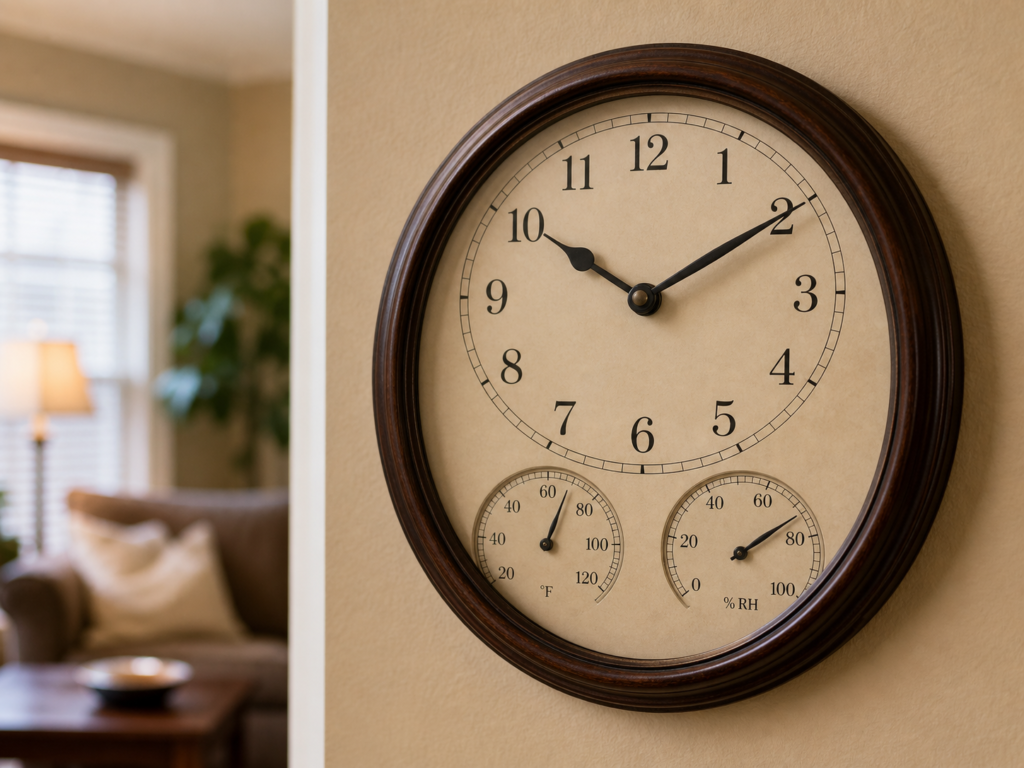
If you are not sure whether the home has a broad moisture problem, begin with Too Much Moisture in Your Home.
Portable or Whole-House?
For one defined 1,500-square-foot main floor, apartment, basement, or connected lower-level zone, a portable compressor dehumidifier is usually the correct starting class.
A whole-house dehumidifier connects to the HVAC system and is selected for the home’s total moisture load, duct layout, climate, and airflow. It is not simply a larger portable unit.
Use How Big of a Dehumidifier Do I Need for My Home? when the humidity problem affects most of the house rather than one 1,500-square-foot zone.
Disclosure: This page may include affiliate links. If you buy through those links, HumidityAtHome may earn a small commission at no extra cost to you.
As an Amazon Associate I earn from qualifying purchases.
Product Paths for 1,500 Square Feet
40 to 50 Pint Class
Use for mild to moderate humidity in an above-grade, open, and reasonably well-circulated space.
Look for a humidistat, continuous-drain connection, washable filter, auto restart, and accessible controls.
50 Pint Class With Drain Options
Use for basements, musty lower levels, laundry moisture, divided spaces, humid climates, or areas that recover slowly after rain.
Prioritize continuous drainage, auto restart, a clear humidistat, easy filter access, and practical hose routing.
Indoor Humidity Meters
Use a humidity meter before buying when the decision is based only on comfort, odor, or condensation.
Tiny thermoelectric or compact small-room units are not appropriate for controlling a full 1,500-square-foot house area, basement, apartment, or lower-level zone.
Compare Nearby Sizes
Closer to 1,000 sq ft
Use the smaller-space guide for a large apartment zone, compact lower level, or smaller connected area.
Closer to 2,000 sq ft
Use the larger guide for a broader basement, open lower level, or larger connected zone.
Use Moisture Load and Drainage to Choose the 1,500-Sq-Ft Range
For most 1,500-square-foot spaces, choose a 45 to 50 pint dehumidifier.
Use a 40-pint class only for a mildly humid, above-grade, open space with good circulation. Use a 50-pint class for a basement, lower level, laundry area, musty zone, divided layout, humid climate, or space that repeatedly stays above 55% RH.
At this size, the right answer depends on both moisture-removal capacity and air movement through the full zone. A larger machine cannot compensate for closed rooms, blocked airflow, or an active water source.