
At 2,500 to 3,000 square feet, humidifier sizing is mainly a distribution and system-planning problem. A single coverage number is not enough to tell you whether one portable humidifier can treat the space.
One high-capacity unit may work in a genuinely open large zone. A typical large home usually contains bedrooms, hallways, stairwells, closed doors, and multiple areas that behave differently. In that situation, the better comparison is often one large portable unit versus several dry zones versus whole-house humidification.
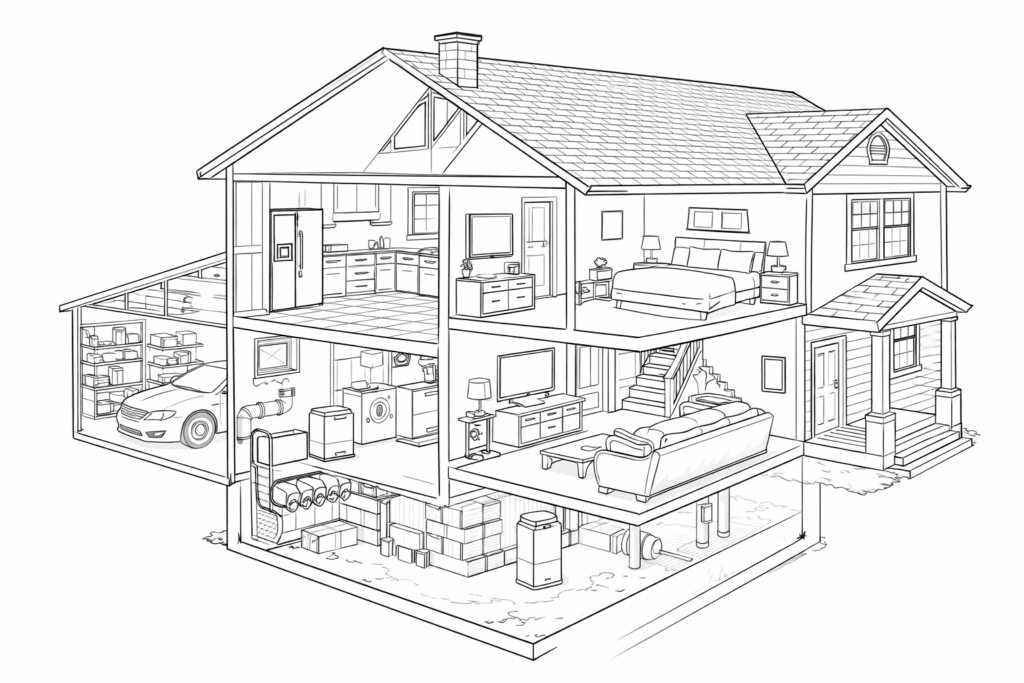
Quick answer: 2,500 vs 3,000 square feet
For 2,500–3,000 square feet, one published coverage rating does not prove that moisture reaches all rooms equally. Start with the humidifier size calculator, then check readings in separate zones and practical refill or water-supply needs. Stop increasing output if condensation appears. Technical references: EPA humidifier care ASHRAE Psychrometrics.
| Space | Practical starting point | Main question |
|---|---|---|
| Around 2,500 sq ft | Large-zone portable, multiple units, or whole-house comparison | Is this one open zone or several rooms? |
| Around 3,000 sq ft | Zone planning or whole-house strategy | Are you treating one large area or most of the home? |
| Multi-level or highly divided home | Multiple zones / whole-house comparison | Can moisture actually move to the rooms that need it? |
At 2,500 square feet, choose the distribution strategy first
A 2,500-square-foot rating can sound like a simple equipment match, but the floor plan matters more than the label.
One large portable unit can still make sense when:
- the treated area is one large open zone
- air moves freely throughout the space
- the unit can be positioned near the center
- humidity readings are similar from one end to the other
- the goal is not to humidify several closed bedrooms at once
Multiple units may be the cleaner answer when:
- the home has several separate dry zones
- bedrooms stay closed
- a home office or sleeping area needs different control
- one portable unit reaches its target locally but other rooms remain dry
Whole-house humidification becomes worth comparing when:
- most of the home is dry
- multiple portable units would be required
- repeated tank filling and cleaning becomes impractical
- the heating system and duct arrangement support a central approach
At 3,000 square feet, classify the home before choosing equipment
A 3,000-square-foot open loft and a 3,000-square-foot two-story house are completely different humidification jobs.
The first may behave like one very large zone. The second may contain several independent zones separated by floors, doors, and airflow patterns.
Before choosing equipment, identify which of these describes the goal:
- One large open area is dry.
- Several specific rooms are dry.
- Most of the home is dry.
Those three conditions lead to different solutions.
Why one portable unit often falls short in a large home
A humidifier can only add moisture to the air that moves through or around it. It does not actively send equal humidity through closed doors, around corners, upstairs, and into remote bedrooms.
That is why a very large coverage claim does not guarantee even humidity throughout a large house.
If the main living area reaches the desired humidity but bedrooms remain dry, increasing the output in the living room can create too much humidity locally without solving the remote-room problem.
High ceilings, great rooms, and stairwells
Large-space floor area can underestimate the actual air volume.
Vaulted ceilings, two-story great rooms, open stairwells, and large connected spaces increase the amount of air being treated. They also create stronger vertical air movement, which can change where the added moisture goes.
Treat those features as reasons to be conservative about portable-unit coverage claims.
Measure by zone
For a large home, use more than one humidity meter or move the same meter between representative locations.
Check:
- the main living area
- the primary bedroom
- another frequently occupied room
- an upper or lower level if the home has more than one floor
If all locations are similarly dry, a larger system may be justified. If only one or two zones are dry, targeted equipment may be simpler.
Use the humidity measurement guide for placement and interpretation.
Use the humidifier size calculator for a starting estimate.
Use the humidifier size chart for a quick size comparison.
One large unit, multiple units, or whole-house?
| Strategy | Best fit | Main limitation |
|---|---|---|
| One high-capacity portable | One large open zone | Weak distribution into separated rooms |
| Multiple portable units | Several specific dry zones | More filling, cleaning, and maintenance |
| Whole-house humidifier | Most of a ducted home is consistently dry | Installation, system compatibility, and cost |
The goal is not to buy the biggest possible humidifier. The goal is to match the equipment strategy to the way the home is divided.
For separate dry zones, compare One Humidifier or Multiple Humidifiers? and Portable vs Whole-House Humidifier before choosing the equipment strategy.
Humidifier Options for Large Open Zones
Affiliate disclosure: HaH may earn a commission if you buy through these links, at no additional cost to you.
For a large connected zone around 2,500 square feet:
Check high-capacity humidifiers for about 2,500–3,000 sq ft on Amazon
For a very large open area approaching 3,000 square feet:
Check portable humidifiers around 3,000–3,500 sq ft on Amazon
Choose a Humidification Strategy for 2,500–3,000 Sq Ft
At 2,500 square feet, decide whether you are treating one large zone, several dry zones, or most of the home.
At 3,000 square feet, system strategy matters more than the advertised coverage number. One portable humidifier can work in a genuinely open area, but a divided large home often needs multiple zones or a whole-house comparison.
Measure the rooms that matter before choosing equipment.