Humid climates change how dehumidifier sizing works. The square footage still matters, but it is not the whole answer. Warm, damp outdoor air keeps adding moisture to the home through doors, air leaks, crawlspaces, basements, laundry areas, and normal daily use.
That means a dehumidifier in a humid region is not just drying one sealed room one time. It may be fighting a steady moisture load all season.
In a humid climate, start with the normal square-footage range, then move toward the higher end when your readings, layout, or moisture source justify it.
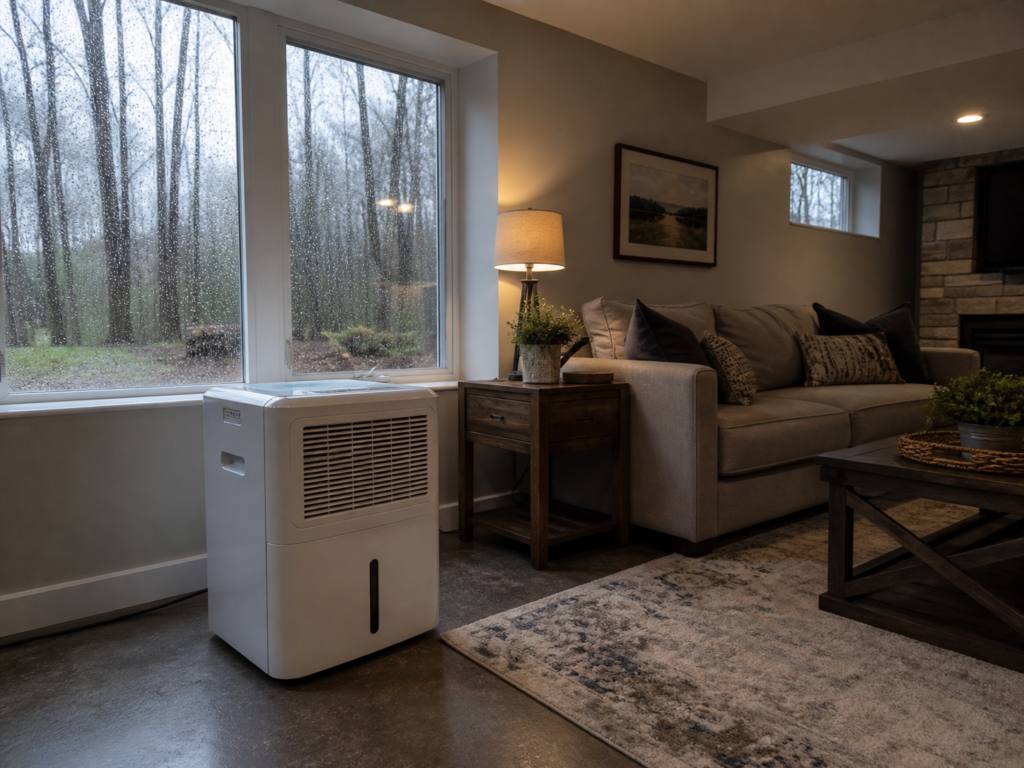
Fast Answer: What Size Dehumidifier for a Humid Climate?
Outdoor RH alone does not tell you how much moisture incoming air will add: air temperature and dew point matter. In a humid climate, frequent outside-air entry can increase the load on a portable dehumidifier. Use the suggested capacity as a shopping range and verify results with indoor measurements. Technical references: ASHRAE Psychrometrics EPA moisture and mold.
For a humid climate, use the normal dehumidifier size chart as your starting point, then lean toward the higher end of the range if the space stays above 60% relative humidity, has a basement or crawlspace connection, has poor air sealing, or the unit needs to run during long humid stretches.
| Space or zone | Humid-climate starting point | Move up when |
|---|---|---|
| Small room or bedroom | Upper end of 20–30 pint range | The room stays over 60% RH or has poor airflow |
| 1,000–1,500 sq ft zone | 40–50 pint range | The area is open, leaky, or connected to damp lower space |
| 2,000+ sq ft open area | 50–70 pint range | The unit must serve a large open layout or multiple connected rooms |
| Basement or crawlspace-adjacent area | Upper end of the recommended range | The space is below grade, cool, musty, or repeatedly damp |
If you have not measured yet, do that first. A humid climate is a warning sign, not a substitute for indoor humidity readings.
Why Humid Climates Change Dehumidifier Sizing
Square footage tells you how much air the dehumidifier has to treat. Climate tells you how often moisture is being added back into that air.
In a dry or mild climate, a dehumidifier may only need to handle occasional dampness. In a humid climate, the moisture load can be continuous. Doors open. Outdoor air leaks in. Basements and crawlspaces stay cooler. Air conditioning may cool the home before it removes enough moisture.
Common humid-climate factors include:
- Outdoor air already carrying high moisture
- Doors, windows, and attached garages bringing humid air inside
- Air leaks around walls, windows, vents, rim joists, and crawlspaces
- HVAC systems that cool faster than they dehumidify
- Basements, slabs, and crawlspaces absorbing moisture from surrounding soil
- Laundry rooms, bathrooms, kitchens, and indoor drying adding moisture indoors
This is why a dehumidifier that looks acceptable on a basic chart may still feel undersized in a humid region.
Measure Before You Buy Bigger
Do not size up just because the weather outside is humid. Size up when the indoor readings show the space needs more capacity.
Check the problem area with a separate indoor humidity meter. A thermostat reading in the hallway may not tell you what is happening in the basement, bedroom, laundry area, crawlspace entrance, or lower level.
When to Size Up in a Humid Climate
Humid-climate sizing is mostly about margin. A smaller unit may collect water, but still fail to lower the room to a stable humidity range.
Move up one capacity range when one or more of these conditions are present:
| Condition | Why it matters | What to do |
|---|---|---|
| Humidity stays above 60% | The space is not stabilizing | Move toward the higher end of the size range |
| Unit runs constantly | The moisture load may be larger than the unit can handle | Check placement, airflow, drainage, and capacity |
| Basement or crawlspace connection | Cool surfaces can raise relative humidity quickly | Use basement or crawlspace-specific guidance |
| Open floor plan | The unit is treating more connected air | Size for the actual open zone, not one room |
| High ceilings | More air volume than square footage suggests | Consider the next size range |
| Humidity rebounds quickly | Moisture keeps entering the space | Look for leaks, infiltration, drainage, or ventilation issues |
For the full square-footage framework, use the main guide on how big of a dehumidifier you need for your home.
Moisture Load Matters More Than the Product Label
A dehumidifier rating is not a promise that the unit will control every space of that size. The label does not know how damp your climate is, how leaky your home is, whether your crawlspace is sealed, or whether humid air is being pulled into the lower level.
Moisture load increases when:
- The home has basement or crawlspace space
- Windows show condensation during humid weather
- The home is near water, marshy ground, or coastal air
- Ventilation is limited or uneven
- Air leakage allows humid outdoor air inside
- The AC cools the home but leaves the air damp
- The dehumidifier has to serve more than one connected zone
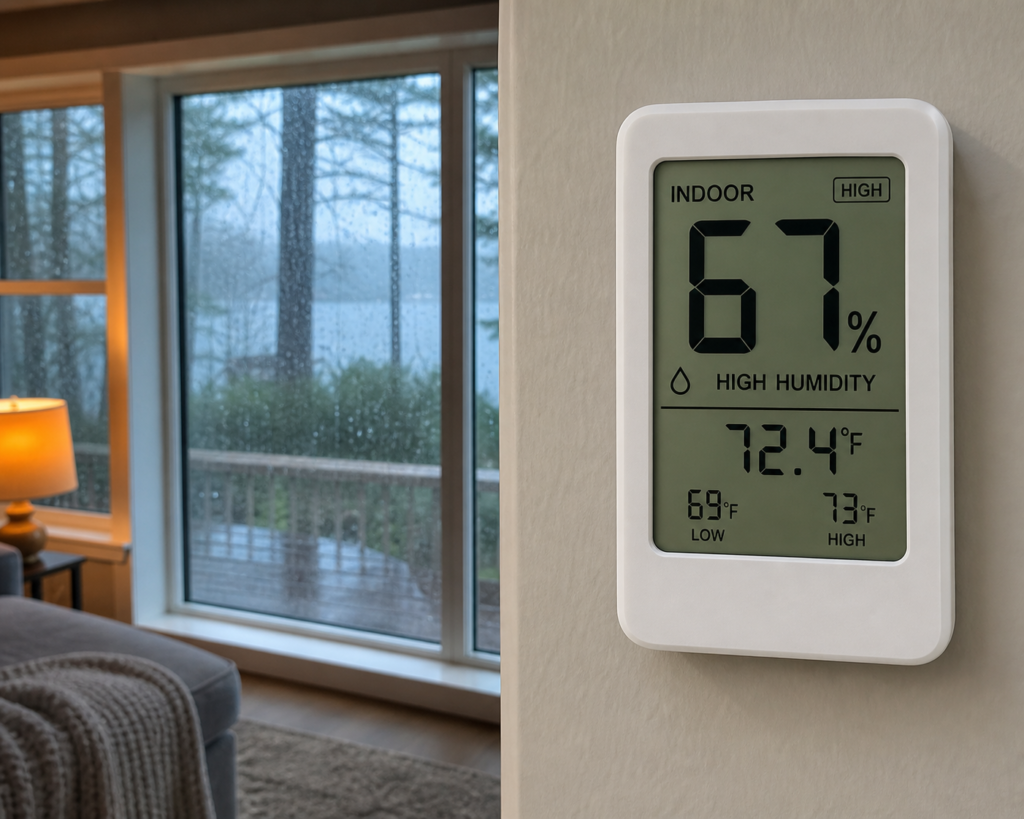
In humid climates, these conditions are common rather than occasional. That does not mean every room needs the biggest machine available. It means the real moisture load should guide the final choice.
Basement and Crawlspace Adjustment
Basements and crawlspaces usually need more caution in humid climates because they are cooler, lower, and more connected to soil moisture than normal rooms.
Warm humid air entering a cool basement or crawlspace can raise relative humidity quickly. Concrete, masonry, framing, stored items, insulation, and exposed ground can all make the problem harder to control.
If the problem area is a basement, use the basement dehumidifier size guide.
If the problem area is below the house, use the crawlspace dehumidifier size guide.
If the home is near the water, see the guide to choosing a dehumidifier for coastal homes.
Continuous Drainage Is Worth Prioritizing
In a humid climate, bucket emptying gets old fast. A high-capacity dehumidifier can collect a lot of water during humid weather. If the bucket fills while you are asleep, at work, or away for the weekend, the unit shuts off and humidity climbs again.
For humid regions, continuous drainage is usually more important than small convenience features.
Look for:
- A drain hose connection
- A nearby floor drain, utility sink, sump pit, or condensate drain
- A built-in pump or external pump if water must drain upward
- Easy filter access
- A clear humidistat or adjustable humidity setting
- Enough airflow space around the intake and exhaust
Drainage matters most in basements, laundry areas, crawlspaces, lower levels, and homes where the unit may run for long stretches.
Ceiling Height and Open Layouts
Most basic sizing guidance assumes normal rooms with roughly 8-foot ceilings. Higher ceilings increase total air volume. Open layouts also increase the amount of connected air the dehumidifier has to treat.
Move up one capacity range if the home has:
- Vaulted ceilings
- Large open living areas
- Open stairwells
- Multi-level air movement
- Long connected rooms without doors
- A lower level that opens into the main living space
A dehumidifier can only control the air it can reach. Layout matters almost as much as square footage once the space is open and connected.
Portable vs Whole-House Dehumidifiers in Humid Regions
Portable dehumidifiers work best for defined problem zones. That includes basements, bedrooms, laundry rooms, finished lower levels, crawlspace-adjacent areas, garages, and main living areas where humidity is most noticeable.
Whole-house dehumidifiers may make sense when the entire home stays humid, the HVAC system cannot maintain comfortable humidity, or several zones need control at once. Those systems are sized differently and depend on ductwork, airflow, mechanical layout, and installation conditions.
Do Not Use a Portable Unit as a Whole-House Fix
A portable dehumidifier can help one zone. It is not the same as a properly designed whole-house humidity system. If the entire home is sticky, the AC short cycles, or every level has high humidity, the equipment decision may need to involve HVAC airflow and ductwork, not only pint rating.
Buying Direction for Humid Climates
Disclosure: This page may include affiliate links. HumidityAtHome may earn a commission if you buy through those links, at no extra cost to you.
For humid climates, most homeowners should start with the largest problem zone, not the whole house. Choose a unit that has enough pint capacity for that zone, a hose drain option, an adjustable humidistat, and enough airflow clearance to run steadily.
Practical Starting Point
If your main problem is a large damp zone, basement, lower level, or open area in a humid region, compare high-capacity portable dehumidifiers with drain options and avoid the bottom end of the size range.
If you are not sure whether the problem is local or whole-home, use a humidity meter in several rooms for a few days before buying a larger unit.
Practical Recommendation
In a humid climate, choose the higher end of your square-footage range when the space is actually staying damp. Prioritize steady operation over the smallest possible unit.
A practical setup should include:
- Enough pint capacity for the actual problem zone
- Adjustable humidity control
- Continuous drain capability
- Good airflow around the unit
- Easy filter access
- A separate humidity meter for checking results
For many homes, maintaining indoor relative humidity around 50% is a reasonable comfort target. In very damp spaces, getting consistently below 60% may be the first meaningful improvement.
Reality Check
A dehumidifier manages airborne moisture. It does not correct drainage problems, foundation leaks, roof leaks, plumbing leaks, or structural water intrusion.
If humidity remains high even with adequate capacity, investigate air infiltration and moisture sources. Wet crawlspaces, poor grading, leaking windows, damp basements, and poor drainage can overwhelm equipment.
Equipment controls indoor air conditions. It does not eliminate outdoor humidity.
Where to Go Next
Use the next guide based on what you are trying to solve.
Choose Capacity for Persistent Humidity and Reliable Drainage
In a humid climate, buy for the moisture load, not just the square footage.
For smaller rooms, choose the higher end of the normal range when readings stay high. For large open areas, basements, crawlspace-adjacent areas, or consistently damp spaces, expect to move into 40–70 pint units sooner.
The right dehumidifier for a humid climate is the one that can keep up, drain reliably, and run consistently without spending the whole season stuck at its limit.