
Estimate Humidifier Output Before Buying
Dry indoor air is easy to ignore until the house starts feeling sharp, staticky, uncomfortable, or hard to balance during heating season.
This humidifier size calculator estimates a practical humidifier size based on square footage, dryness level, and space type. It is meant for real homes, not perfect lab conditions.
The goal is not to push the biggest humidifier possible. The goal is to add enough moisture to help the space without over-humidifying the room, soaking nearby surfaces, or creating a cleaning problem.
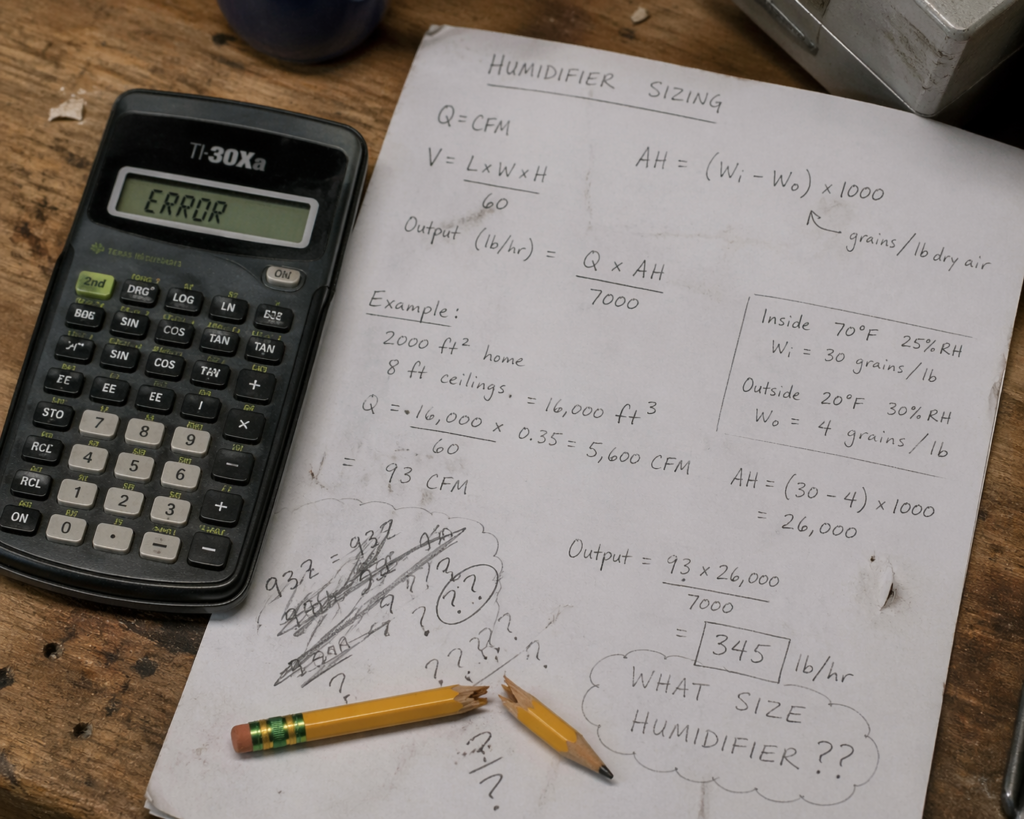
Measure Before You Size a Humidifier
Dry air symptoms can be misleading. A room may feel uncomfortable because the humidity is low, but air leaks, heating patterns, room temperature, and closed doors can also affect comfort.
Use a humidity meter before buying a larger humidifier. Check the room before the humidifier runs, after several hours, and again the next day. That tells you whether the room is actually dry or whether the humidifier is simply too small for the space.
Humidifier Size Calculator
Enter the room or connected-zone area and the observed dryness level to receive a starting humidifier size category. This is a planning estimate, not a calculation of a building’s actual water-vapor load or a guarantee of a particular RH. Outdoor conditions, air exchange, room temperature, and equipment output affect results; confirm the choice with a humidity meter and check cold surfaces for condensation. Technical references: EPA humidifier care ASHRAE Psychrometrics.
Disclosure: This calculator may include affiliate links to humidifiers or humidity meters that fit the sizing guidance below. If you buy through those links, HumidityAtHome may earn a small commission at no extra cost to you.
Calculate Humidifier Size
Estimate the humidifier size your space may need based on square footage, dryness level, and space type.
Your Recommended Size
Browse options by size:
- Recommended choice: Check large room humidifiers on Amazon
Reality check: This is a starting estimate. Air leakage, constant furnace use, high ceilings, open layouts, and very dry outdoor conditions can push real humidifier needs higher. If windows get wet or nearby surfaces feel damp, the humidifier may be running too much or set too high.
How to Read the Result
The calculator estimates humidifier output in gallons per day and translates that into a practical product category. Treat the result as a starting range, not a guarantee.
Humidifiers are affected by room layout, door position, heating system runtime, air leakage, ceiling height, outdoor conditions, and how often the unit is cleaned and refilled.
| Calculator result | Common fit | Watch for |
|---|---|---|
| Small room humidifier | Bedroom, office, nursery-size room, small enclosed space | May be too weak for open rooms |
| Medium room humidifier | Standard bedroom or modest living area | Tank size and refill frequency |
| Large room humidifier | Larger living room or open area | White dust, cleaning, and placement |
| Console humidifier | Large open zone or multiple connected rooms | Noise, floor space, and water use |
| Whole-house range | Large home or severe dry-air problem | May need installed or furnace-mounted solution |
When Humidifier Sizing Matters Most
Humidifier sizing matters most when the dry-air problem is persistent, not occasional. A small unit can make a bedroom more comfortable, but it may do very little for an open living room or a full house with leaky winter air.
- You run heat for long periods in winter.
- Indoor humidity stays low even after a humidifier runs.
- Static, dry-feeling rooms, or wood movement show up during heating season.
- The home has high ceilings, open rooms, or strong air leakage.
- You are trying to humidify more than one room from a single unit.
If you want a simpler reference, use the humidifier size chart by square footage.
Do Not Oversize Without Measuring
A humidifier that is too small may not raise humidity enough. A humidifier that is too large can make the room damp, leave condensation on windows, or push moisture into areas that should stay dry.
That is why the result should be checked with a humidity meter. If the room stays dry, move up one size. If windows get wet or surfaces feel damp, turn the unit down, move it, or reduce runtime.
Oversizing Warning
Do not run a large humidifier blindly in a small room. Too much added moisture can cause wet windows, damp surfaces, musty smells, or moisture collecting where you do not want it.
Use a humidity meter and adjust the setting instead of guessing by comfort alone.
Room, Apartment, or Whole House?
The same square footage can behave differently depending on the layout. A closed bedroom is easier to humidify than an open living area. An apartment with connected rooms may need more output than one bedroom, but less than a full house.
Use the calculator for a first pass, then check the more specific guide if your space has a clear layout.
Single Room
For a bedroom, office, or small enclosed room, a dedicated room humidifier is usually the cleanest starting point.
Apartment or Open Area
Connected rooms need more care. One small tabletop unit may not carry a living room, dining area, and hallway.
Large Home
Large open spaces and full-house dryness may need a console unit, multiple humidifiers, or a whole-house option.
When the Calculator Is Not Enough
The calculator is useful when the dry-air problem is mostly about space size and dryness level. It is less reliable when the home has major air leakage, very high ceilings, open staircases, multiple dry zones, or a heating system that dries the air quickly.
You may need to adjust upward if:
- The humidifier runs constantly but the humidity barely rises. See what happens if a humidifier is too small.
- The room is open to a hallway, stairway, or another large space.
- The home is leaky or drafty in winter.
- The furnace runs often and the air dries out quickly.
- You are trying to use one portable humidifier for several rooms.
You may need to adjust downward if windows get wet, surfaces feel damp, or the room starts to smell musty.
Not Sure You Need a Humidifier?
If you have not confirmed the problem yet, start with the dry-air diagnosis before buying equipment.
Do I Need a Humidifier for My Home?
Why Is My House Dry in Winter?
Solving the Opposite Problem?
If the air feels damp, sticky, musty, or clammy, you may be dealing with excess moisture instead of dry air.
Use the dehumidifier size calculator if you need to remove moisture rather than add it.
Use the Humidifier Estimate, Then Check Measured RH
A humidifier size calculator gives you a useful starting point, but the room still has to prove it. Measure humidity, choose a humidifier that fits the space, and watch for signs that the unit is too small or too large.
For one room, start with a room humidifier. For a larger open area, look at large-room or console units. For a full-house dry-air problem, compare whole-house options instead of expecting one small tabletop unit to fix everything.
Next step: Use the calculator above, then compare the result with the humidifier size chart by square footage.