
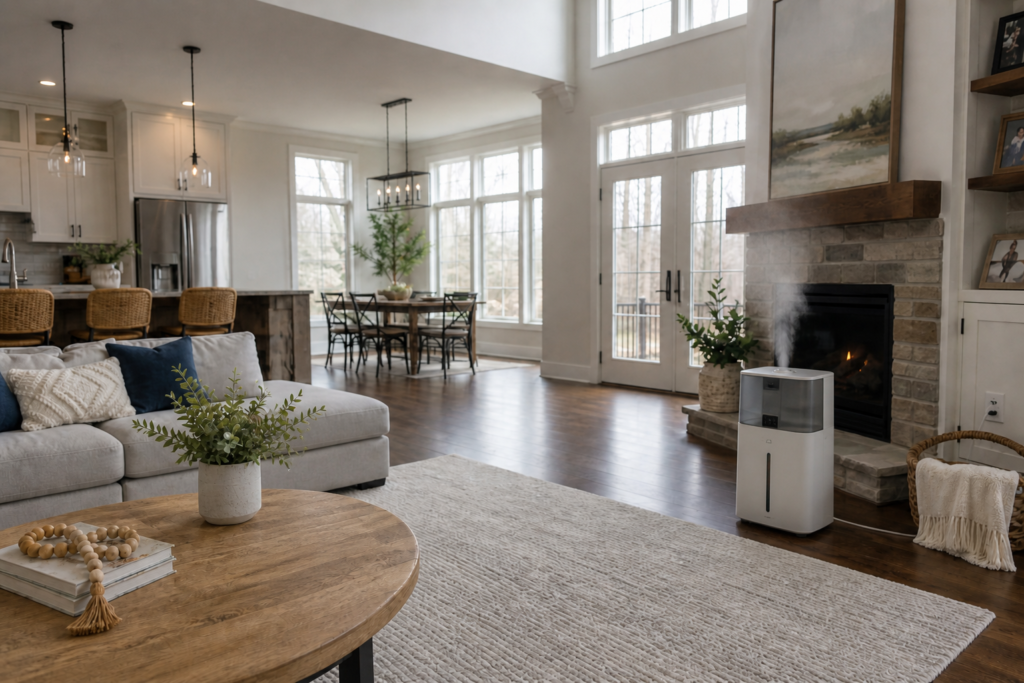
A humidifier for 1500 square feet is usually a large-zone portable humidifier, not a small-room unit and not automatically a whole-house system.
This size can work well for a large apartment, open main floor, finished basement zone, loft-style space, or connected living area. It works best when the space behaves like one large zone instead of several separate rooms.
For most 1500 sq ft spaces, start with a portable humidifier rated around 1500–1800 square feet. Size up only when the area is open to other spaces, has tall ceilings, loses air quickly, or gets severely dry in winter.
Fast Answer for 1500 Square Feet
For a normal 1500 sq ft space, use this as the starting point:
| Space Type | Best Starting Size |
|---|---|
| Large open apartment | 1500 sq ft rated humidifier |
| Open main living floor | 1500–1800 sq ft rated humidifier |
| Finished basement zone | 1500–1800 sq ft rated humidifier |
| Loft or high-ceiling space | Move up one size |
| Divided floor plan | Size each problem zone separately |
| Whole house with several rooms | Consider multiple units or whole-house |
A 1500 sq ft humidifier can be a good fit when the treated area is open and connected. It becomes less reliable when the space is broken into bedrooms, halls, bathrooms, closed doors, stairways, and side rooms.
For a broader whole-home starting point, see what size humidifier do I need for my home. For split layouts, the humidifier size calculator is the better next step.
What 1500 Square Feet Really Means
A 1500 sq ft humidifier rating usually assumes fairly normal conditions: standard ceiling height, closed windows, average insulation, moderate winter dryness, reasonable air leakage, and one connected humidification zone.
Those assumptions matter because 1500 square feet can describe very different homes.
A 1500 sq ft open apartment may act like one large zone. A 1500 sq ft ranch house with three bedrooms and a hallway may not. A 1500 sq ft finished basement may behave differently than a drafty main level.
Square footage gives the starting range. Layout, airflow, ceiling height, and measured humidity decide whether the unit can actually keep up.
Measure Before You Buy
Before choosing a unit, confirm the actual indoor humidity. Start with how to measure humidity in your home if you have not checked the space yet.
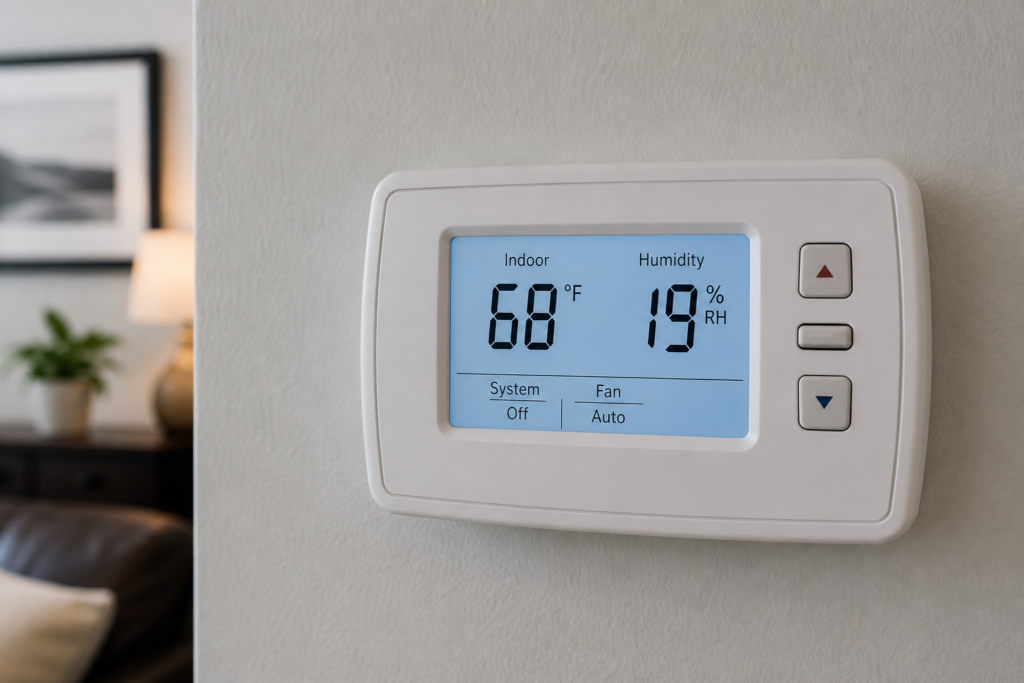
At 1500 square feet, measure in more than one spot. A single reading near the humidifier may not show what is happening across the full zone.
Best Use Case: A Large Connected Zone
A 1500 sq ft humidifier is best used for one large connected area.
Good use cases include a large apartment, open living room and dining area, finished basement family room, main floor living space, loft-style apartment, large open office or hobby area, or a small single-level home with doors open.
This is the point where portable humidifier sizing starts to become less forgiving. A small bedroom humidifier is not enough. A mid-size unit may run constantly. A large-zone unit gives more output, more tank capacity, and better margin for winter dryness.
At this size, runtime matters as much as coverage. A humidifier that technically covers the space but needs constant refilling will become irritating quickly.
The 1500 Sq Ft Problem: One Zone or Several?
The most important question is not only “How many square feet?”
It is: is this one connected zone, or several smaller zones pretending to be one number?
A 1500 sq ft humidifier can work well when the space is open enough for air to move. It can struggle when the same square footage is divided across several rooms.
| Works Better | Works Worse |
|---|---|
| Open apartment | Several bedrooms with closed doors |
| Open main floor | Long hallway layout |
| Finished basement room | Split-level home |
| Loft-style living area | Main floor plus upstairs |
| Large connected living/dining space | Rooms separated by walls and doors |
| Main zone with steady air movement | Stairwell pulling air away from the main zone |
If the dry-air problem is spread across multiple separated rooms, do not just divide the total square footage evenly. Size each problem zone separately.
For example, a 900 sq ft open living area and a 300 sq ft bedroom may need different solutions. One larger unit in the living area may help that main zone, while the bedroom may still need its own smaller humidifier.
For apartment-specific layout guidance, use what size humidifier for an apartment.
Measure in More Than One Spot
At 1500 square feet, one humidity reading may not tell the full story.
Put a humidity meter in the main dry zone first. Then check another spot across the space, especially if the layout is long, open to a hallway, or partly divided.
| Indoor RH Reading | What It Usually Means |
|---|---|
| Below 25% | Very dry. A borderline unit may struggle. |
| 25–30% | Dry enough that humidification is reasonable. |
| 30–40% | Often a practical winter comfort range. |
| 40–50% | Usually enough. Watch windows in cold weather. |
| Above 50% | Be careful. Do not add more moisture without a reason. |
If the area near the humidifier improves but the far side stays dry, the issue may be distribution rather than raw capacity.
For broader dry-air diagnosis, see air that’s too dry at home.
Ceiling Height Changes the Load
Most humidifier ratings assume 8-foot ceilings.
That matters because humidifiers treat air volume, not just floor area. A 1500 sq ft space with 10-foot ceilings contains much more air than a 1500 sq ft space with 8-foot ceilings.
| Ceiling Height | Sizing Adjustment |
|---|---|
| 8 feet | Normal 1500 sq ft sizing applies |
| 9 feet | Slight extra capacity may help |
| 10 feet or higher | Move up one size |
| Vaulted ceiling | Treat as a larger space |
| Loft or open stairwell | Expect uneven results |
This matters in lofts, vaulted living rooms, older homes, finished basements, and open stairwell layouts.
Do not jump several sizes larger just because the ceiling is high. Move up gradually and use a humidity meter to confirm the result.
For broad comparisons, use the humidifier size chart by square footage.
Winter Dryness Can Push This Size Hard
A 1500 sq ft humidifier may look large on paper, but winter conditions can still push it hard.
Cold outdoor air carries less moisture. When that air enters the home and gets heated, indoor relative humidity can drop quickly. Forced-air heat can make the problem more noticeable because it keeps air moving across the space.
A 1500 sq ft humidifier may need more margin if indoor humidity regularly drops below 30%, the unit runs most of the day, the tank empties quickly, humidity barely rises after several hours, the area is drafty, the space opens into a stairwell, or dryness returns quickly after the heat runs.
In that case, moving up one size may make sense. The goal is not maximum mist. The goal is enough capacity to hold steady humidity without forcing the unit to run flat out all season.
For winter-specific causes, see why is my house dry in winter and common winter dry air problems at home.
When to Size Up
Move up one size when the space is borderline or the unit cannot hold humidity.
Consider a larger humidifier if the space opens into adjacent rooms, the ceilings are higher than 8 feet, the layout includes a loft or stairwell, indoor humidity stays below 30%, the unit cannot reach the set humidity, the home is drafty, the unit runs constantly, or you want faster recovery after the heat runs.
A slightly larger unit with adjustable controls is often better than a smaller unit running nonstop.
Do not jump too far. Too much humidifier in a limited space can cause condensation, damp surfaces, and a room that starts to feel clammy.
For the opposite problem, see what happens if a humidifier is too large.
When One 1500 Sq Ft Unit Is the Wrong Plan
One large humidifier is not always better than two smaller ones.
A single 1500 sq ft unit may be the wrong plan when bedrooms are dry but doors stay closed, the home has multiple floors, the layout has long hallways, the main room improves but side rooms stay dry, one room needs humidity at night and another during the day, or you are trying to humidify the entire home from one corner.
In those cases, multiple units may work better.
A large unit can handle the main living zone, while a smaller unit can handle a closed bedroom. That usually works better than forcing one portable humidifier to serve rooms it cannot reach.
Portable vs Whole-House for 1500 Square Feet
For 1500 square feet, either option may be reasonable depending on the layout.
A portable humidifier makes sense when you are treating one open zone, a large apartment, a finished basement, or a main living area.
A whole-house humidifier makes more sense when dry air affects most rooms and the home has forced-air heating that can distribute moisture through ductwork.
| Use Portable | Consider Whole-House |
|---|---|
| One large zone is dry | Most rooms are dry |
| You live in an apartment or rental | The home has central forced-air heating |
| The space is open enough for air movement | You want central humidity control |
| You want seasonal winter relief | You are comfortable with installation and maintenance |
| You do not want HVAC installation | You can monitor humidity across the house |
For the direct comparison, see portable vs whole-house humidifier.
Product Guidance
Some links in this section may be affiliate links, which means Humidity at Home may earn a commission if you buy through them, at no extra cost to you.
For a true 1500 sq ft zone, look for a portable humidifier rated around 1500–1800 square feet.
At this size, do not shop only by coverage number. Tank size, controls, refill design, and cleaning access matter a lot.
| Feature | Why It Matters |
|---|---|
| Large tank capacity | Reduces constant refilling |
| Adjustable humidistat | Helps avoid over-humidifying |
| Multiple fan or output settings | Gives control in mild and severe dryness |
| Easy-fill design | Matters more as tank size increases |
| Easy cleaning access | Reduces maintenance problems |
| Filter availability | Important for evaporative units |
| Reasonable noise level | Important in living areas and apartments |
| Auto shutoff | Basic safety and convenience |
A practical starting point is a portable humidifier rated for 1500–1800 sq ft.
Practical Recommendation
For most 1500 sq ft spaces, start with a portable humidifier rated around 1500–1800 sq ft, place it in the main dry zone, and measure humidity in at least two spots.
If the space is open and connected, one large-zone unit may be enough.
If the layout is divided, do not expect one humidifier to solve every room. Use the large unit for the main living area and consider smaller units for bedrooms or closed-off spaces.
If the whole home feels dry, stop treating this as a single-zone sizing problem. Move to what size humidifier do I need for my home or compare portable vs whole-house humidifier.
Keep in Mind
A 1500 sq ft humidifier is a strong portable option, but it still depends on layout.
It works best when the treated area behaves like one connected zone. It struggles when the same square footage is split across closed bedrooms, halls, stairs, or multiple levels.
Measure first. Size for the actual problem area. Watch for condensation. Keep the unit clean. The right goal is steady comfort, not the highest humidity number possible.
More Help
- What size humidifier do I need for my home?
- Humidifier size calculator
- Humidifier size chart by square footage
- How to measure humidity in your home
- What size humidifier for an apartment?
- Why is my house dry in winter?
- What happens if a humidifier is too small?
- What happens if a humidifier is too large?
- Portable vs whole-house humidifier
Last reviewed: PH4 July 1, 2026.