
Most apartments need a humidifier sized for the room or connected area you actually use, not the apartment’s total lease square footage.
A closed bedroom may only need a small-room humidifier. An open studio or connected living area may need a medium portable unit. Larger open apartments, lofts, or unusually dry spaces may justify moving up another size class.
Measure the humidity first, then size for the space where moisture can actually circulate. A humidifier in the living room will not reliably control a bedroom behind a closed door.
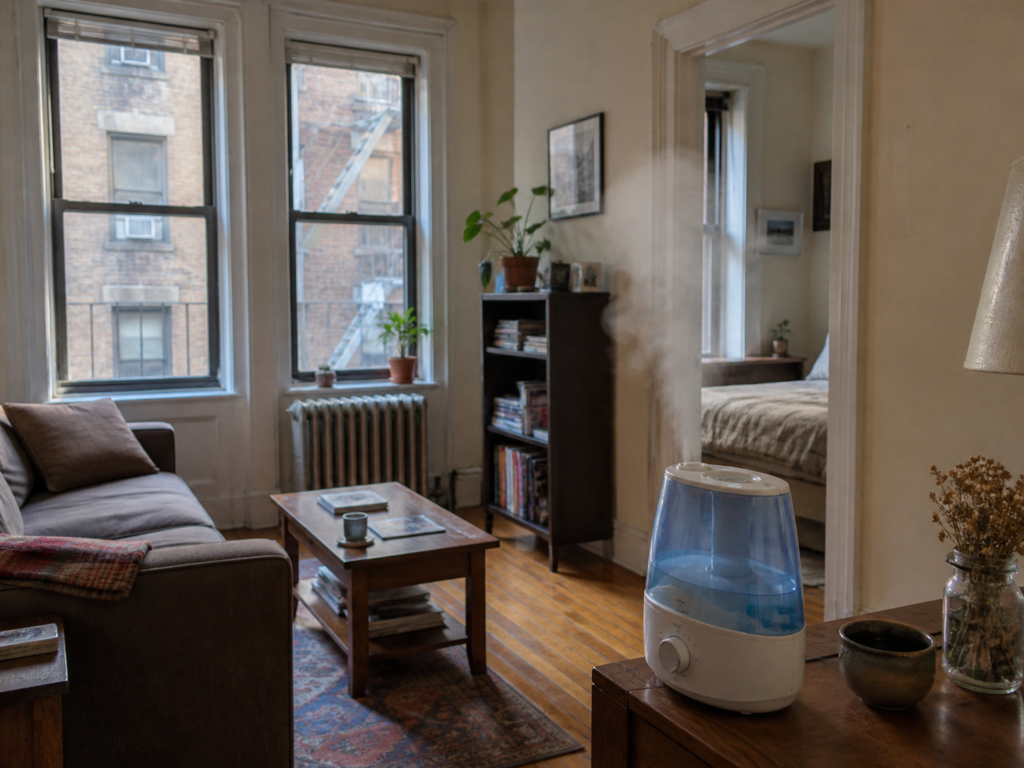
Fast Answer: What Size Humidifier Does an Apartment Need?
Use the square-footage chart to identify an initial category, then check the apartment’s actual humidity and which rooms share air freely. The humidifier size calculator gives a planning estimate, not a guaranteed output for every floor plan. Watch windows and other cold surfaces for condensation as you adjust the unit. Technical references: EPA humidifier care ASHRAE Psychrometrics.
- Bedroom only: Start around the 300–600 sq ft class.
- Small studio or single room: Roughly 500–800 sq ft is a practical starting range.
- Studio or compact one-bedroom: Often 500–1,000 sq ft, depending on how open the layout is.
- Larger open one-bedroom: Consider the 1,000–1,500 sq ft class when the connected area and measured dryness justify it.
- Closed bedrooms: Treat them as separate zones rather than assuming one large living-room unit will handle everything.
Before buying, check the apartment with a humidity meter. If readings are already in a reasonable range, adding more moisture may create a new problem instead of solving one.
Apartment Humidifier Size Chart
Use this chart as a starting point. Then adjust for layout, ceiling height, measured humidity, heating operation, and whether doors stay open or closed.
| Area you want to humidify | Typical starting rating | Best fit |
|---|---|---|
| Bedroom only | 300–600 sq ft | Small-room humidifier |
| Small studio or one room | 500–800 sq ft | Compact portable humidifier |
| Studio or small one-bedroom | 500–1,000 sq ft | Medium portable humidifier |
| Larger one-bedroom or open living area | 1,000–1,500 sq ft | Larger portable humidifier |
| Large open apartment, loft, or high ceilings | 1,500 sq ft or more | Higher-output portable unit or more than one room-specific unit |
For a broader comparison outside apartment layouts, use the Humidifier Size Chart by Square Footage or enter the actual connected area into the Humidifier Size Calculator.
Size the Room, Not the Lease
The biggest apartment sizing mistake is buying for the full apartment when the real dry-air problem is concentrated in one room.
| Situation | How to size it |
|---|---|
| You only sleep in a dry bedroom | Size for the bedroom, not the whole apartment. |
| You work in one dry room during the day | Size for that room and nearby connected space. |
| You have an open studio | Size for the full open area. |
| You want the living room, kitchen, and hallway covered | Measure the connected area where air can actually circulate. |
| You have bedrooms with closed doors | Expect each closed room to behave like a separate zone. |
A humidifier sitting in the living room will not reliably fix a dry bedroom behind a closed door. In a divided apartment, two appropriately sized room units may make more sense than one oversized unit trying to push moisture around corners and through closed doors.
Do not oversize blindly. During cold weather, too much humidification can create wet windows, damp frames, or moisture on cold exterior surfaces. The target is controlled humidity, not maximum mist output.
How Apartment Layout Changes the Answer
Apartments look simple on a floor plan, but moisture does not spread evenly through every doorway and hallway.
| Apartment layout | What it means for sizing |
|---|---|
| Open studio | One properly sized unit usually makes sense. |
| One-bedroom with open living area | One unit may handle the main area but have little effect inside a closed bedroom. |
| Long hallway apartment | Humidity may not travel effectively from one end to the other. |
| Loft or high ceilings | More air volume may justify moving up one capacity tier. |
| Apartment with closed bedrooms | Use room-by-room sizing or separate smaller units where needed. |
Already Know the Size? Move to the Product Decision
This page is for deciding how much apartment you actually need to humidify. Once you know whether you are treating a closed bedroom, studio, open one-bedroom, or larger connected area, use our apartment buying guide to compare the current product choices for those layouts.
When a 500–1,000 Sq Ft Humidifier Is Enough
The 500–1,000 sq ft class is a common starting point for a studio, compact one-bedroom layout, or connected living area. A smaller bedroom may need less.
This range makes the most sense when:
- The apartment or treated zone is small or moderately open.
- You mainly need one bedroom, office, studio, or living area humidified.
- Ceilings are close to normal height.
- Indoor humidity is low but not extreme.
- The unit can maintain the target range without running at full output continuously.
If your actual treated area is around 500 square feet, see the Humidifier for 500 Square Feet guide for more specific sizing judgment.
When to Step Up to 1,000–1,500 Sq Ft
A larger portable humidifier may make sense when the apartment has more connected space, higher ceilings, or consistently low measured humidity during the heating season.
Consider moving up one size when:
- A correctly placed smaller unit runs continuously but humidity remains low.
- The apartment has a genuinely open layout.
- Ceilings are higher than about 8 feet.
- The space includes an open loft.
- Indoor humidity repeatedly remains below about 30%.
- The heating system and outside-air leakage create a substantial winter moisture load.
Moving up one class is reasonable when the measurements support it. Jumping several classes larger usually is not. If your connected area is near 1,000 square feet, use the Humidifier for 1,000 Square Feet guide before making the jump.

Apartment Humidifier Size by Room Type
If you are unsure whether to humidify the entire apartment or only one room, start with the occupied area that repeatedly measures dry.
| Room or area | Practical sizing direction |
|---|---|
| Bedroom | Use a smaller quiet unit sized for the bedroom itself. |
| Living room | Include connected open space where air moves freely. |
| Open studio | Size for the full studio area. |
| Bedroom plus hallway | Only include both when doors remain open and air circulates between them. |
| Whole apartment | Whole-apartment sizing works best when the layout is genuinely open. |
For a divided one-bedroom layout, see Humidifier for a One-Bedroom Apartment.
Portable vs Whole-House Humidifiers in Apartments
Most renters should plan on using portable equipment. Whole-house humidifiers normally require access to the HVAC system, water supply, drainage, and equipment the renter does not own.
| Option | Apartment fit |
|---|---|
| Portable room humidifier | Best fit for bedrooms, studios, and most rented apartments. |
| Large portable console humidifier | Can fit larger open apartments but requires more floor space, water, and cleaning. |
| Whole-house humidifier | Usually impractical unless you own and can modify the HVAC equipment. |
| Multiple smaller units | Often more effective for divided apartments with closed rooms. |
For the broader equipment comparison, see Portable vs Whole-House Humidifier.
Measure Before You Buy
Comfort alone is a poor sizing instrument. Temperature, heating operation, drafts, and air movement can all make a room feel dry.
Measure the Zone You Plan to Treat
Place a humidity meter in the room or open area where the humidifier will operate. Keep it away from the humidifier itself, windows, exterior doors, heating vents, and direct sunlight.
Check morning and evening readings for several days. If readings repeatedly fall below about 30% during heating season, humidification may be reasonable. If the apartment is already in a moderate range, adding a larger humidifier is unlikely to improve the situation.
Use How to Measure Humidity in Your Home for the complete measurement and placement method.
What to Check Before Choosing a Model
Once the size class is clear, apartment use comes down to practical details. A humidifier that is awkward to fill, difficult to clean, or annoying beside the bed often stops getting used.
- Tank size and expected refill frequency
- Adjustable output or automatic humidity control
- Ease of cleaning
- Noise level for bedroom use
- Night mode or dim controls
- Filter or cartridge cost, when applicable
- Safe placement away from electronics, bedding, walls, and furniture
- Enough control to avoid overshooting the target humidity
Ready to Choose the Humidifier?
Once you know which room or connected zone you are treating, the next decision is the actual equipment. Our small-apartment buying guide compares current choices for a closed bedroom, studio or open living area, and larger open apartment or loft.
When the Humidifier Is Too Big
Apartment humidifiers can be oversized. That matters most during cold weather, when windows, frames, and exterior walls may be much colder than the room air.
Signs that the humidifier may be too large or set too high include:
- Water forming on windows
- Damp window frames
- A clammy feeling instead of comfortable air
- Humidity remaining above the intended range
- Musty odor near curtains, closets, or exterior walls
If that happens, lower the output, reduce runtime, improve placement, or move down a size class. See What Happens If a Humidifier Is Too Large? for the full oversized-unit guidance.
Size the Apartment Zone You Can Actually Humidify
For most apartments, size the humidifier for the room or connected zone you actually want to treat.
A closed bedroom may only need the 300–600 sq ft class. Studios and compact connected spaces often fall somewhere around 500–1,000 sq ft. Larger open one-bedroom apartments, lofts, and high-ceiling spaces may justify moving toward the 1,000–1,500 sq ft class when measurements show the additional output is needed.
Measure first, account for doors and layout, and avoid chasing the largest coverage number. Once the size class is clear, move to the Best Humidifier for a Small Apartment guide for the actual product decision.