
A one-bedroom apartment usually should not be treated as one simple square-footage number. The important question is whether the bedroom and living area behave like one connected zone or two separate rooms.
If the bedroom door stays closed overnight, a humidifier in the living room may do very little for the bedroom. If the apartment is open and air moves freely between the rooms, one medium portable humidifier may be enough.
Measure both areas before buying. Then choose the smallest practical setup that can maintain moderate humidity without creating wet windows or damp surfaces.
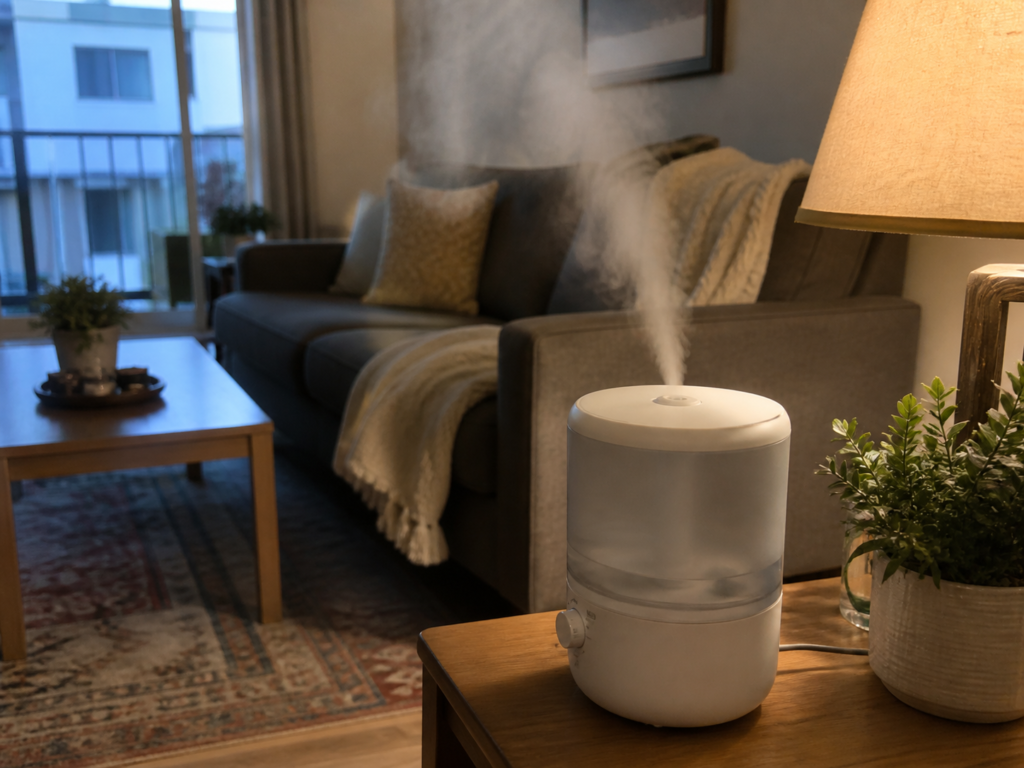
Quick Answer: Humidifier Size for a One-Bedroom Apartment
A bedroom behind a closed door may need a different approach from a connected living area. Measure each occupied zone rather than assuming one apartment-wide number applies everywhere. The humidifier size calculator provides an initial capacity category; verify it against room readings and condensation after use. Technical references: EPA humidifier care ASHRAE Psychrometrics.
- Only the bedroom is dry: Use a small-room humidifier sized for the bedroom.
- Bedroom door stays closed: Treat the bedroom and living area as separate humidity zones.
- Open one-bedroom layout: A medium portable humidifier with automatic humidity control is usually the better starting class.
- Large or high-ceiling one-bedroom: Measure performance before moving to a higher-output class.
- Do not size from lease square footage alone: Size the area where moisture can actually circulate.
The Bedroom Door Changes the Answer
A typical one-bedroom apartment has at least two distinct spaces: the bedroom and the main living area. Whether those spaces can share one humidifier depends heavily on airflow between them.
| Apartment situation | Better humidifier strategy |
|---|---|
| Bedroom door closed most of the night | Treat the bedroom as its own zone. |
| Bedroom door usually open | One unit may serve a larger connected area if measurements confirm it. |
| Living room is normal but bedroom is dry | Use a bedroom-sized unit rather than humidifying the entire apartment. |
| Bedroom and living room are both consistently dry | Consider a medium unit in an open central area or separate room units if doors remain closed. |
| Large open layout or high ceilings | Measure the connected area and actual RH before increasing capacity. |
This is why two apartments with the same listed square footage can need different equipment. An open 700-square-foot apartment may behave more like one room. A divided 700-square-foot apartment may behave like two separate spaces.
Measure the Bedroom and Living Area Separately
Put a humidity meter in the bedroom and another in the main living area, or move the same meter between the two spaces over several days. Check readings in the morning and evening and during normal heating operation.
Keep the meter away from the humidifier, exterior doors, windows, heating vents, and direct sunlight. You are looking for the normal room pattern, not the reading from the wettest or driest spot you can find.
For the full method, use How to Measure Humidity in Your Home.
If Only the Bedroom Is Dry
If the bedroom repeatedly measures dry while the living room is already in a reasonable range, treat the bedroom rather than the whole apartment.
This is usually the simplest one-bedroom setup. A compact humidifier takes less space, uses less water, is easier to carry and clean, and gives you better control over the room that actually needs moisture.
| Bedroom priority | What to look for |
|---|---|
| Quiet operation | Consider fan noise, water sounds, button beeps, and vibration. |
| Controlled output | Enough adjustment to prevent a small room from becoming too humid. |
| Easy cleaning | Wide openings and accessible tank and base surfaces. |
| Overnight use | Enough tank capacity for normal nighttime operation. |
| Safe placement | Stable location away from bedding, electronics, walls, and windows. |
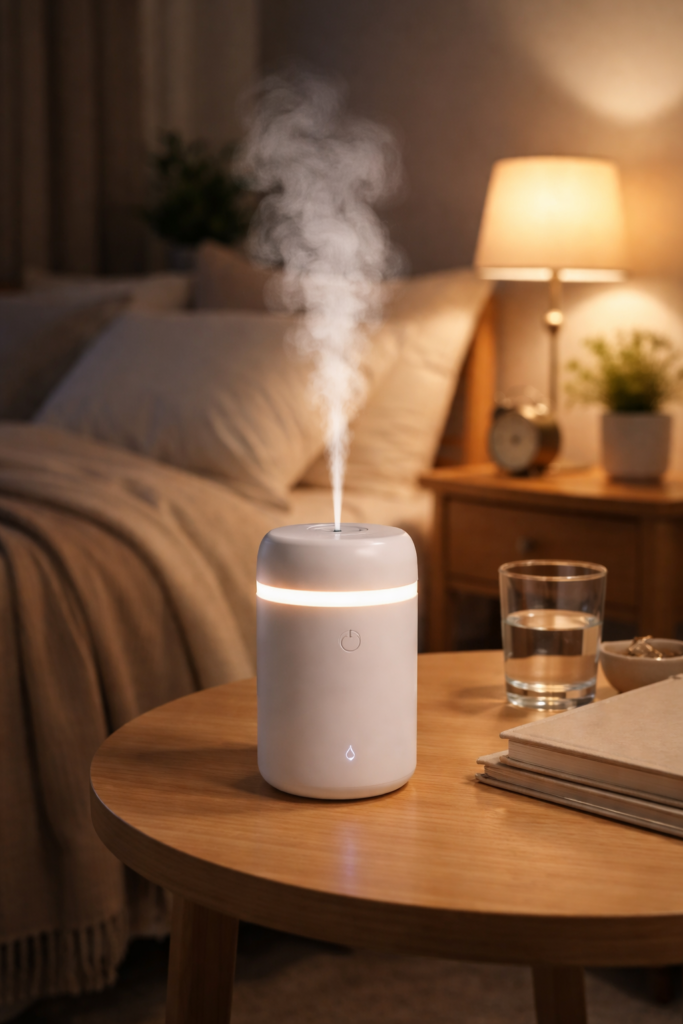
If the Whole One-Bedroom Apartment Is Dry
If both the bedroom and living area repeatedly measure low, look at how connected the apartment actually is.
An open living room, kitchen, hallway, and bedroom with the door normally open may allow one medium portable humidifier to influence most of the space. A divided floor plan with closed doors will not distribute moisture nearly as evenly.
For the actual square-footage calculation, use What Size Humidifier for an Apartment?. That page handles the sizing job. This page is about deciding whether your one-bedroom apartment should be treated as one zone or several.
One Humidifier or Two?
One larger humidifier is not automatically better than two smaller units. The right answer depends on where the dry air actually occurs and whether moisture can travel between the rooms.
| Use one unit when | Consider separate units when |
|---|---|
| The apartment is mostly open. | The bedroom door stays closed overnight. |
| Both areas show similar RH readings. | The bedroom and living room show substantially different readings. |
| Air circulates freely between rooms. | A hallway or closed door separates the dry areas. |
| A correctly placed medium unit maintains the connected zone. | One unit runs continuously but the remote room remains dry. |
Do not buy two humidifiers just because the apartment has two rooms. Start with the measured problem. If one properly sized unit controls the occupied area, the second unit adds water, cleaning, storage, and another appliance to trip over.
Apartment reality check: A bigger humidifier cannot force moisture evenly through closed doors. If one room stays dry while another becomes humid, the problem may be distribution rather than insufficient humidifier capacity.
What Size Class Usually Fits?
Use the room or connected area as the starting point rather than the total apartment size.
| One-bedroom situation | Practical starting class |
|---|---|
| Dry closed bedroom only | Small-room humidifier |
| Open bedroom and nearby living area | Medium portable humidifier |
| Open compact one-bedroom apartment | Medium portable with automatic humidity control |
| Large open one-bedroom or high ceilings | Higher-output portable class only when measurements justify it |
| Separated dry bedroom and dry living area | Consider two correctly sized room units instead of one oversized unit |
For exact size ranges, use the Humidifier Size Chart by Square Footage or the Humidifier Size Calculator.
Which Humidifier Should You Actually Choose?
For a dry closed bedroom, our current apartment guide starts with the compact Levoit Classic 160 class. For an open one-bedroom living area, the Levoit Classic 300S class adds more capacity and automatic humidity control.
The product decision belongs in the main apartment buying guide, where the current models, larger-space option, features, and buying links are kept together.
Automatic Humidity Control Is Useful in a One-Bedroom Apartment
Automatic humidity control becomes more useful as the treated area gets larger. Instead of running at one fixed output until you notice condensation, a humidistat-equipped unit can reduce output as the room approaches its selected range.
That does not eliminate the need to measure the room independently. The humidifier’s sensor sits close to the machine and may not represent the bedroom, far side of the living room, or another room behind a doorway.
A separate humidity meter gives you a better picture of whether the apartment is actually being controlled evenly.
Where to Put the Humidifier
Placement affects how well a humidifier serves a one-bedroom apartment and how likely it is to create moisture problems nearby.
Better placement
- Inside the room that actually measures dry
- On a stable, water-resistant surface
- With open space around the mist outlet
- Away from heating vents and direct sunlight
- Where the tank can be removed and refilled safely
Avoid placing it
- Directly beside a cold window
- Against drywall or furniture
- Where mist lands on bedding
- Beside electronics or paper
- In a hallway simply because it looks central when the dry room is behind a closed door
Watch the Windows
Apartment windows are often the first place excessive winter humidity becomes visible. Cold glass can collect condensation even when the room does not feel particularly humid.
If the windows begin fogging regularly, water collects on the sill, or nearby surfaces become damp, reduce the humidifier output or stop adding moisture until you understand why.
Use Why Are My Windows Wet? if condensation becomes part of the problem.
Do Not Chase the Same RH in Every Room
A one-bedroom apartment does not need perfectly identical readings everywhere. Small differences between the bedroom and living area are normal.
The useful question is whether the occupied rooms remain comfortably within a reasonable range without condensation. Trying to force every room to the exact same number can lead to excessive humidification in the room closest to the machine.
When to Move Up or Stay Smaller
| What you observe | What it means |
|---|---|
| The bedroom reaches a reasonable RH easily | Stay with the smaller bedroom setup. |
| The living area stays dry while a correctly placed unit runs continuously | Check sizing and consider moving up one class. |
| The room nearest the humidifier gets humid but the bedroom stays dry | Distribution is the problem. Do not simply buy a larger unit. |
| Windows begin fogging | Reduce output or move down in capacity. |
| Both bedroom and living area remain dry with doors open | A medium apartment-sized unit may be appropriate. |
| Only one room ever measures dry | Treat that room instead of the entire apartment. |
For the warning signs on either side, see What Happens If a Humidifier Is Too Large? and What Happens If a Humidifier Is Too Small?.
Size the Bedroom and Living Area as One Zone or Two
A one-bedroom apartment is a layout problem before it is a square-footage problem.
If only the bedroom is dry, use a small humidifier in the bedroom. If the apartment is open and both areas measure dry, a medium portable humidifier may serve the connected space. If doors stay closed and the rooms behave differently, treat them as separate zones rather than buying one oversized machine.
Measure the bedroom and living area, decide whether they function as one zone or two, and then use Best Humidifier for a Small Apartment for the current product choices.