
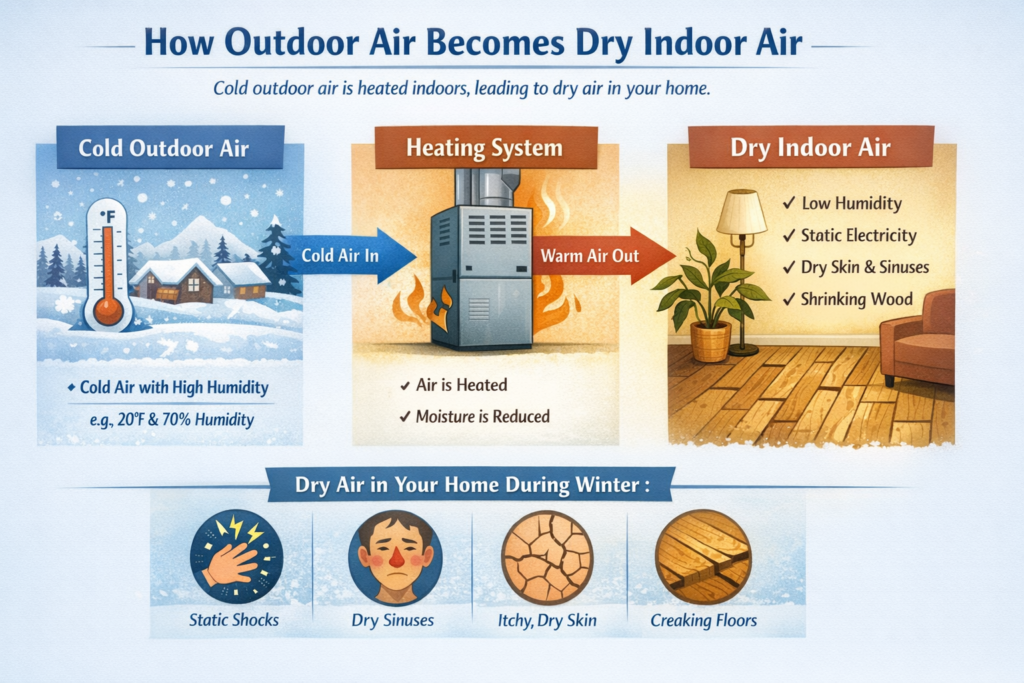
Dry air in a house usually happens when cold outdoor air gets inside, is warmed by the heating system, and ends up with a much lower relative humidity. The furnace often gets blamed, but the bigger issue is usually cold air, air leakage, long heating run time, and low indoor moisture working together.
This is why dry air is usually worse in winter. The house may be a normal 68°F to 72°F and still feel dry because the air itself is carrying very little moisture.
Why Indoor Air Gets Dry: Heating, Outdoor Air, and Leakage
Cold outdoor air often contains less water vapor than warm indoor air. When that air enters a house and is heated, its relative humidity can fall even though the water vapor has not been deliberately removed. Before increasing humidification, measure RH and consider condensation on the home’s coldest surfaces. Technical references: ASHRAE Psychrometrics EPA moisture and mold.
The most common cause of dry indoor air is cold outdoor air entering the home and being heated. Warm air can hold more moisture than cold air, so when cold air comes indoors and warms up without gaining moisture, the relative humidity drops.
That dry-air pattern is usually stronger when the weather is cold, the heating system runs often, the house has drafts or air leaks, or there are not many indoor moisture sources such as cooking, showers, people, pets, or plants.
What dry air actually means
Dry air is not just air that feels uncomfortable. It usually means the relative humidity in the room is low enough that the air pulls moisture from people, wood, fabric, and surfaces more easily.
In a home, dry air often shows up as static shocks, dry-feeling rooms, shrinking wood trim, gaps in flooring, dry furniture, or a house that feels harsher than the thermostat suggests. Those clues matter, but they are still clues. A humidity meter gives you the actual number.
Measure before blaming the house
If the indoor humidity stays below about 30% RH, dry air is probably part of the problem. If the reading is closer to 35% to 45%, the room may feel bad because of drafts, uneven heat, airflow, or cold surfaces instead of truly low humidity.
Common reasons indoor air gets dry
Dry air usually does not come from one cause. In most homes, several small conditions stack together until the house starts to feel dry.
| Cause | What happens | What to check |
|---|---|---|
| Cold outdoor air | Cold air starts with less moisture than warm air. | Dryness that gets worse during cold weather. |
| Heating run time | Heating warms the air but usually does not add moisture. | Long furnace, heat pump, or baseboard heating cycles. |
| Air leaks and drafts | Dry outdoor air keeps replacing indoor air. | Windows, doors, attic gaps, basement rim joists, and fireplace areas. |
| Exhaust fans and dryers | Indoor air is pushed outside and replaced by outdoor air. | Bath fans, range hoods, clothes dryers, and vented appliances. |
| Low indoor moisture | The house does not add much moisture back into the air. | Few occupants, little cooking, short showers, low plant count, or strong ventilation. |
| Room-specific airflow | One room may dry out faster than the rest of the house. | Closed doors, strong supply vents, poor return airflow, or rooms over garages. |
If every room is dry, think whole-house pattern. If one bedroom or office feels dry, compare that room against the hallway or another room before assuming the entire home needs more humidity.
If the problem is strongest after the bedroom door closes at night, see Bedroom Air Too Dry at Night.
Cold outdoor air and heating
Cold outdoor air naturally holds less moisture than warm air. When that air leaks into the house and gets heated, the amount of moisture in the air may not change much, but the relative humidity drops because the warmer air could hold more moisture.
That is why a house can feel dry even when the heating system is working normally. The heat is not usually “burning off” moisture. It is warming air that already came in with very little moisture to begin with.
Heating systems running for long periods
Furnaces, heat pumps, baseboard heaters, and space heaters all warm the air. Most of them do not add moisture while doing it.
During a cold snap, the heating system runs longer and the house exchanges more air with the outdoors. The result can be a slow drop in indoor humidity over several days. That is when static shocks, dry wood, and dry-feeling rooms tend to become more obvious.
Air leaks and drafts
Air leaks do not have to feel dramatic to matter. Small gaps around windows, doors, attic penetrations, basement edges, and exterior walls can keep feeding the house with cold outdoor air.
Once that air enters the house and warms up, it can lower indoor relative humidity. A drafty house can feel dry even if the heating system is not doing anything unusual.
Do not add humidity blindly
Adding moisture can help when the house is truly dry, but too much humidity during cold weather can create window condensation and damp cold-surface problems.
If your windows are already wet, do not treat the house like a simple dry-air problem. That is a moisture and surface-temperature problem first.
Low natural moisture inside the home
Some homes simply do not add much moisture back into the air. That does not mean anything is wrong. It just means the home has fewer everyday moisture sources to offset the dry air coming in from outside.
Indoor moisture tends to be lower when:
- Fewer people live in the home.
- Cooking is minimal.
- Showers are short or strongly ventilated.
- There are few houseplants.
- Bath fans, range hoods, or dryers run often.
That is why two similar houses in the same neighborhood can feel different in winter. The building matters, but how the house is used matters too.
Ventilation and exhaust fans
Bathroom fans, kitchen range hoods, clothes dryers, and fireplaces all remove indoor air. When that air leaves, replacement air has to come from somewhere.
In winter, the replacement air is often cold and dry. Once it enters and warms up, indoor relative humidity can fall. Ventilation is still necessary, but heavy exhaust use can make dry-air symptoms more noticeable during cold weather.
Home design and construction
Older homes may feel dry because they leak more outdoor air. Newer homes may still feel dry because they are heated for long stretches during cold weather and may use mechanical ventilation.
Dry air is not always a defect. Sometimes it is just the seasonal behavior of a house that is being heated through a long cold spell. The practical question is not whether the house is perfect. The question is whether the indoor humidity reading is low enough to justify action.
Weather patterns and climate
Regional climate affects how often dry air shows up. Homes in cold or naturally dry areas usually deal with winter dryness more often than homes in warm, humid regions.
Short-term weather matters too. A week of cold, dry outdoor air can make a house feel different from one week to the next, even if nothing inside the home changed.
When a humidifier makes sense
A humidifier makes sense when the indoor RH reading confirms low humidity and the problem is not mainly a draft, cold window, airflow issue, or condensation problem.
Use this as the basic decision path:
| What you find | What it probably means | Next step |
|---|---|---|
| Whole house stays below 30% RH | Dry air is likely real. | Consider humidifier sizing after checking drafts and condensation risk. |
| One room is dry but other rooms are normal | Room airflow, drafts, or temperature may be the issue. | Measure that room and compare it with nearby rooms. |
| House feels dry but RH is 35% to 45% | The discomfort may not be a humidity problem. | Check airflow, drafts, and room temperature. |
| Windows are wet during cold weather | The house may already have enough moisture for those cold surfaces. | Do not add humidity until condensation is understood. |
Next step
If your humidity readings are low across the house, move from cause-finding to humidifier sizing. If you have not measured yet, start there first. Guessing is how people end up with the wrong humidifier, wet windows, or a machine that helps one room while ignoring the actual problem.
FAQ
Does a furnace cause dry air?
A furnace can make dry air more noticeable, but it usually is not the only cause. The main issue is often cold outdoor air entering the home, getting heated, and ending up with low relative humidity.
Why is my house dry in winter?
Winter air starts with less moisture. When that air comes indoors and gets warmed, the relative humidity drops. Air leaks, long heating cycles, and exhaust fans can make the pattern stronger.
Can a house be dry even if it feels warm?
Yes. Temperature and humidity are different. A house can be warm and still have low relative humidity, especially during cold weather.
What indoor humidity level is too dry?
Indoor air is usually considered dry when it stays below about 30% RH. Readings between 30% and 40% can be normal in winter, but the right target also depends on windows, outdoor temperature, and condensation risk.
Should I buy a humidifier if my house feels dry?
Measure first. A humidifier may help if the humidity is actually low, but it will not fix drafts, leaky windows, poor airflow, or uneven room temperatures by itself.