
Quick answer: A humidifier for 2,500 square feet is not just a bigger small-room humidifier. One high-capacity portable unit can work if the space is open, connected, and mostly one zone. If the home is divided by floors, bedrooms, hallways, closed doors, or a stairwell, multiple units or a whole-house humidifier may make more sense.
A humidifier for 2,500 square feet sits near the edge of what most portable humidifiers can realistically handle.
That does not mean a portable humidifier cannot work. It can. But at this size, the printed coverage number is only part of the answer. The bigger question is whether moisture can actually reach the dry areas you care about.
An open 2,500 sq ft main level is one problem. A two-story 2,500 sq ft home with bedrooms, hallways, closed doors, and a stairwell is a different problem.
The 2,500 sq ft question is really about distribution
By the time you are trying to humidify 2,500 square feet, the better question is not only “what size humidifier do I need?”
The better question is: can one humidifier actually reach the dry areas?
A portable humidifier adds moisture from one location. It does not automatically distribute that moisture through every bedroom, hallway, floor, or distant room. If the air moves freely, one large unit may raise humidity across a wide area. If the home is divided, the room near the humidifier may improve while bedrooms or upstairs rooms stay dry.
Simple rule: If the space is open and connected, one large unit may work. If the space is divided and uneven, think in zones before buying a larger humidifier.
One large unit vs multiple units vs whole-house
For 2,500 square feet, there are usually three realistic paths.
| Setup | Best fit | Main drawback |
|---|---|---|
| One high-capacity portable humidifier | Open main level, loft, large apartment, or connected living area | Weak distribution in divided homes |
| One large unit plus smaller room units | Main zone plus dry bedrooms, offices, nursery, or upstairs rooms | More tanks, cleaning, filters, and noise |
| Whole-house humidifier | Most rooms are dry and the home has forced-air heat | Requires HVAC installation, maintenance, and humidity monitoring |
The wrong move is buying the biggest portable humidifier available and expecting it to act like ductwork. Portable units can help, but they still work from one location.
When one large portable humidifier can work
One large portable humidifier can make sense when the dry area behaves like one connected zone.
- The dry area is mostly open.
- The space is mostly one level.
- Doors usually stay open.
- Air moves naturally through the main zone.
- Dry-air complaints are concentrated in the same area.
- The humidifier can sit near the center of the problem zone.
- You are willing to refill and clean a large portable unit.
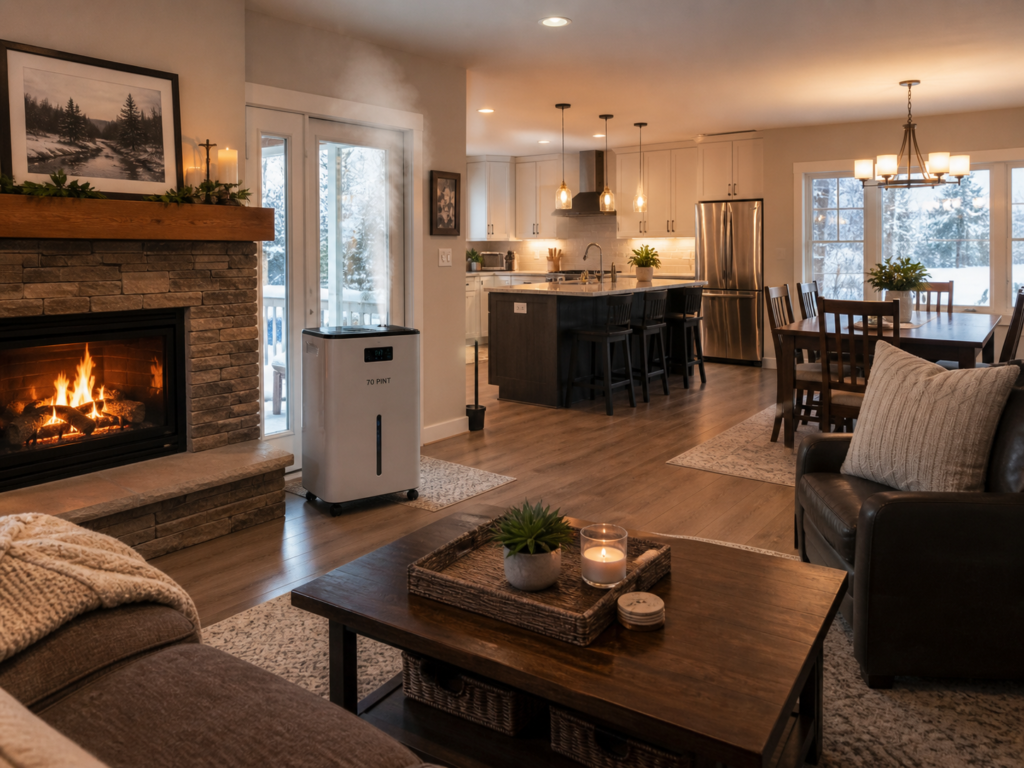
Good examples include a large open main level, open apartment, loft-style space, finished basement family area, or one large connected living zone.
In that layout, a portable humidifier rated around 2,500–3,000 sq ft may be a practical starting point. For a smaller large-zone comparison, see humidifier for 2000 square feet.
When one unit becomes wishful thinking
A 2,500 sq ft rating can be misleading in a divided home. The humidifier may have enough output on paper, but output is only part of the problem. The moisture still has to move.
One large portable humidifier becomes less realistic when the home has:
- Multiple floors.
- Closed bedrooms.
- Long hallways.
- Split-level rooms.
- A stairwell that pulls air away from the main area.
- Dry rooms far from the humidifier.
Warning sign: If the room near the humidifier gets comfortable but bedrooms, upstairs rooms, or distant rooms stay dry, the problem is probably distribution. A larger unit may over-humidify the nearby area without fixing the dry rooms.
For related sizing symptoms, see what happens if a humidifier is too small and what happens if a humidifier is too large.
Multiple smaller units may be the better answer
At 2,500 square feet, multiple smaller humidifiers often make more sense than one oversized portable unit.
That does not mean putting a humidifier in every room. It means treating the home by actual dry zones.
| Dry-air problem | Better strategy |
|---|---|
| Open main living area is dry | One large portable unit |
| Bedrooms stay dry with doors closed | Add smaller bedroom units |
| Upstairs stays dry while downstairs improves | Add an upstairs unit or compare whole-house |
| Finished basement is dry separately | Treat the basement as its own zone |
| Most of the home is dry | Compare multi-unit setup with whole-house humidification |
| One room gets damp while others stay dry | Stop sizing up and rethink distribution |
The tradeoff is maintenance. Multiple units mean more tanks to fill, more cleaning, more filters, more noise, and more places where humidity can drift too high. That does not make multiple units wrong. It means they need to be used deliberately.
For zone planning, compare humidifier for 500 square feet, humidifier for 1000 square feet, and what size humidifier for an apartment.
When whole-house humidification becomes cleaner
At 2,500 square feet, a whole-house humidifier becomes a serious comparison point, especially if most rooms are dry and the home has central forced-air heat.
A whole-house humidifier uses the HVAC system to distribute moisture through ductwork. That does not make it maintenance-free. It still needs proper setup, water supply, pad or media replacement depending on type, and careful humidity control in cold weather.
But it solves one problem portable units do not solve well: distribution.
| Consider whole-house when | Stay portable when |
|---|---|
| Most rooms are dry | Only one large zone is dry |
| You have central forced-air heat | You rent or do not want HVAC installation |
| You are tired of filling tanks | You want seasonal or room-specific control |
| Bedrooms, hallways, and main areas all need help | Dryness is limited to a bedroom, office, or main room |
| You can maintain and monitor the system | You want simpler equipment with no HVAC work |
For that decision, see portable vs whole-house humidifier.
Ceiling height and stairwells change the answer
Most humidifier ratings assume normal ceiling height and reasonable conditions. A 2,500 sq ft home with 8-foot ceilings is not the same as a 2,500 sq ft home with vaulted ceilings, a two-story living room, or an open stairwell.
Higher ceilings mean more air volume. Open stairwells can also create uneven results. A humidifier on the main level may lose moisture upward while still failing to fix bedrooms or distant rooms.
Size up when: the space is open, connected, has high ceilings, and measured humidity stays low after normal runtime.
Split the space when: one area improves but bedrooms, upstairs rooms, offices, or distant rooms stay dry.
Measure before buying bigger
At this size, guessing gets expensive. Use at least two humidity meters before deciding whether you need one large unit, multiple units, or a whole-house option.
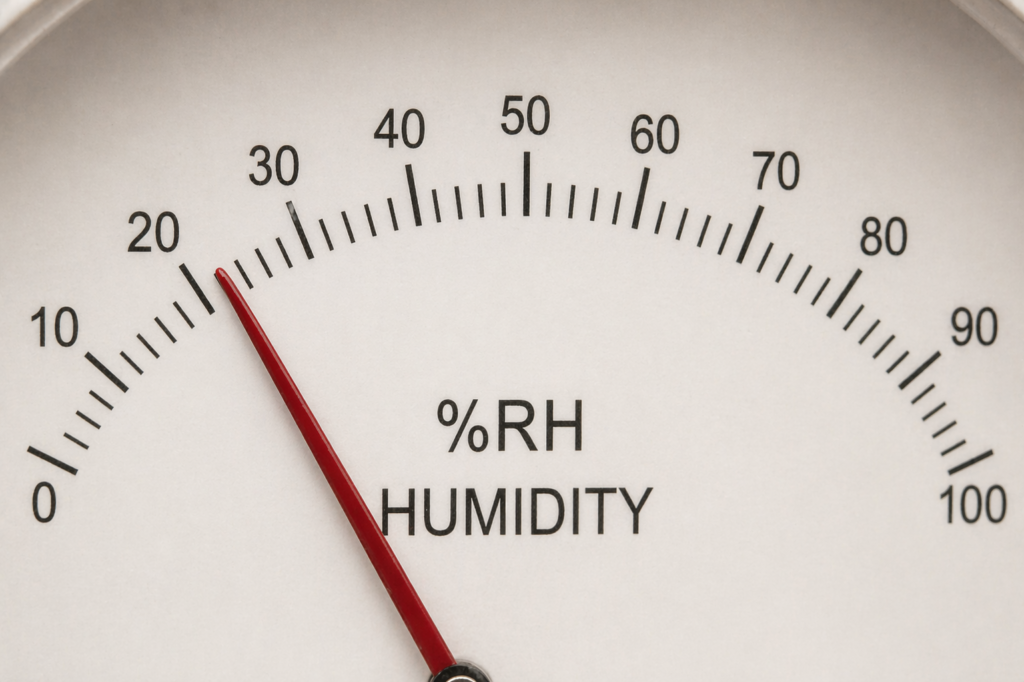
Put one meter near the main dry area and another in a distant room or bedroom. If the main area is at 38% RH and the bedroom is at 25% RH, the house may not have an overall capacity problem. It may have a distribution problem.
| Indoor RH reading | What it usually means |
|---|---|
| Below 25% | Very dry. Expect serious runtime or multi-zone planning. |
| 25–30% | Dry enough that humidification may be reasonable. |
| 30–40% | Often a practical winter comfort range. |
| 40–50% | Usually enough. Watch windows in cold weather. |
| Above 50% | Be careful. Do not add more moisture without a clear reason. |
For measurement basics, use how to measure humidity in your home. For broader dry-air diagnosis, see air that’s too dry at home.
Disclosure: This page may include affiliate links. If you buy through those links, HumidityAtHome may earn a small commission at no extra cost to you.
Product path: high-capacity portable humidifier
For a true open 2,500 sq ft zone, look for a high-capacity portable humidifier rated around 2,500–3,000 square feet. At this size, do not shop only by the coverage number. A unit that technically covers the space but needs constant refilling may not be practical.
Product Path: High-Capacity Portable Humidifiers
Use this for one open, connected dry zone around 2,500 square feet. Look for large tank capacity, adjustable humidistat, long runtime between refills, easy filling, easy cleaning access, filter availability if evaporative, reasonable noise level, stable floor placement, auto shutoff, and controls that help avoid over-humidifying.
Practical recommendation
For 2,500 square feet, do not start by assuming one portable humidifier will fix the entire home. Start by identifying the dry zones.
If the home is open, mostly one level, and air moves well, a high-capacity portable humidifier rated around 2,500–3,000 sq ft may be a reasonable first step.
If the home is divided, multi-level, or dry in several separated rooms, compare three options before buying: one large portable humidifier for the main open area, one large unit plus smaller room units, or a whole-house humidifier if the home has forced-air heating.
Bottom line
A humidifier for 2,500 square feet is not just a bigger version of a 1,000 sq ft or 1,500 sq ft humidifier. At this size, layout becomes the decision.
One large portable humidifier can work in an open, connected space. It can disappoint in a divided home where bedrooms, upstairs rooms, or distant areas do not share airflow with the main zone.
Measure first. Check more than one room. Watch for condensation. Size the real dry zones, not just the total square footage.
Related next steps:
- What size humidifier do I need for my home?
- Humidifier size calculator
- Humidifier size chart by square footage
- How to measure humidity in your home
- Humidifier for 2000 square feet
- Humidifier for 3000 square feet
- What happens if a humidifier is too small?
- What happens if a humidifier is too large?
- Portable vs whole-house humidifier
Last reviewed: PH4 July 3, 2026.