
A finished basement usually needs more dehumidifier than the square footage alone suggests. Carpet, drywall, furniture, closets, and closed rooms can hide moisture before the space feels obviously damp.
For most finished basements, start in the 40 to 50 pint range. Move toward 50 to 70 pints if the basement is larger, carpeted, divided into rooms, smells musty, or stays above 55% to 60% relative humidity.
What Size Dehumidifier Does a Finished Basement Need?
In a finished basement, damp finishes can conceal water entering behind walls or below flooring. Check for seepage, plumbing issues, and drainage problems before treating a persistent dampness problem as an appliance-sizing question. A dehumidifier may reduce airborne moisture, but it does not confirm concealed materials are dry. Technical references: UMN basement moisture EPA moisture and mold.
A small finished basement with mild humidity may only need a 30 to 40 pint dehumidifier. A typical finished basement usually starts around 40 to 50 pints. A large, carpeted, musty, divided, or regularly damp finished basement should usually be sized closer to 50 to 70 pints.
If you do not know the actual humidity, measure it first. A finished basement that looks clean but sits above 55% RH is not as dry as it looks.
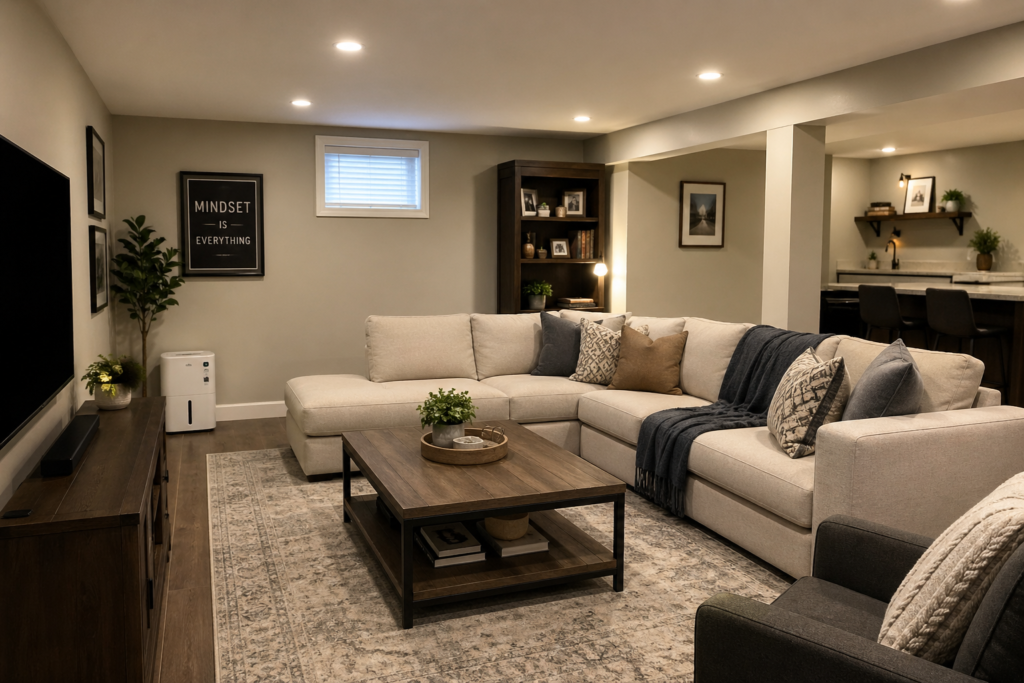
Finished basement dehumidifier size chart
Use this table as a starting point. Then adjust up if the basement is below grade, carpeted, musty, divided into rooms, or regularly above 55% RH.
| Finished basement condition | Typical size range | Use this when |
|---|---|---|
| Small, open, mildly humid finished space | 30 to 40 pints | The space is under about 800 sq ft, air moves freely, and RH only rises slightly during humid weather. |
| Typical finished basement | 40 to 50 pints | The basement is roughly 800 to 1,500 sq ft, has regular dampness, or needs steady seasonal control. |
| Large, carpeted, or divided finished basement | 50 to 70 pints | The basement is over about 1,500 sq ft, has rooms or closed doors, or contains carpet, furniture, storage, or soft goods. |
| Musty or above 60% RH | 50 to 70 pints | The basement smells musty, feels clammy, fills buckets quickly, or stays above 60% RH for long stretches. |
| Water intrusion or active leaks | Fix water first | A dehumidifier can help control air moisture, but it is not a repair for seepage, plumbing leaks, or standing water. |
If your basement falls between two rows, choose based on dampness, not ego. A slightly stronger unit is usually less annoying than one that runs constantly and still leaves the carpet smelling like a lake house with commitment issues.
Measure before choosing the final size
Finished basements are good at hiding moisture. Check the RH in the main finished area, near exterior walls, near the basement bathroom if there is one, and inside rooms that stay closed.
If readings stay near 50% RH, you may only need moderate capacity. If the basement sits above 55% or climbs above 60%, size up and look for moisture sources, airflow problems, drainage issues, or a unit that can run continuously without relying only on a bucket.
Why finished basements need extra caution
An unfinished basement usually tells on itself. You can see concrete, exposed walls, water marks, damp corners, or cold surfaces.
A finished basement is quieter about the same problem. Carpet can hold odors. Drywall can hide moisture. Upholstered furniture can absorb mustiness. Closets and side rooms can stay humid while the main room feels normal.
That changes the sizing decision. You are not only trying to make the basement feel better. You are trying to keep finished materials from sitting in damp air for weeks at a time.
| Finished basement feature | Why it changes sizing | What to do |
|---|---|---|
| Carpet or rugs | Soft materials hold odor and moisture longer than bare concrete. | Move toward the higher end of the size range. |
| Drywall and trim | Finished surfaces can hide dampness until odors or swelling show up. | Keep RH stable instead of reacting only after the room smells musty. |
| Closed rooms | One unit may dry the main room while side rooms stay damp. | Open doors, improve airflow, or consider a second smaller unit. |
| Basement bathroom | Showers and poor exhaust add moisture below grade. | Measure near the bathroom and use the fan long enough after showers. |
| Storage areas | Boxes, clothes, and soft goods can trap musty smells. | Keep air moving and avoid stuffing storage against exterior walls. |
When to size up
Square footage is only the starting point. A finished basement should be sized up sooner when the moisture load is steady, the layout is divided, or the room contains materials you do not want sitting in damp air.
- Choose the higher end if RH stays above 55%.
- Size up if readings reach 60% or higher for long periods.
- Size up if the basement smells musty after rain or humid weather.
- Size up if the space is carpeted, furnished, or used as regular living space.
- Size up if the basement is divided into bedrooms, offices, storage rooms, or closed-off areas.
- Size up if a smaller unit runs constantly and the RH still does not drop.
In a finished basement, being slightly undersized is usually the bigger mistake. The room may look normal while the unit is quietly losing the fight.
When a smaller dehumidifier may be enough
Do not automatically jump to the largest unit. A smaller dehumidifier may be fine when the basement is open, lightly finished, mildly humid, and already close to the target humidity range.
- The finished area is small and open.
- Humidity only rises during short seasonal periods.
- RH usually stays near 50%.
- There is no musty smell, damp carpet, or repeated bucket-filling problem.
- The unit can be placed where air moves through the space.
The point is not to buy the biggest machine you can tolerate. The point is to choose enough capacity to keep the finished space stable without making the basement unpleasant to use.
A dehumidifier will not fix water intrusion
If the finished basement has active leaks, seepage, wet carpet after storms, plumbing leaks, standing water, or drainage problems outside the foundation, deal with the water source first.
A dehumidifier can control moisture in the air. It cannot make a wet wall, failed drain, roof runoff problem, or plumbing leak behave itself. The house still gets a vote.
Placement matters in a finished basement
A good dehumidifier can still perform poorly if it is trapped in the wrong spot. Finished basements often fail by air distribution, not just capacity.
Place the unit where it can pull air from the finished area and push dry air back into the space. Avoid burying it in a closed utility room unless that room is the actual moisture source and air can move between areas.
Watch these problem spots:
- Behind couches
- Inside closets
- Near exterior walls
- Around basement bathrooms
- In rooms with closed doors
- Near storage boxes, rugs, or upholstered furniture
If one room stays humid while the main area improves, you may need better airflow, open doors, a small fan, or a second unit instead of one larger machine in the wrong location.
Plan the drainage before you buy
A finished basement dehumidifier may remove a lot of water during humid weather. Bucket-only operation can work, but it gets old quickly if the bucket fills every day.
More important, a full bucket stops the unit. A stopped dehumidifier is just a plastic appliance quietly judging you from the corner.
| Drainage setup | Best fit | Watch out for |
|---|---|---|
| Bucket only | Small or mildly humid finished spaces | The unit stops when full, so daily emptying may become the weak point. |
| Gravity drain hose | Basements with a nearby floor drain | The hose needs a steady downward path. |
| Built-in pump | Basements where water must go up to a sink, standpipe, or drain line | More convenient, but more parts to maintain. |
| Continuous drain setup | Finished basements needing steady seasonal control | Still needs periodic hose, filter, and bucket area checks. |
For a finished basement, drainage convenience is not a luxury feature. It is part of whether the unit actually runs enough to protect the space.
Product paths for finished basements
Disclosure: This page may include affiliate links. If you buy through those links, HumidityAtHome may earn a small commission at no extra cost to you.
Use these product paths after you have checked the basement size, layout, humidity level, and drainage options. Finished basements are not a place for random category dumping.
Product Path: 30 to 40 pint dehumidifiers
Use this range for a small, open finished basement with mild humidity and no musty smell. Look for a built-in humidistat, easy filter access, auto-restart, and a drain hose option if you plan to run it regularly.
Product Path: 40 to 50 pint dehumidifiers
Use this range for many finished basements between about 800 and 1,500 square feet, especially when the space has regular seasonal dampness but not severe moisture. Look for continuous drain, washable filter, humidistat control, and enough capacity that the unit is not running nonstop.
Product Path: 50 to 70 pint dehumidifiers
Use this range for larger, carpeted, divided, musty, or regularly damp finished basements. Look for continuous drain or pump options, a clear humidistat, auto-restart, practical noise level, and enough airflow for the finished layout.
Related basement guides
Use these next depending on what you are trying to solve.
- Basement Dehumidifier Size — use this for the broader basement sizing framework.
- What Size Dehumidifier for a Small Basement? — use this if the basement is smaller but still damp or musty.
- How Big of a Dehumidifier Do I Need for My Home? — use this for whole-home and room-size logic.
- Crawlspace Dehumidifier Size — use this instead if the moisture problem is below the finished basement area.
FAQ
What size dehumidifier is best for a finished basement?
Most finished basements start around 40 to 50 pints. Move toward 50 to 70 pints if the basement is large, carpeted, divided into rooms, musty, or regularly above 55% to 60% RH.
Is a 30 pint dehumidifier enough for a finished basement?
A 30 pint unit may be enough for a small, open, mildly humid finished space. It is usually too small for a larger, musty, carpeted, or divided finished basement.
Should I size a finished basement dehumidifier by square footage only?
No. Square footage is only the starting point. Finished materials, humidity readings, basement layout, airflow, drainage, and musty odor all matter.
Do finished basements need a drain hose?
A drain hose is not required, but it is useful if the dehumidifier runs often. Bucket-only operation works until the bucket fills and the unit shuts off.
What humidity level should a finished basement stay at?
Many finished basements are more comfortable and less musty when kept near 45% to 50% RH. If readings stay above 55% or reach 60% for long periods, treat the basement as a damp-air problem.