
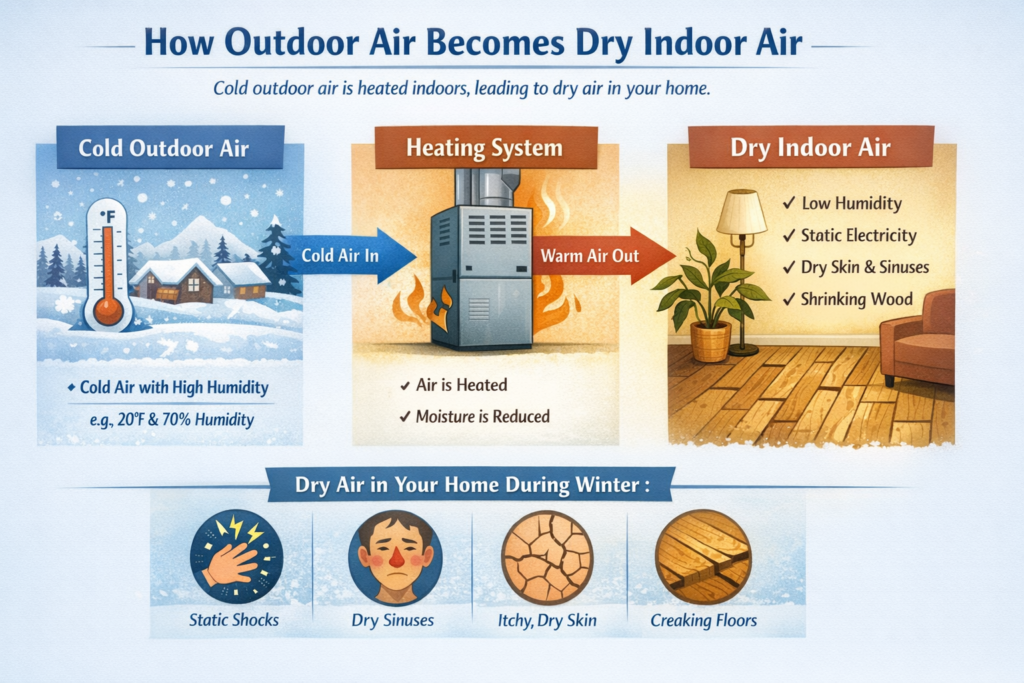
If your house feels dry every winter, the main cause is usually simple: cold outdoor air gets inside, then your heating system warms it up. Warmed air can hold more moisture, but if no moisture is added, the relative humidity drops.
That is why a house can be warm by temperature and still feel dry, scratchy, static-heavy, or uncomfortable.
Fast answer:
Your house feels dry in winter because cold outdoor air contains less moisture. When that air leaks or ventilates into the home and gets heated, indoor relative humidity can fall quickly. Heating usually exposes the dryness; it does not need to “burn up” water to make the house feel dry.
Cold Air Starts With Less Moisture
Heating incoming winter air changes its relative humidity because warmer air can hold more water vapor. That is why indoor RH can drop during cold weather even without a dehumidifier running. Measure the occupied rooms, and do not raise humidifier output without checking for condensation on cold windows or walls. Technical references: ASHRAE Psychrometrics EPA moisture and mold.
Cold winter air usually carries less moisture than warm summer air. When that cold air enters the house, it brings that low moisture level with it.
Once the air is heated indoors, the temperature rises but the amount of moisture in the air may not rise with it. The result is lower relative humidity.
This is the core winter dry-air problem. The air is warmer, but it is still moisture-poor.
Heating Makes the Dryness Easier to Feel
Heating does not have to remove moisture from the air to make the house feel dry. It only has to warm low-moisture air.
As the air warms and relative humidity drops, moisture may leave skin, lips, nasal passages, wood, and fabric surfaces more easily. That is why the house may feel harsher even when the thermostat says the temperature is comfortable.
| Winter condition | What happens indoors |
|---|---|
| Cold outdoor air enters the home | It brings low moisture with it. |
| The heating system warms that air | Relative humidity drops if moisture is not added. |
| Air moves through rooms | Dryness becomes more noticeable across the house. |
| Windows stay closed | The house may feel stale, dry, or static-heavy. |
| Outdoor weather stays cold for days | Indoor dryness can persist until conditions change. |
Forced-Air Heat Can Make It Feel Worse
Forced-air heat often makes dry air more noticeable because it moves warm air through the house. That moving air can make skin, eyes, noses, and throats feel drier.
Baseboard, radiant, and other heating systems can still be part of a dry winter pattern. The system type changes how the dryness feels, but the main cause is still cold outdoor air being warmed indoors.
In other words, the furnace is not always the villain. Sometimes it is just warming air that was already dry.
Signs Your Home May Be Too Dry in Winter
Dry winter air usually shows up as a pattern, not one isolated symptom. See common winter dry-air symptoms.
| Sign | What it may suggest |
|---|---|
| Static shocks | Indoor humidity may be very low. |
| Dry-feeling skin or lips | Dry air may be contributing to comfort issues. |
| Scratchy throat or dry nose indoors | The air may be too dry for comfort. |
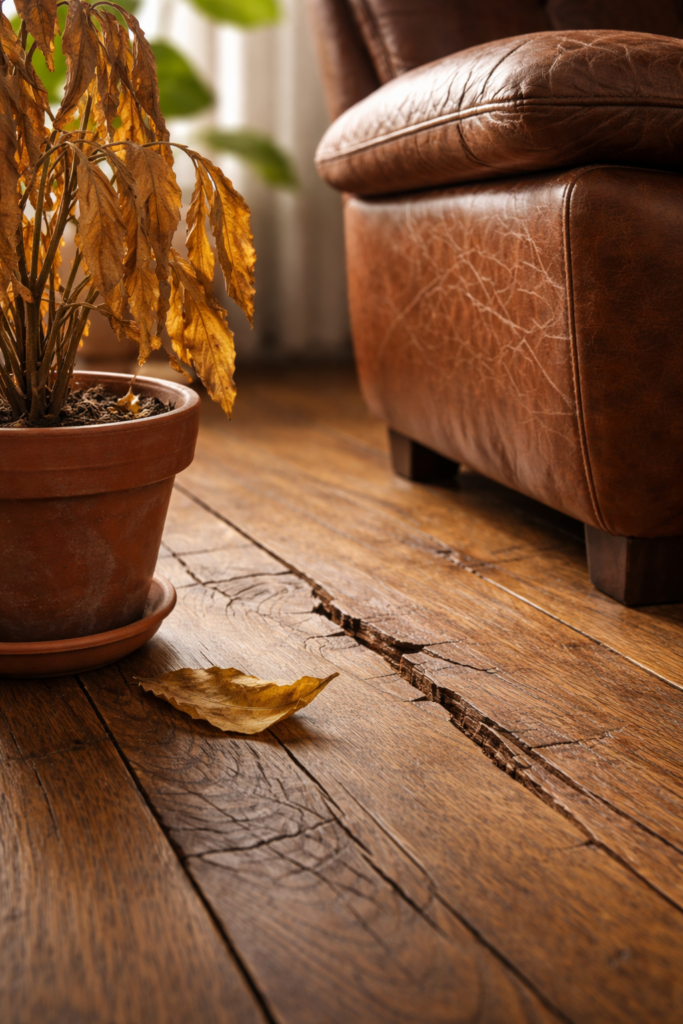
| Wood floors or furniture creak more | Wood may be reacting to seasonal moisture loss. |
| Houseplants dry out faster | The room may be losing moisture quickly. |
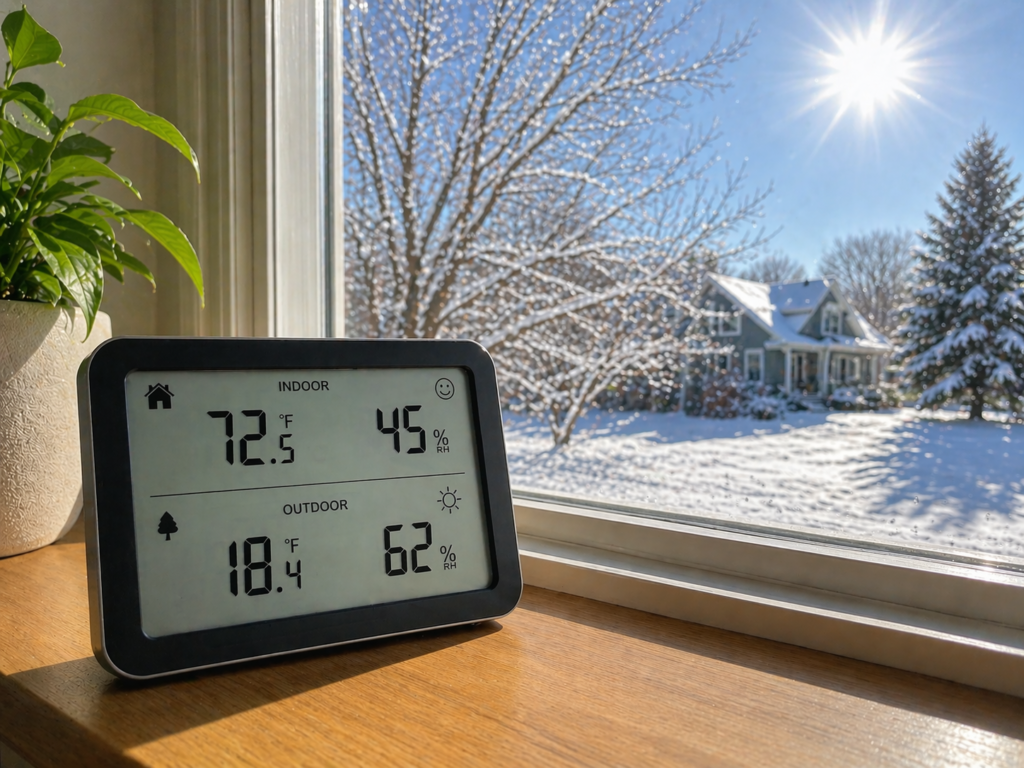
| Humidity meter reads low | Dry indoor air is no longer just a guess. |
The last one matters most. A humidity meter gives you a real reading instead of relying only on how the house feels.
Why Some Houses Feel Drier Than Others
Two houses in the same town can feel very different in winter. The amount of dryness depends on climate, air leakage, heating runtime, layout, and how much moisture the home adds back through normal living.
Dryness may be more noticeable in homes with:
- Cold outdoor weather for long stretches
- Drafts or frequent air leakage
- Forced-air heat running often
- Large open spaces or high ceilings
- Rooms far from kitchens, bathrooms, and other moisture sources
- Very little cooking, shower steam, or indoor moisture generation
None of this automatically means the house is poorly built. It means the home is losing or diluting indoor moisture faster than it is replacing it.
Daily Life Adds Moisture, But Usually Not Enough
Cooking, showering, breathing, laundry, and houseplants can all add moisture indoors. In milder weather, that may be enough to keep the house comfortable.
In colder weather, normal moisture sources often cannot keep up with the dry outdoor air entering the home. That is why a house that feels fine in spring or fall may feel harsh in January.
Measure Before You Add Moisture
Before buying a humidifier, measure the humidity in the rooms where the dryness is most noticeable. Do not place the meter directly beside a humidifier, heat register, bathroom, kitchen, exterior door, or window.
Let the reading settle, then check it at different times of day. A single reading is useful. A pattern is better.
Measurement path:
Start with how to measure humidity in your home. If the reading is consistently low, move into the dry-air path. If the reading is normal, the discomfort may not be mainly a humidity problem.
When Dry Winter Air Becomes Worth Fixing
Dry winter air is common. That does not mean every home needs equipment.
It becomes worth addressing when the dryness is consistent, measurable, and uncomfortable enough to matter.
| Situation | Practical next step |
|---|---|
| Humidity is low and the house feels dry | Consider controlled humidification. |
| Only one bedroom feels dry | Start with that room instead of the whole house. |
| The whole apartment feels dry | Size for the connected living area. |
| Windows start getting wet | Back off; too much humidity creates a damp-air problem. |
| Humidity reads normal | Look beyond humidity before buying equipment. |
For the broader dry-air path, see air that is too dry at home. For sizing, use what size humidifier you need for your home.
Do Not Overcorrect
Adding moisture can improve comfort when the air is truly dry, but more is not always better.
If you push humidity too high during cold weather, the house may trade dry-air discomfort for condensation, wet windows, damp sills, or musty areas. That is a different problem.
If you are deciding whether your humidifier is the wrong size, compare what happens if a humidifier is too large with what happens if a humidifier is too small.
Measure Winter Humidity Before Adding Moisture
Your house feels dry in winter because cold outdoor air contains less moisture. When that air gets inside and is heated, the indoor relative humidity can fall.
Heating makes the dryness easier to notice, but the real issue is usually low-moisture outdoor air being warmed indoors.
Measure the humidity before buying anything. If the reading is consistently low and the house feels uncomfortable, then humidification may make sense. If the reading is normal, the problem may not be dry air.
Related Guides
Measure first
Confirm whether the air is actually dry before choosing equipment.
Dry-air path
Use this if the whole home feels dry, harsh, or static-heavy.
Choose the right size
If humidity is truly low, size the humidifier by space and layout.