

Quick answer: If your AC can’t keep up and the house feels gross, the problem may not be temperature alone. Sticky air, damp furniture, clammy bedrooms, and heavy indoor air often point to high humidity. Check the room with a humidity meter before assuming the air conditioner is the only problem.
When your AC cannot keep up, the house does not always just feel hot. Sometimes it feels sticky, stale, damp, heavy, and uncomfortable in a way the thermostat does not explain.
The couch feels a little damp. Bedrooms feel clammy. The air feels thick. You walk inside expecting relief from the heat, but the house still feels gross.
That is the point where temperature and humidity need to be separated. The thermostat tells you how warm the air is. It does not tell you how much moisture is riding around in that air.
Why the house feels gross even with the AC running
Air conditioning mainly cools the air. It also removes some moisture while it runs, but that does not mean it always controls humidity well enough for comfort.
During hot, humid weather, the AC may be fighting two battles at once. It has to remove heat from the house and deal with moisture in the air. If the house is gaining heat quickly, rooms have poor airflow, or outdoor humidity is high, the system may cool some of the air while the house still feels sticky.
That sticky feeling is usually not imagination. When indoor humidity is high, sweat does not evaporate as easily. Fabric can feel damp. Air feels heavier. A room at 75°F with high humidity can feel worse than a room a little warmer with lower humidity.
Measure first: Put a humidity meter in the room that feels worst. If the reading is often above 55% to 60% RH, humidity is probably part of the comfort problem. If humidity is normal, look harder at AC airflow, heat gain, insulation, windows, or duct issues.
Hot is different from sticky
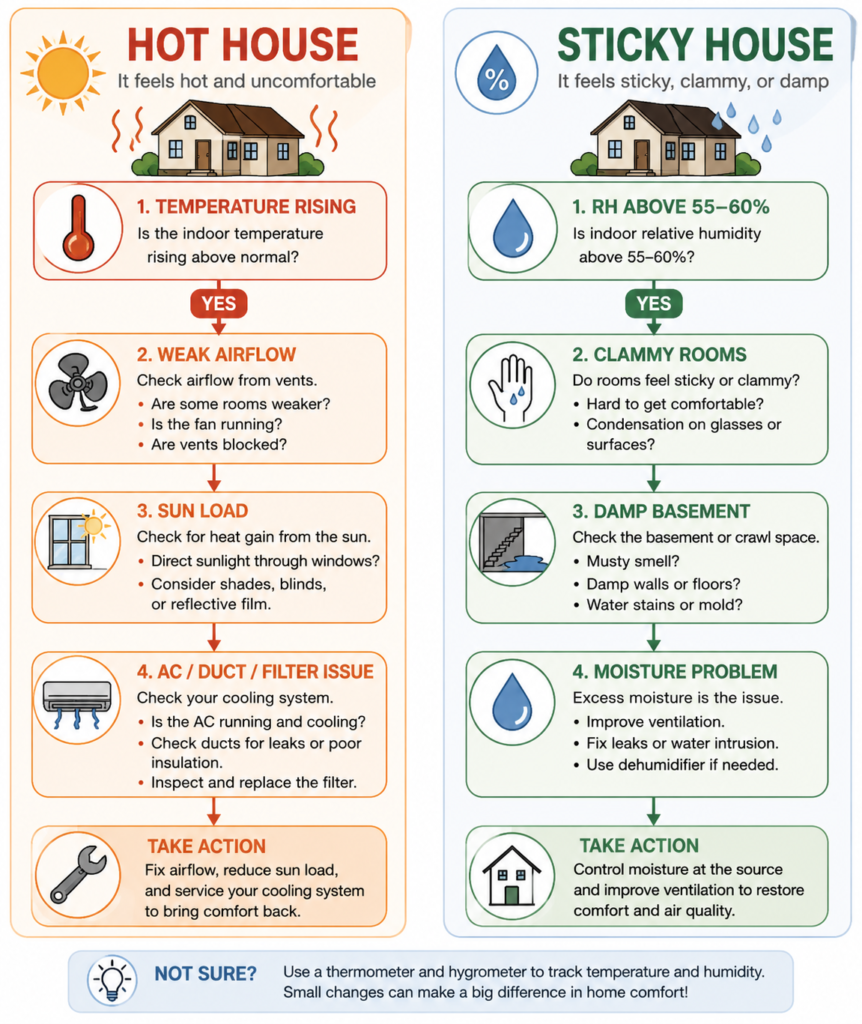
A hot house and a sticky house can feel similar, but they do not always have the same cause.
| What you feel | Likely direction | What to check first |
|---|---|---|
| The house is hot and the temperature keeps rising | Cooling problem or heat gain | AC airflow, filter, vents, sun load, insulation, ductwork |
| The thermostat looks acceptable but the house feels sticky | Humidity problem may be involved | Indoor RH in the room that feels worst |
| Basement or lower level feels clammy | Damp-zone problem | Basement humidity, drainage path, and dehumidifier sizing |
| One bedroom feels heavy at night | Room airflow or closed-door problem | Room humidity, vent airflow, return path, and door position |
| Humidity is normal but comfort is still bad | Probably not a moisture-first problem | Cooling performance, airflow, windows, insulation, and heat gain |
This split matters because a dehumidifier is not a magic comfort machine. It can help remove moisture. It cannot fix weak cooling, blocked airflow, bad ductwork, heavy sun exposure, or a struggling AC system.
Signs humidity is part of the problem
Humidity may be making the house feel worse if several of these are true:
- The house feels sticky even when the thermostat is close to the setpoint.
- Bedding, furniture, rugs, or carpet feel slightly damp.
- The basement or lower level feels clammy.
- The AC runs, but the air still feels heavy.
- Windows, closets, or corners smell musty.
- The room feels worse after rain or during humid weather.
- A humidity meter shows readings above 55% to 60% RH.
If several of those apply, start with too much moisture in your home before assuming the air conditioner is the only issue.
Signs the AC is the bigger problem
Humidity is not always the main problem. Sometimes the AC simply is not keeping up with the heat load.
The AC may be the bigger issue if:
- The air from the vents is not cool.
- The indoor temperature keeps rising all afternoon.
- The AC runs constantly and never reaches the thermostat setting.
- Some vents have weak airflow.
- The HVAC filter is dirty.
- The outdoor unit is not running normally.
- One side of the house is much hotter than the other.
Reality check: A dehumidifier will not repair an AC system that is not cooling. If the supply air is not cool, airflow is weak, or the house temperature keeps climbing, deal with the cooling problem first.
Can a dehumidifier make the house feel better?
Yes, but only when humidity is part of the problem.
A portable dehumidifier removes moisture from the air. It does not cool the room like an air conditioner. It also adds a small amount of heat while it runs. That sounds backwards, but in a damp room the comfort gain from lower humidity can still be noticeable.
This works best when the AC is cooling some, but the house still feels sticky. It is especially common in damp basements, lower levels, offices, bedrooms, and rooms that do not get enough air movement.
For the direct equipment answer, see can a dehumidifier help when your AC can’t keep up.
What to do first
Do not start with the biggest dehumidifier on the shelf. Start with the room that feels worst and figure out whether the problem is heat, humidity, or both.
- Measure the humidity in the room that feels sticky.
- Check the temperature in that same room.
- Make sure the AC vent is open.
- Check whether the return path is blocked.
- Check the HVAC filter.
- Look for heavy sun load from windows.
- Compare that room with the rest of the house.
If humidity is above 55% to 60%, moisture is probably part of the comfort problem. If humidity is normal but the room is hot, focus on AC airflow, insulation, windows, and heat gain.
When a dehumidifier is worth considering
A dehumidifier is worth considering when the humidity reading supports it.
- Indoor humidity is high.
- The AC still blows cool air.
- The house feels sticky instead of just hot.
- The problem is worse in damp rooms or lower levels.
- You can empty the bucket regularly or use a safe drain setup.
- You size the unit for the room and moisture level, not just the square footage claim on the box.
For larger areas, use the dehumidifier sizing guide instead of guessing. If you already know the room size and dampness level, use the dehumidifier size calculator.
Disclosure: This page may include affiliate links. If you buy through those links, HumidityAtHome may earn a small commission at no extra cost to you.
Helpful tool: a humidity meter
The humidity meter is the cheapest mistake-prevention tool in this whole problem. It tells you whether the house feels gross because the air is too damp or because the AC and airflow need attention.
Product Path: Digital Humidity Meter
Use this before buying a dehumidifier if the house feels sticky but you do not know the actual indoor humidity. Look for an easy-to-read RH display, temperature display, compact size, and high/low memory if available.
Bottom line
If your AC cannot keep up and the house feels gross, do not assume the problem is only temperature. A sticky, clammy house often points to high humidity. A hot house with weak airflow points more toward AC performance, insulation, ductwork, or heat gain. Many homes have some of both during extreme summer weather.
Measure the humidity first. If it is high, a dehumidifier may help the house feel more comfortable while the AC handles the cooling. If humidity is normal, stop chasing moisture and look at the cooling side instead.
Related next steps:
Last reviewed: PH4 July 3, 2026.