

Quick answer: A dehumidifier can help when your AC is cooling the house but the air still feels sticky, clammy, or heavy. It will not replace air conditioning, fix weak airflow, or make hot air cold. The dividing line is humidity. Measure the room first.
When the weather gets brutally hot, your air conditioner may run for hours and still leave the house feeling uncomfortable. Sometimes the problem is not only temperature. Sometimes the AC is cooling, but the indoor air is still carrying too much moisture.
A dehumidifier does not cool your home the way an air conditioner does. It does not replace AC, repair a weak system, or fix a house that is gaining heat faster than the equipment can remove it. But when the thermostat looks reasonable and the house still feels like a damp towel, humidity may be the missing piece.
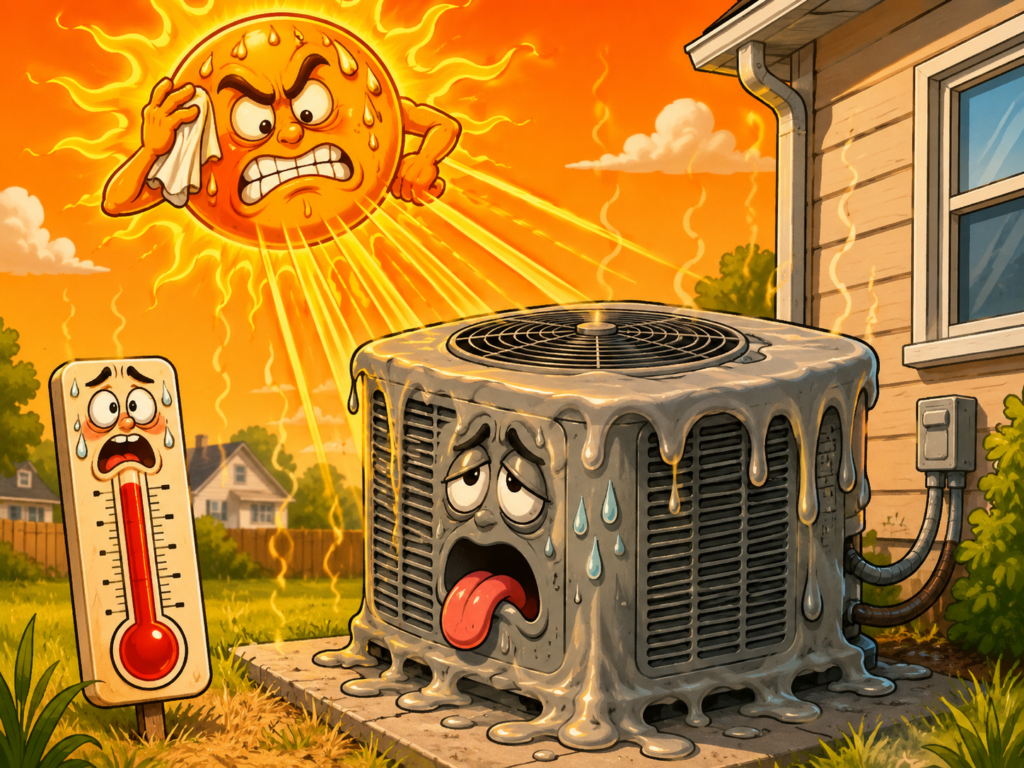
What a dehumidifier can actually do here
An air conditioner removes heat and can also remove some moisture while operating; a dehumidifier primarily targets airborne moisture and does not replace cooling capacity. A portable dehumidifier also releases heat into the room while running. Check temperature and RH separately before choosing equipment, and seek qualified HVAC assessment for an AC system that is not functioning as expected. Technical references: EPA moisture and mold ASHRAE Standard 55 overview.
An air conditioner removes heat from indoor air. It also removes some moisture as part of the cooling process, but moisture removal is not always enough. Short run cycles, high outdoor humidity, closed rooms, basements, shaded lower levels, and poor airflow can leave indoor humidity high even when the AC is doing some cooling.
A dehumidifier removes moisture from the air. It may make the space feel more comfortable because lower humidity helps the room feel less sticky. It does not lower temperature like AC. Most portable dehumidifiers also add a small amount of heat back into the room while they run, which is one reason the humidity reading matters before you buy one.
Measure first: Put a humidity meter in the room that feels worst. If the room regularly sits above 55% to 60% RH, humidity may be part of the comfort problem. If the room is already around 40% to 50% RH, the problem is more likely heat gain, airflow, insulation, or AC performance.
Use the humidity reading to decide what problem you actually have
This is the split that keeps you from buying the wrong thing. The thermostat tells you temperature. A humidity meter tells you whether moisture is making that temperature feel worse.
| What you see | Likely issue | Best next step |
|---|---|---|
| Temperature is high and keeps climbing | Cooling problem, heat gain, airflow problem, or AC capacity issue | Check AC basics before using a dehumidifier as a workaround |
| Temperature is acceptable but the house feels sticky | Humidity may be too high | Measure RH and consider moisture control if readings stay above 55% to 60% |
| Basement or lower level feels damp during hot weather | Below-grade moisture or weak air movement | Measure RH in that area and size the dehumidifier for the actual space |
| One room feels worse than the rest of the house | Closed door, poor airflow, exterior wall, sun load, or room-specific moisture | Measure that room separately before treating the whole house |
| Humidity is normal but comfort is still poor | Not primarily a moisture problem | Look at airflow, insulation, window heat gain, thermostat settings, or AC performance |
If the reading points to moisture, a dehumidifier may help. If the reading does not point to moisture, buying a dehumidifier is just a more expensive way to avoid the real problem. Houses are very good at punishing guesses.
When a dehumidifier helps with AC comfort
A dehumidifier is most useful when the air conditioner is still cooling, but the indoor air remains damp enough to feel uncomfortable. This often shows up as clammy rooms, sticky air, slow-drying towels, damp lower levels, or a house that feels warmer than the thermostat number says it should.
- Indoor humidity stays above 55% to 60% RH.
- The thermostat says the house is cool enough, but the air still feels heavy.
- A basement, lower level, office, bedroom, or shaded room feels damp during hot weather.
- The AC runs, but it does not remove enough moisture for the space.
- The home feels noticeably better after humidity drops, even if the temperature barely changes.
That does not mean every hot room needs a dehumidifier. It means humidity should be checked before assuming the AC is the whole story.
When a dehumidifier will not help
A dehumidifier is not the answer if the AC is failing to cool the house. If the supply air is not cool, the indoor temperature keeps rising, or the system is running constantly without holding temperature, start with the cooling system and basic airflow checks.
Reality check: A dehumidifier will not fix a dirty HVAC filter, blocked vents, weak airflow, duct problems, poor insulation, heavy window heat gain, low refrigerant, or an undersized or failing AC system. It can help with moisture. It cannot rescue a cooling system that is losing the fight.
Should you run a dehumidifier with the AC?
Yes, in some homes it makes sense to run a dehumidifier while the AC is also running. The best case is a home where the AC is cooling, but indoor humidity stays high. The AC handles temperature. The dehumidifier helps remove moisture.
Placement matters. A portable dehumidifier works best in the dampest area or in a room where air can circulate. Do not block the intake or exhaust. For longer runtime, a drain hose-capable unit is usually less annoying than carrying a bucket through the house like a sad summer hobby.
Also remember that a dehumidifier adds some heat while it runs. In a small closed bedroom, that heat may be noticeable. In a damp basement, lower level, or open area, the comfort improvement from lower humidity may still be worth it.
What to check before buying anything
Before buying or running a dehumidifier all day, check the basics. Start with the room that feels worst, then work outward.
- Measure the room’s humidity after the meter has had time to stabilize.
- Check whether the HVAC filter is clean.
- Make sure supply vents are open and return vents are not blocked.
- Confirm the AC is actually blowing cool air.
- Look for major sun load through windows.
- Compare the bad room with the rest of the house.
- Check whether the problem is worse in a basement, lower level, or closed room.
If humidity is high, moisture control is worth considering. If humidity is normal, the problem is probably not a dehumidifier problem.
Disclosure: This page may include affiliate links. If you buy through those links, HumidityAtHome may earn a small commission at no extra cost to you.
Helpful tool: start with a humidity meter
The meter comes first. Without a humidity reading, you are guessing whether the house has a moisture problem, an AC problem, or both.
Product Path: Digital Humidity Meter
Use this before buying a dehumidifier if the house feels sticky but you do not know the actual indoor RH. Look for an easy-to-read relative humidity display, temperature display, compact size, and high/low memory if available.
Best next step
If your AC cannot keep up and the house feels sticky, do not start by buying the biggest dehumidifier you can find. Start by separating temperature from humidity.
- Measure indoor humidity in the room that feels worst.
- If RH is above 55% to 60%, treat moisture as part of the problem.
- If RH is normal, check airflow, heat gain, insulation, and AC performance.
- If moisture is part of the problem, size the dehumidifier to the room and dampness level.
Need the size?
Use the sizing guide if you know the room size and want the right pint range.
Want a faster answer?
Use the calculator when you know the square footage and dampness level.
Still diagnosing?
If the whole house feels damp, start with the moisture diagnosis path.
A dehumidifier can help when your AC is cooling but the house still feels clammy. It cannot replace air conditioning. It can only help when humidity is part of the comfort problem.