
How Outdoor Moisture Affects Indoor Humidity
Indoor humidity tells you what the air inside the house is doing. Outdoor temperature, humidity, and dew point help explain why the indoor reading is changing.
Do not compare indoor and outdoor relative humidity percentages by themselves. Relative humidity changes with temperature. Cold outdoor air can show high RH and still dry the house after it is heated. Warm outdoor air can show a similar RH while carrying far more moisture.
For decisions about opening windows or bringing in outdoor air, dew point provides a better moisture comparison than outdoor RH alone.
Indoor humidity does not exist by itself. Your home exchanges air with the outdoors even when the windows are closed.
That is why the same house can feel damp during a rainy summer week, dry during winter heating season, or more comfortable after the weather changes. The indoor reading matters, but outdoor conditions often explain what is driving it.
A simple indoor humidity meter tells you what is happening in a room. An indoor-outdoor monitor adds context by showing what the weather is doing at the same time.
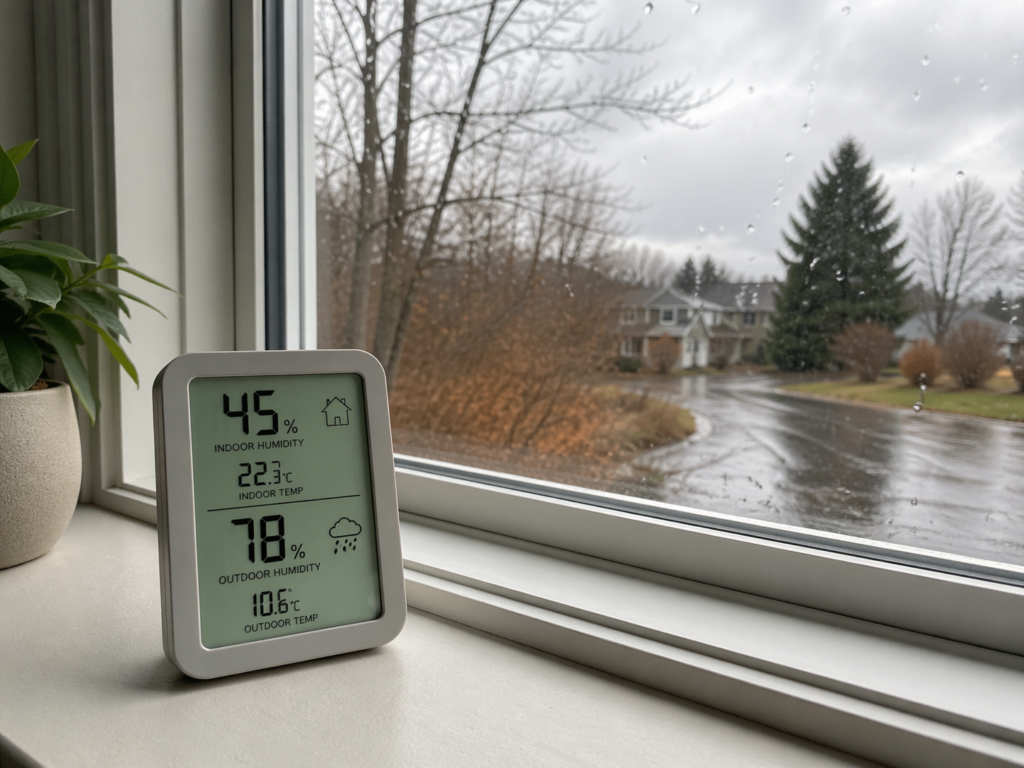
How outdoor air changes indoor humidity
Outdoor air enters the house through intentional ventilation, normal use, and leaks in the building.
- Doors opening and closing
- Open or cracked windows
- Bathroom and kitchen exhaust fans
- Clothes-dryer exhaust
- Fresh-air ventilation systems
- Leaks around windows, doors, walls, floors, attics, and penetrations
- Air movement between a basement, crawlspace, garage, attic, and living space
When outdoor air enters, the house must heat it, cool it, or tolerate it near outdoor conditions. Those temperature changes can make the resulting indoor RH look very different from the outdoor RH shown by a weather app.
Why indoor and outdoor RH cannot be compared directly
Relative humidity is a percentage of saturation at the air’s current temperature. The same RH reading indoors and outdoors can therefore represent different actual moisture amounts when temperatures differ. Dew point can provide a more useful comparison when deciding whether incoming outdoor air is likely to add moisture. Technical references: ASHRAE Psychrometrics EPA moisture and mold.
Relative humidity describes how close the air is to saturation at its current temperature. Warmer air can contain more water vapor than colder air before reaching saturation.
This creates two common homeowner traps:
- Cold outdoor air with high RH: Once that air enters and is heated, its RH can become very low. This is one reason homes often become dry during winter.
- Warm outdoor air with moderate-looking RH: That air may carry a large amount of moisture. Once it enters a cool basement or air-conditioned home, it can increase the indoor moisture load.
| Outdoor condition | Common indoor effect | What to watch |
|---|---|---|
| Cold winter air | Indoor RH often drops after the air is heated | Low RH readings, static, dry-air complaints |
| Warm air with a high dew point | Cooling the air can leave the house damp or increase AC moisture-removal demand | Rising indoor RH and clammy rooms |
| Several rainy or humid days | Basements and lower levels may trend upward | Persistent readings rather than one spike |
| Cool air with a lower dew point than indoors | Ventilation may help remove indoor moisture | Indoor RH falling after outdoor air is introduced |
| Rapid weather change | Indoor readings may lag behind outdoor conditions | Patterns over several hours or days |
Practical rule: Outdoor RH alone does not tell you whether outdoor air will dry or dampen the house. Compare temperature and dew point along with RH.
Dew point is the better outdoor moisture number
Dew point is the temperature at which air becomes saturated and condensation can begin. Unlike relative humidity, dew point does not rise or fall merely because the same air is heated or cooled.
That makes dew point more useful when deciding whether outdoor air will add or remove moisture:
- If the outdoor dew point is lower than the indoor dew point, ventilation generally moves moisture in the drying direction.
- If the outdoor dew point is higher than the indoor dew point, ventilation generally adds moisture to the house.
- If the dew points are close, opening windows may change temperature and air quality more than it changes the indoor moisture level.
Many weather apps report outdoor dew point. Some indoor monitors calculate indoor dew point from temperature and RH. If your equipment does not show indoor dew point, watch what happens to the indoor RH after introducing outdoor air rather than relying on outdoor RH alone.
When outdoor weather explains an indoor problem
Indoor and outdoor readings together can explain problems that appear random when you look only at the house.
| What you notice | Outdoor comparison | Likely next step |
|---|---|---|
| House becomes damp after rain | Rain and outdoor dew point have remained high | Check the basement, crawlspace, and indoor trend |
| Home becomes dry during winter | Cold outdoor air is entering while heating runs | Measure several rooms before choosing a humidifier |
| Humidity rises after opening windows | Outdoor air carries more moisture than indoor air | Close the windows and use cooling or dehumidification |
| Indoor humidity falls after airing out | Outdoor air carries less moisture than indoor air | Ventilation may be helping |
| Basement stays humid while upstairs is normal | Weather may contribute, but the problem remains localized | Investigate basement moisture, airflow, and temperature |
| One room differs while other rooms track together | Outdoor weather does not fully explain the difference | Check placement, airflow, exterior surfaces, and local moisture |
If most indoor locations rise and fall with the weather, outdoor conditions are probably influencing the whole house. If one room behaves differently, investigate that room before blaming the weather or buying whole-house equipment.
Should you open windows when the house feels humid?
Open windows only when the outdoor air is better for the problem you are trying to solve.
If outdoor air has a clearly lower dew point than indoor air, opening windows may help remove moisture. If outdoor air has a higher dew point, opening windows will usually add moisture even if the breeze temporarily feels comfortable.
| Condition | Likely result from opening windows |
|---|---|
| Cool, dry outdoor air and damp indoor air | May help lower the indoor moisture level |
| Warm, humid outdoor air and a cool house | Usually adds moisture and increases cooling demand |
| Rainy weather with a high outdoor dew point | Usually makes indoor dampness harder to control |
| Cold winter air and already-dry indoor air | Can make the house even drier after the air is heated |
| Outdoor and indoor moisture levels are similar | May provide fresh air without changing humidity much |
Fresh air is not automatically dry air. A lower outdoor RH percentage does not prove that outdoor air contains less moisture. Check temperature and dew point before using open windows as humidity control.
How to compare indoor and outdoor humidity
- Place an indoor meter in a representative living area away from vents, windows, doors, sunlight, humidifiers, and dehumidifiers.
- Use a separate outdoor sensor placed in shade with open airflow and protection from direct rain.
- Record indoor and outdoor temperature and RH at the same time.
- Add outdoor dew point from the monitor or a local weather source when available.
- Note rain, open windows, HVAC operation, showers, cooking, laundry, and other events that may affect the reading.
- Compare morning and evening readings for at least three days. Use seven days when conditions are borderline or changing.
For the complete indoor method and downloadable tracking log, use How to Measure Humidity in Your Home.
Where to place an outdoor humidity sensor
An outdoor sensor can produce a technically real but unrepresentative reading when it is installed against a hot wall, in direct sun, under a dryer vent, or where rain can wet it.
| Better outdoor placement | Avoid |
|---|---|
| Shaded location with open airflow | Direct sunlight |
| Protected from direct rain | Location where water can enter the sensor |
| Away from walls that store solar heat | Brick, siding, or roofing heated by the sun |
| Away from exhaust outlets | Dryer, bathroom, kitchen, or combustion exhaust |
| Away from HVAC equipment | Air-conditioner condenser discharge |
| Within the manufacturer’s communication range | Locations blocked by heavy masonry or metal |
Do not place the outdoor sensor on the inside of a window and treat it as an outdoor reading. The glass, wall, indoor leakage, and solar heating can create a small environment that represents neither the room nor the open outdoor air.
Weather station versus simple humidity meters
A weather station is not automatically more accurate than a simple humidity meter. Its main value is comparison and additional outdoor context.
| Tool | Best use | Main limitation |
|---|---|---|
| Basic indoor humidity meter | Checking one room or comparing several indoor rooms | Does not show outdoor conditions |
| Multi-sensor indoor and outdoor monitor | Comparing rooms, floors, and one outdoor reference point | Normally provides limited weather information |
| Connected indoor-outdoor weather station | Remote monitoring, history, alerts, and local weather context | Higher cost and more setup |
| Backyard weather station | Humidity, temperature, rainfall, wind, and local weather trends | More equipment than basic humidity diagnosis requires |
If you only need to know whether a bedroom or basement is too dry or damp, use a basic indoor meter. If you need to understand whether weather is driving the indoor condition, use an indoor-outdoor monitor.
Disclosure: This page includes affiliate links. If you buy through those links, HumidityAtHome may earn a small commission at no extra cost to you.
As an Amazon Associate I earn from qualifying purchases.
Indoor and outdoor humidity-monitoring options
Best for several indoor areas plus outdoor reference: Ambient Weather WS-10-X4
Best for: Comparing a basement, living area, bedroom level, and outdoor location without building a full backyard weather station.
The WS-10-X4 includes a central display and four remote temperature and humidity sensors. This makes it useful when room-to-room and indoor-outdoor comparison matters more than rainfall or wind data.
- Central display
- Four included remote sensors
- Indoor and outdoor temperature and humidity comparison
- No need to move one meter between rooms
Main limitation: It is primarily a local display system rather than a complete connected weather platform.
Best connected weather setup: Ambient Weather WS-2000
Best for: Homeowners who want indoor readings, outdoor weather, Wi-Fi access, alerts, and expansion beyond basic humidity monitoring.
The WS-2000 is a connected weather station rather than a simple room hygrometer. It makes sense when rainfall, wind, outdoor conditions, remote access, and add-on sensors all serve a real purpose.
- Indoor and outdoor monitoring
- Wi-Fi remote access and alerts
- Local weather measurements
- Support for compatible add-on sensors
Main limitation: It costs more and is unnecessary when you only need to check one or two indoor rooms.
Best straightforward backyard station: AcuRite Iris
Best for: Homeowners who want indoor and outdoor temperature and humidity along with rainfall, wind speed, and wind direction on a dedicated display.
The AcuRite Iris is appropriate when local weather tracking is part of the goal. It provides more context than a simple humidity meter but is more equipment than most room-humidity checks require.
Main limitation: The outdoor sensor array requires appropriate siting, mounting, and maintenance to produce useful weather readings.
Product packages and compatibility can change. Confirm included sensors, supported channels, display features, remote-access requirements, and add-on compatibility before ordering.
How to use the readings
Take indoor and outdoor readings at the same time for several days. Note whether the HVAC is running, windows are open, rain has occurred, and particular rooms feel different.
- If indoor humidity rises during warm weather with a high outdoor dew point, outdoor moisture is probably adding to the indoor load.
- If indoor humidity drops during cold weather while heating runs, outdoor air is probably drying the house after it enters and warms.
- If one room stays high while other rooms remain normal, investigate that room instead of treating the entire house.
- If the basement stays high while upstairs remains normal, use basement-specific moisture and equipment guidance.
- If indoor RH changes briefly after cooking or showers and then returns toward normal, the event may be temporary.
- If indoor and outdoor conditions look reasonable, temperature, airflow, insulation, odors, or HVAC performance may be causing the discomfort instead of humidity.
What the readings tell you next
| Pattern | Likely direction | Next page |
|---|---|---|
| Most rooms remain above 55% to 60% RH | Broader damp-air problem | Too Much Moisture in Your Home |
| Basement remains high while living areas are normal | Localized lower-level problem | Basement Dehumidifier Size |
| Most rooms remain below 30% RH | Broader dry-air condition | Air That’s Too Dry at Home |
| One room behaves differently | Local placement, airflow, temperature, or moisture issue | Humidity Meter Placement Guide |
| You need several indoor comparisons | Multi-pack or multi-sensor monitoring | Best Indoor Humidity Meters |
| You need remote alerts and history | Connected humidity monitoring | Wi-Fi and Bluetooth Humidity Monitors |
Use Temperature and Dew Point to Interpret Indoor and Outdoor RH
Indoor humidity tells you what is happening inside the house. Outdoor temperature, humidity, and dew point help explain why it is happening.
Do not compare indoor and outdoor RH percentages as if temperature does not matter. Use dew point when deciding whether outdoor air will add or remove moisture.
For simple room checks, a basic humidity meter is enough. For weather-driven problems, window-opening decisions, basements, seasonal swings, or outdoor comparisons, an indoor-outdoor monitor provides better context.
The goal is not to collect more numbers. The goal is to understand the pattern before buying a humidifier, dehumidifier, monitoring system, or weather station.