
A small basement can still need a real dehumidifier. The square footage may be modest, but the moisture load can be much heavier than an upstairs bedroom, office, or living room.
For most small basements, start around 40 to 50 pints. Use 30 to 40 pints only when the basement is mildly damp and easy to dry. Move toward 50 pints or larger if the basement smells musty, stays above 60% RH, has poor airflow, or the bucket fills constantly.
What Size Dehumidifier Works in a Small Basement?
A small basement can still have a substantial moisture problem if water seeps through walls or floors or if cold surfaces collect condensation. Identify the moisture source before relying on a pint estimate. Rated dehumidifier capacity is measured under defined conditions and can differ in a cooler basement. Technical references: UMN basement moisture EPA moisture and mold.
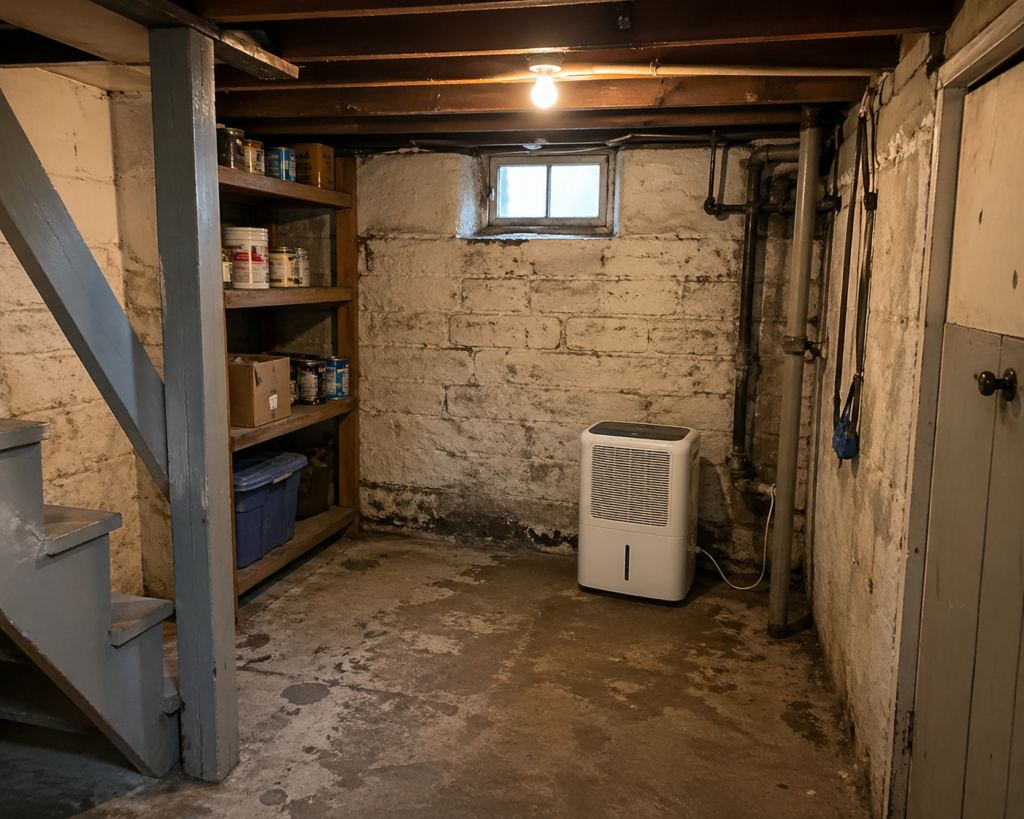
A small basement usually needs more dehumidifier than its square footage suggests. Concrete, cool surfaces, limited airflow, and ground moisture can make a 600 to 900 square foot basement behave like a much larger damp space.
Practical starting point: 40 to 50 pints for most small basements. Size smaller only if the space is mildly damp. Size larger if RH stays high, the basement smells musty, or the unit runs constantly without reaching the setpoint.
Small basement dehumidifier size chart
Use this table as the starting point. Then adjust based on actual humidity, musty smell, drainage, airflow, and how often the dehumidifier needs to run.
| Small basement condition | Starting size | What it means |
|---|---|---|
| Under 500 sq ft, mildly damp | 30 to 40 pints | Works when humidity rises only seasonally and drops quickly once the unit runs. |
| 500 to 900 sq ft, regular dampness | 40 to 50 pints | The best starting range for many small basements. |
| Musty, cool, or slow to dry | 40 to 50 pints or larger | Use the higher end if the space smells damp or the unit needs long runtime. |
| Above 60% RH for long periods | 50 pints or larger | Size up and look for moisture sources, drainage issues, or poor airflow. |
| Standing water, seepage, or wet carpet | Fix water first | A dehumidifier helps air moisture, but it is not a basement waterproofing repair. |
If your basement falls between two rows, choose based on dampness instead of floor area alone. A small basement can still beat up a small dehumidifier.
Measure first if you are unsure
Before choosing the final size, check the basement humidity for a few days. Measure near the center of the space, near exterior walls, and in corners or storage areas that do not get much airflow.
If the basement usually stays near 50% RH, moderate capacity may be enough. If it sits above 55% or climbs above 60%, size up and look for the reason moisture keeps returning.
Why a small basement is not the same as a small room
An upstairs room mostly deals with indoor air. A basement has more ways to collect moisture. Concrete walls, slabs, rim joists, cool surfaces, outside air leaks, stored items, and poor airflow all change the sizing decision.
Cooler air also changes how the basement feels. A small basement can have the same amount of moisture as another room, but because the air is cooler, the relative humidity can read higher and the space can feel damp or musty.
That is why a 600 square foot basement may need a stronger dehumidifier than a 600 square foot bedroom. The basement has less floor area, but it may have a much heavier moisture load.
When 30 to 40 pints may be enough
A smaller dehumidifier can work in a small basement when the problem is mild and occasional.
- The basement is under about 500 square feet.
- The space is open, not divided into several damp corners.
- Humidity only rises during humid weather.
- There is no strong musty smell.
- The dehumidifier can bring RH back near 45% to 50% without running nonstop.
- The bucket does not need constant emptying.
This is the “small basement, mild problem” case. It exists. It is just not every small basement.
Why 40 to 50 pints is the safer starting point
For many small basements, 40 to 50 pints is the more practical choice. It gives the unit enough capacity to handle damp concrete, humid weather, stored items, laundry moisture, and lower airflow without running itself into the ground.
This range makes sense when the basement:
- Is roughly 500 to 900 square feet
- Smells musty during humid weather
- Has cool concrete walls or floors
- Contains storage, laundry equipment, or a utility area
- Has poor airflow or closed-off corners
- Needs steady seasonal moisture control
The goal is not to buy the biggest machine possible. The goal is to choose a unit that can pull humidity down and cycle, instead of running all day and still losing.

When to size up to 50 pints or more
Size up when the basement is small but the moisture problem is not small. This is where square footage can fool you.
| Sign | What it suggests | What to do |
|---|---|---|
| RH stays above 60% | The moisture load is high. | Use more capacity and check for moisture sources. |
| Musty smell returns quickly | Moisture is being held in materials or corners. | Size up and improve airflow. |
| Bucket fills daily | The unit is removing real water, not just trimming comfort humidity. | Consider a drain hose or pump setup. |
| Unit runs constantly | The unit may be undersized or the basement has a persistent source. | Check placement, setpoint, RH trend, and water entry. |
| Dampness gets worse after rain | The basement may have outside water influence. | Investigate grading, seepage, drains, or leaks before relying on equipment. |
If several of these are true, a compact dehumidifier is probably the wrong answer. Small basement does not automatically mean small appliance.
Do not use a dehumidifier as a water repair
A dehumidifier manages moisture in the air. It does not repair foundation cracks, plumbing leaks, standing water, failed grading, roof runoff, or basement seepage.
If water is entering the basement, fix the water source first. The dehumidifier can help with leftover humidity, but it should not be the only plan.
Drainage matters in a small basement
Small basements can fill a dehumidifier bucket faster than expected. If the basement is damp enough to need daily emptying, bucket-only operation becomes the weak point.
Before buying, decide how the water will leave the unit.
| Drainage setup | Use this when | Watch out for |
|---|---|---|
| Bucket only | The basement is mildly damp or only needs seasonal use. | The unit shuts off when the bucket fills. |
| Gravity drain hose | There is a nearby floor drain lower than the dehumidifier outlet. | The hose needs a steady downward path. |
| Built-in pump | Water must go up to a sink, standpipe, or drain line. | More convenient, but adds another part to maintain. |
| Continuous drain setup | The basement needs regular humidity control. | Still check the hose, filter, bucket area, and pump if equipped. |
For a small basement that stays damp most of the season, drainage convenience is not a bonus feature. It is the difference between a unit that runs and a unit that sits there full.
Placement can make a small unit look worse than it is
A dehumidifier needs air movement. If it is tucked behind boxes, trapped in a utility corner, or placed where dry air cannot reach the rest of the basement, the readings may stay high even when the unit is working.
Place the unit where it can pull damp air from the space and push drier air back into the basement. Keep doors open when possible. Move storage away from the unit. Avoid burying it behind laundry baskets, shelving, or the seasonal pile of things nobody wants to admit they own.
If one corner stays damp while the main area improves, the problem may be airflow, not just capacity.
Product paths for small basements
Disclosure: This page may include affiliate links. If you buy through those links, HumidityAtHome may earn a small commission at no extra cost to you.
Use these as product classes, not automatic answers. The right range depends on basement size, dampness, RH reading, drainage, and whether the unit can actually move air through the space.
Product Path: 30 to 40 pint dehumidifiers
Use this range for a small, open basement with mild seasonal dampness. Look for a built-in humidistat, auto-restart, washable filter, and drain hose option.
Product Path: 40 to 50 pint dehumidifiers
Use this range for most small basements with regular dampness, musty odor, cool concrete, storage, or poor airflow. Look for continuous drain, a clear humidistat, auto-restart, and enough capacity that the unit can cycle instead of running nonstop.
Product Path: 50 pint and larger dehumidifiers
Use this range when a small basement stays above 60% RH, smells musty, fills the bucket quickly, or needs stronger seasonal control. Look for drain hose or pump options, auto-restart, practical filter access, and enough airflow for the basement layout.
Related basement guides
Use these next depending on what kind of basement problem you are actually solving.
Basement Dehumidifier Size
Use this for the broader basement sizing framework.
Finished Basement Dehumidifier Size
Use this if the basement has carpet, drywall, furniture, or living space.
How Big of a Dehumidifier Do I Need for My Home?
Use this if you are sizing for more than the basement.
Crawlspace Dehumidifier Size
Use this instead if the damp area is below the living space rather than a basement room.
FAQ
What size dehumidifier do I need for a small basement?
Most small basements should start around 40 to 50 pints. Use 30 to 40 pints only for a small, open, mildly damp space. Move to 50 pints or larger if the basement is musty, above 60% RH, or slow to dry.
Is a 30 pint dehumidifier enough for a small basement?
Sometimes. A 30 pint unit may work in a small basement with mild seasonal humidity. It is usually too small for a musty basement, a basement above 60% RH, or a space where the unit runs constantly.
Is a 50 pint dehumidifier too big for a small basement?
Not necessarily. A 50 pint dehumidifier can be a good choice for a small basement with regular dampness, musty odor, poor airflow, or high RH readings. Capacity should match the moisture load, not only the square footage.
Should I use a drain hose in a small basement?
A drain hose is useful if the unit runs often or the bucket fills daily. Bucket-only operation can work, but once the bucket is full, the unit stops removing moisture.
What humidity level should a small basement stay at?
A practical target for many basements is around 45% to 50% RH. If the basement stays above 55% or reaches 60% for long periods, treat it as a damp-air problem and size the dehumidifier accordingly.