
The best humidifier for a small apartment depends on how the apartment is divided. A closed bedroom, open studio, and larger connected living area need different amounts of moisture and different equipment.
For a closed bedroom, our current simple pick is the Levoit Classic 160. For a studio or open living area, the Levoit Classic 300S adds a larger tank and automatic humidity control. For a genuinely larger open apartment or loft that remains dry, the Dreo 717S provides substantially more capacity and output.
Do not choose from the square footage printed on the lease alone. Measure the area you actually use, then choose enough capacity to maintain moderate humidity without causing wet windows or damp surfaces.
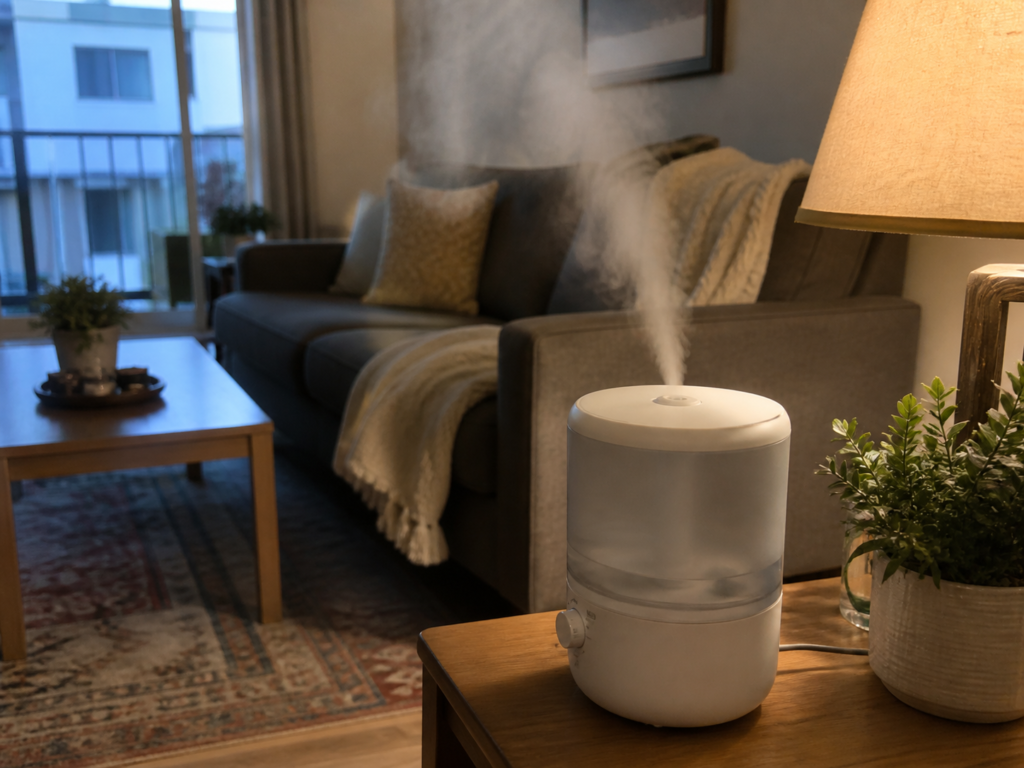
Quick Answer: Best Humidifier for a Small Apartment
These choices are based on the space to be served, published product specifications, maintenance and refill needs, and available supporting information—not a claim that HaH tested every listed humidifier. Check room RH before purchase, and use the humidifier size calculator for a planning estimate. A larger tank reduces refill frequency but does not guarantee even humidification throughout an apartment. Technical references: EPA humidifier care ASHRAE Psychrometrics.
- Closed bedroom: Levoit Classic 160. Compact, simple, quiet, and easier to clean and store than a large apartment-wide unit.
- Studio or open living area: Levoit Classic 300S. A larger 6-liter model with automatic humidity control for a connected living space.
- Larger open apartment or loft: Dreo 717S. An 8-liter higher-output model for a genuinely larger connected dry area where measurements justify more capacity.
- Measure before buying. The best model is still the one that fits the actual dry zone without pushing humidity high enough to create condensation.
Do not expect one living-room humidifier to evenly control a closed bedroom. Treat separate rooms as separate zones when doors stay closed.
How these picks were selected
These are researched recommendations based on current manufacturer specifications, room-layout fit, humidity controls, cleaning access, tank size, and day-to-day apartment use. We have not conducted hands-on testing of these models. Check current specifications, price, and availability before buying.
Our Current Small-Apartment Humidifier Picks
These are practical picks by apartment layout rather than a ranking based on the biggest coverage number. Manufacturer coverage claims are useful for comparison, but actual performance depends on ceiling height, doors, airflow, starting humidity, heating operation, and how much outside air enters the apartment.
Disclosure: This page includes affiliate links. If you buy through those links, HumidityAtHome may earn a small commission at no extra cost to you.
As an Amazon Associate I earn from qualifying purchases.
Best for a Closed Bedroom: Levoit Classic 160
Why it fits: The Classic 160 is a straightforward 2.5-liter ultrasonic cool-mist humidifier. It uses a top-fill tank, has manual mist adjustment, shuts off when empty, and has a wide opening and simple base that make routine cleaning easier.
Levoit rates the unit for up to 25 hours on its lowest setting and lists operating noise below 28 dB at maximum mist. That makes it a sensible fit when the dry-air problem is mainly in a bedroom, office, or other closed small room.
Watch for: It does not provide automatic humidity control. Use a separate humidity meter and reduce output if the room approaches the upper end of your target range or windows begin to fog.
Best for a Studio or Open Living Area: Levoit Classic 300S
Why it fits: The Classic 300S steps up to a 6-liter top-fill tank and automatic humidity control. Levoit rates it for rooms from 215 to 505 square feet and up to 60 hours of runtime on its lowest mist setting.
Its Auto Mode can adjust mist output around a selected humidity target, which is useful in an apartment because the goal is controlled moisture rather than simply running as much mist as possible. The larger tank also reduces refill frequency compared with a small bedroom unit.
Watch for: A 505-square-foot coverage rating does not mean it will evenly humidify several closed rooms. It makes more sense for a studio, open living-and-sleeping area, or connected portion of a one-bedroom apartment.
Best for a Larger Open Apartment or Loft: Dreo 717S
Why it fits: The Dreo 717S is the higher-output choice in this group. It has an 8-liter tank, automatic controls, and a manufacturer-rated coverage area of up to 600 square feet.
Dreo lists up to 80 hours of runtime, a maximum mist output of 550 mL per hour, and a 28 dB noise rating. That extra capacity makes more sense in a genuinely open loft, high-ceiling apartment, or larger connected zone that remains dry after a medium unit is correctly placed and operated.
Watch for: This is more humidifier than a small closed bedroom normally needs. Do not move to the larger class simply because the apartment’s total lease square footage is larger.
Measure Before Choosing an Apartment Humidifier
A room can feel dry without being dry enough to justify adding moisture. Temperature, airflow, heating operation, and outdoor weather also affect comfort.
Place a humidity meter in the room you plan to treat. Keep it away from the humidifier, window, exterior door, supply vent, and direct sunlight. Record morning and evening readings for at least three days.
| Measured indoor RH | Apartment decision |
|---|---|
| Below about 25% RH | The room is very dry. Humidification may be reasonable, but start with controlled output. |
| 25% to 30% RH | The room is dry enough that a humidifier may help. |
| 30% to 40% RH | Often a practical winter range. Do not add moisture solely to chase a higher number. |
| 40% to 50% RH | Usually sufficient. Watch cold windows and exterior walls. |
| Above 50% RH | Do not add moisture without a specific reason and careful monitoring. |
Use How to Measure Humidity in Your Home for the complete placement and tracking method. If several rooms repeatedly measure low, use Air That’s Too Dry at Home to check the broader cause.
Size the Room or Connected Area, Not Just the Lease Square Footage
An apartment’s listed square footage does not tell you how well moisture will move between rooms.
Open studios often behave like one zone. A one-bedroom apartment with the bedroom door closed behaves more like two separate zones. A humidifier in the living room may have little effect on the closed bedroom overnight.
| Apartment layout | Best starting class | Current example |
|---|---|---|
| Closed bedroom | Small room humidifier | Levoit Classic 160 |
| Studio apartment | Medium portable humidifier | Levoit Classic 300S |
| Open one-bedroom apartment | Medium portable with automatic humidity control | Levoit Classic 300S |
| One-bedroom with closed doors | Room-specific humidifier | Treat the dry occupied room rather than the entire apartment |
| Open loft or high ceilings | Higher-output portable class | Dreo 717S when measurements justify the additional output |
| Several separated rooms | Treat the driest occupied room first | One large portable unit may not distribute moisture evenly |
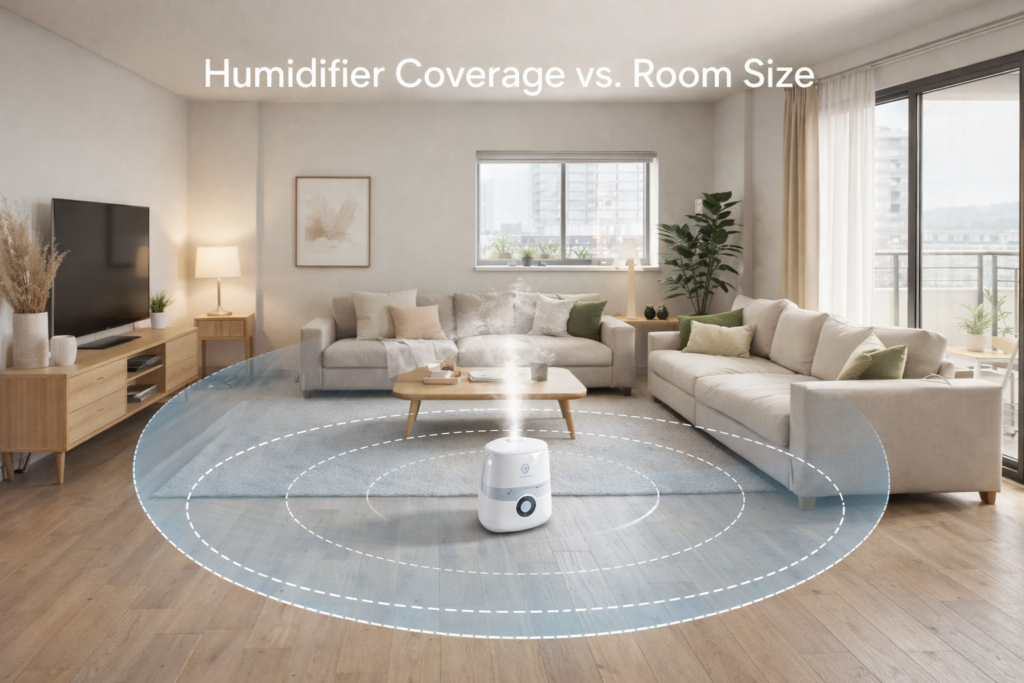
Use the Humidifier Size Chart by Square Footage for a quick comparison or enter the actual space into the Humidifier Size Calculator.
For apartment-specific sizing judgment, see What Size Humidifier for an Apartment?
The Best Humidifier Class for Each Apartment Use
The model matters, but the product class still matters first. Use the room layout and measured humidity to decide which class belongs in the space before comparing individual features.
| Use case | Product class | Features to prioritize |
|---|---|---|
| Bedroom or nursery-sized room | Small portable humidifier | Low noise, easy cleaning, adjustable output, auto shutoff |
| Studio apartment | Medium portable humidifier | Adjustable output, useful tank capacity, steady runtime |
| Open living and sleeping area | Medium portable with humidistat | Automatic humidity control, longer runtime, wider output adjustment |
| Open loft or high-ceiling apartment | Higher-output portable unit | Larger tank, adjustable output, measured humidity control |
| Closed bedroom plus separate living room | Room-specific humidifier | Correct size for the room actually occupied |
A higher-output model is not automatically better. The correct product class is the smallest practical unit that can maintain the measured room without running at maximum output continuously.
Apartment Features That Matter More Than Extra Modes
Apartment humidifiers live close to beds, desks, televisions, furniture, and neighbors. Practical features usually matter more than the length of the feature list.
| Feature | Why it matters in an apartment |
|---|---|
| Adjustable output | Helps prevent excess moisture in a small enclosed room. |
| Humidistat or automatic control | Can reduce output when the room reaches the selected range. |
| Quiet operation | The humidifier may run near a bed, desk, or television. |
| Overnight tank capacity | Reduces interruptions and middle-of-the-night refills. |
| Top-fill or wide tank opening | Makes refilling and cleaning easier in a small kitchen or bathroom. |
| Easy access to internal surfaces | A complicated tank or narrow base is harder to clean routinely. |
| Auto shutoff | Stops operation when the tank empties. |
| Dim display or night mode | Reduces bedroom light disturbance. |
| Replacement-filter availability | Matters when the unit requires filters, wicks, or cartridges. |
| Stable base and leak-resistant design | Helps reduce the risk of damage to apartment floors and furniture. |
WiFi controls, decorative lighting, multiple mist patterns, and app features are secondary. They only add value when they solve a specific apartment-use problem. Automatic humidity control is more useful than an app simply because it helps prevent a small room from receiving more moisture than it needs.
Noise and Bedroom Use
A humidifier that seems quiet in a living room may be noticeable beside a bed.
For bedroom use, consider more than the fan or mist sound:
- Button beeps
- Water movement or bubbling
- Motor cycling
- Bright displays
- Empty-tank alerts
- Vibration against a nightstand or dresser
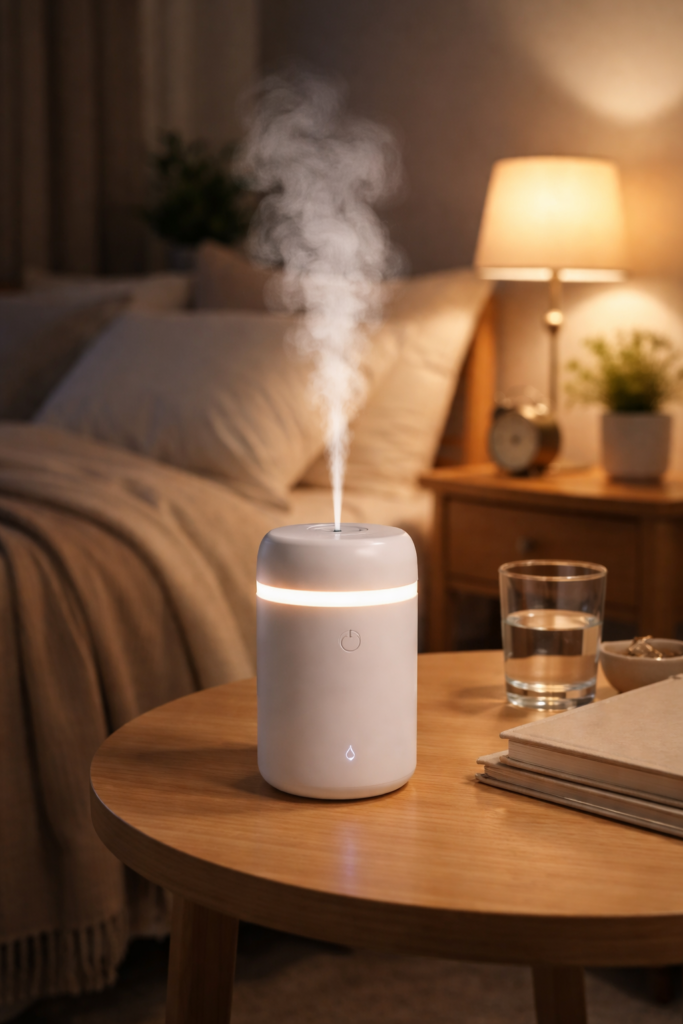
If the bedroom is the only dry room, use the Humidifier for a One-Bedroom Apartment guide or compare the 500-square-foot humidifier path.
Tank Size, Refilling, and Cleaning
A humidifier becomes inconvenient quickly when the tank is too small, difficult to carry, or awkward to refill and clean.
Before buying, consider the complete refill path:
- Can the tank fit under the kitchen or bathroom faucet?
- Is the full tank comfortable to carry?
- Can you reach the tank corners and base for cleaning?
- Can removable parts dry completely between uses?
- Will replacement filters, wicks, or cartridges be easy to store and obtain?
A larger tank can extend runtime, but it also weighs more when full and occupies more storage space. Choose enough capacity for the expected runtime rather than buying the largest tank available.
Place the Humidifier Without Damaging the Apartment
Apartment placement requires enough clearance for airflow and enough protection for nearby floors, walls, furniture, electronics, and windows.
Better placement
- Stable, level, water-resistant surface
- Clear area around the mist outlet
- Away from electronics and paper
- Away from direct sunlight and heating vents
- Where the tank can be removed without spilling
Avoid placing it
- Directly beside a cold window
- Against drywall or furniture
- On an unstable shelf
- Where mist falls onto bedding or flooring
- Where a leak could affect the apartment below
Condensation warning: If windows fog, nearby surfaces become damp, or the room feels heavy, lower the output or stop the humidifier. Use Why Are My Windows Wet? to separate normal cold-glass condensation from a broader humidity problem.
Humidifiers for Renters: Lease Rules and Building Restrictions
Portable humidifiers usually require no building modification, but renters should still check the lease or building rules when appliance use, floor protection, water damage, or shared HVAC systems are addressed.
Do not modify plumbing, ductwork, heating equipment, or electrical circuits without permission. A portable unit should remain self-contained and should not create moisture damage for the apartment, neighboring unit, or building envelope.
Off-Season Storage Matters in a Small Apartment
A humidifier may only be needed during part of the heating season. Before choosing a large model, decide where it will go when it is not running.
- Empty the tank and base completely.
- Clean the unit before storage.
- Allow every part to dry.
- Remove or replace filters as directed.
- Store the cord and small parts with the unit.
- Keep it where the tank will not crack or collect dust and moisture.
When to Move Up or Stay Smaller
The first purchase does not have to be a permanent commitment to one size class. Watch what the room actually does after the humidifier has been running normally.
| What you observe | Better decision |
|---|---|
| The measured room remains dry while the unit runs continuously | Check placement and doors, then consider moving up one product class. |
| The apartment has high ceilings or an open loft | Use air volume and measured performance, not floor area alone. |
| The bedroom is dry but the living room is normal | Use a bedroom-sized unit rather than treating the whole apartment. |
| Humidity rises quickly or windows begin fogging | Reduce output or use a smaller class. |
| The living-room unit does not affect a closed bedroom | Treat the bedroom as a separate zone. |
| The apartment is closer to 1,000 sq ft and mostly open | Consider the humidifier for 1,000 square feet guidance before assuming one portable model can handle the entire apartment. |
See What Happens If a Humidifier Is Too Large? and What Happens If a Humidifier Is Too Small? for the signs on each side.
Practical Recommendation
For most renters with one dry closed bedroom, start small. The Levoit Classic 160 represents the kind of compact bedroom humidifier that is easier to refill, clean, store, and control than a large apartment-wide unit.
For a studio or open connected living area, the Levoit Classic 300S is the strongest all-around choice here because its larger tank and automatic humidity control solve practical apartment problems without automatically jumping to the highest output.
Move to the Dreo 717S class only when the apartment is genuinely open, has more air volume, and measurements show that additional output is needed.
Choose an Apartment Humidifier for the Occupied Zone
The best humidifier for a small apartment is not necessarily the largest one rated for the full apartment square footage.
For a closed bedroom, the Levoit Classic 160 is the simple pick. For a studio or open living area, the Levoit Classic 300S is the better general-purpose choice. For a larger open apartment or loft with a measured need for more output, the Dreo 717S provides the extra capacity.
Measure first, size the occupied room or connected zone, and watch what happens after the humidifier starts running. Noise, refill burden, cleaning access, placement, condensation control, lease considerations, and off-season storage matter more than chasing the largest coverage claim.