
A crawlspace dehumidifier can work in cold weather, but only if the unit is built for the temperatures your crawlspace actually sees.
In a cold crawlspace, the first question is not pint capacity. The first question is whether the dehumidifier can operate at the crawlspace temperature without icing, shutting down, or losing most of its moisture-removal ability.
Fast answer:
For cold-weather crawlspaces, choose the equipment type before choosing the pint size. A warm, sealed crawlspace may work with a crawlspace-rated refrigerant dehumidifier. A crawlspace that drops into colder winter temperatures may need low-temperature-rated equipment or a desiccant dehumidifier instead.
Before buying anything, put a humidity meter and thermometer in the crawlspace for several days. Measure both relative humidity and temperature. A crawlspace that is 65°F is a different dehumidifier problem than one that sits in the 40s or low 50s during winter.
For the measurement step, start with how to measure humidity in your home. In crawlspaces, a temperature reading is just as important as the humidity number.
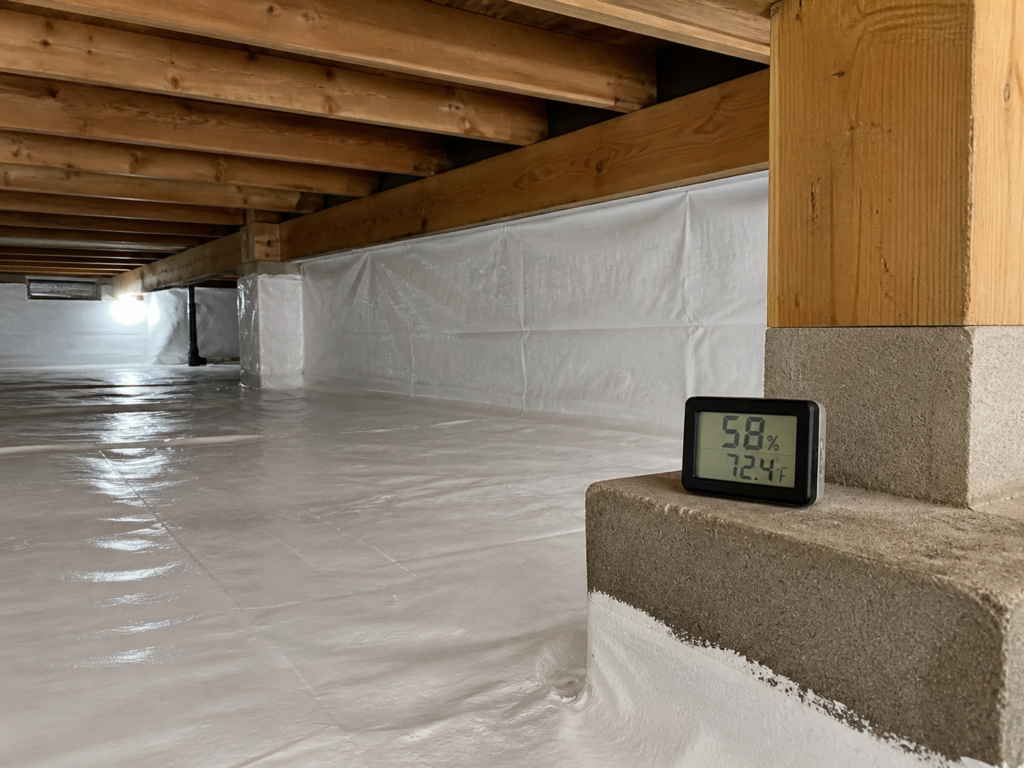
Cold Crawlspace Dehumidifier Decision Chart
Use this chart as a practical starting point. Always check the manufacturer’s operating-temperature range before buying or installing a unit.
| Crawlspace condition | What it usually means | Better equipment direction |
|---|---|---|
| Sealed crawlspace, usually above 60°F | Refrigerant dehumidifiers can often work if sized correctly. | Crawlspace-rated refrigerant dehumidifier |
| Sealed but damp crawlspace in the 50s | Some standard portable units may struggle or lose performance. | Low-temperature-rated crawlspace dehumidifier |
| Crawlspace drops into colder winter temperatures | Refrigerant performance may fall sharply or icing may become a problem. | Low-temperature or desiccant dehumidifier |
| Vented crawlspace with exposed soil or outside air movement | The dehumidifier may keep drying new outside air instead of stabilizing the space. | Fix crawlspace conditions first |
| Standing water, leaks, or drainage failure | The problem is bulk water, not just damp air. | Correct water source before relying on equipment |
If the crawlspace is warm, sealed, and accessible, normal crawlspace sizing may apply. For that path, use crawlspace dehumidifier size.
Why Standard Portable Units Struggle in Cold Crawlspaces
Most common portable dehumidifiers are refrigerant dehumidifiers. They remove moisture by cooling air across a coil so water condenses out of the air.
That process works best in warmer indoor spaces. In a cold crawlspace, the unit may not remove moisture the way the label suggests.
In cold crawlspaces, a standard portable dehumidifier may:
- Ice up on the coils
- Cycle on and off too often
- Remove less water than expected
- Shut down during colder periods
- Run for long periods without lowering humidity much
- Fail to keep up after outdoor weather changes
That does not mean portable dehumidifiers never work in crawlspaces. It means the crawlspace temperature has to match the dehumidifier’s operating range.
Cold-weather rule:
Do not fix a temperature mismatch by buying more pints. A larger room dehumidifier is still the wrong tool if the crawlspace is below the unit’s useful operating range.
Temperature Comes Before Pint Capacity
Check the manufacturer’s published operating-temperature range and defrost instructions for the exact dehumidifier before selecting it for a cold crawlspace. A rated pint capacity does not establish performance outside the conditions specified for that model. First investigate water entry, ground moisture, drainage, and enclosure conditions; the sizing recommendation is a starting estimate, not a guarantee. Technical references: NC State moisture checklist EPA moisture and mold.
Pint capacity still matters, but it comes after temperature, drainage, access, and crawlspace condition.
A crawlspace that stays above normal operating temperatures most of the year is a different problem than a crawlspace that drops into cold winter conditions. The same pint rating can perform very differently in those two spaces.
Before choosing a size, check:
- Lowest typical crawlspace temperature
- Typical crawlspace humidity
- Whether the crawlspace is encapsulated
- Whether foundation vents are open, closed, or leaky
- Whether exposed soil is covered by a vapor barrier
- Whether there is standing water or bulk water entry
- Whether a drain route is available
- Whether the unit can be serviced safely
- Whether safe power is available in the crawlspace
If the crawlspace drops below the listed operating range of the dehumidifier, choose equipment designed for that condition instead of simply moving up to a larger portable unit.
When a Standard Portable Unit May Still Work
A standard portable refrigerant dehumidifier may still work in a crawlspace if the space is sealed, warm enough, easy to access, and not exposed to constant outdoor air.
That usually means:
- The crawlspace is encapsulated or reasonably sealed
- Temperatures stay within the unit’s operating range
- Outdoor air is not constantly entering
- The unit can drain continuously
- The filter can be checked and cleaned
- The space has safe electrical access
- The unit is protected from dirt, standing water, and physical damage
In those cases, normal crawlspace sizing can apply.
| Crawlspace condition | Rough starting range | Notes |
|---|---|---|
| Small sealed crawlspace | 30–40 pint | Only if temperatures stay within the operating range. |
| Medium sealed crawlspace | 40–50 pint | Continuous drainage is strongly preferred. |
| Larger or damp sealed crawlspace | 50–70 pint | A dedicated crawlspace unit is usually a better fit. |
For sizing by area and moisture level, use crawlspace dehumidifier size.
When to Use a Crawlspace-Rated Dehumidifier
A crawlspace-rated dehumidifier is usually the better choice when the space is damp, enclosed, difficult to access, or expected to need long-term moisture control.
These units are built more like permanent moisture-control equipment than a living-room appliance. They are often designed for continuous drainage, better service access, stronger airflow, ducting options, and tougher crawlspace conditions.
A crawlspace-rated unit makes sense when:
- The crawlspace is encapsulated but persistently damp
- You do not want to crawl under the house to empty a bucket
- The unit may run unattended for long periods
- Moisture returns quickly after shutdown
- The crawlspace protects floors, framing, insulation, or stored items
- You need a drain hose or pump setup
- You want equipment built for a dirty, tight, utility-space environment
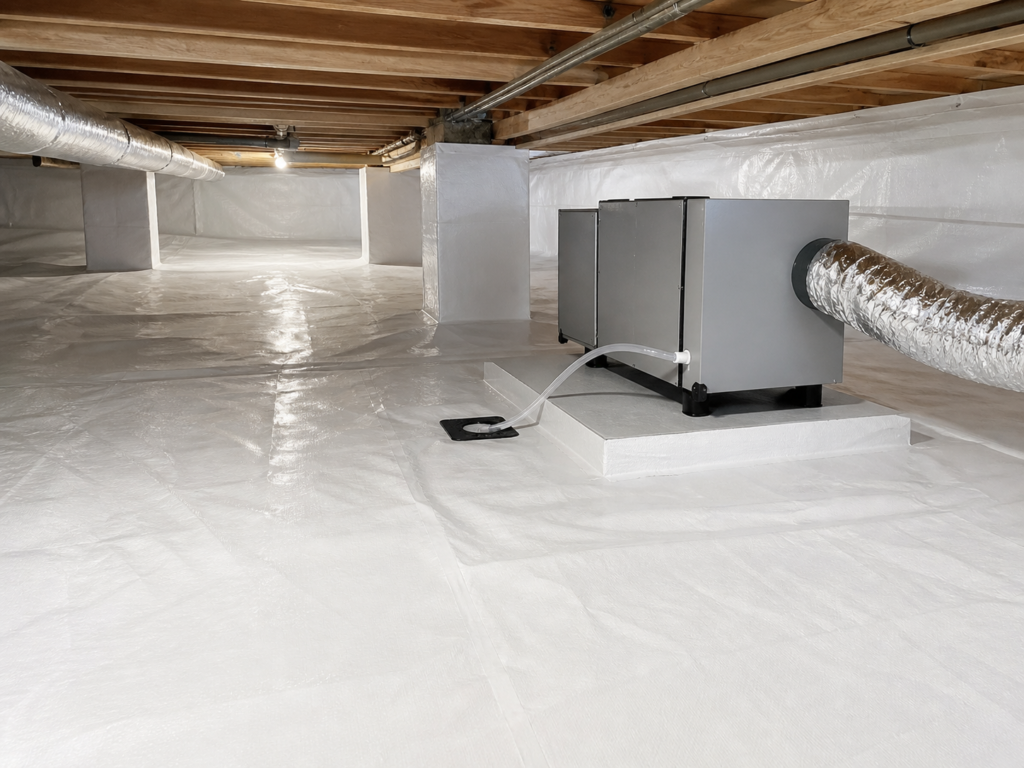
When Desiccant Dehumidifiers Make Sense
Desiccant dehumidifiers use a different drying method than standard refrigerant units.
Instead of relying on cold coils, they use a moisture-absorbing material or wheel. That can make them more useful in colder conditions where refrigerant dehumidifiers lose performance.
A desiccant dehumidifier may make sense if:
- The crawlspace gets cold for long periods
- A refrigerant unit ices up or shuts down
- Humidity control is needed below normal room-temperature conditions
- The space needs drying during colder months
- The installation can handle the power, air movement, and drainage requirements
Desiccant units are not the default answer for every crawlspace. They may use more energy and may require more careful setup. But in genuinely cold crawlspaces, they can be the right tool when a refrigerant dehumidifier is fighting the conditions.
Encapsulation Still Matters
A dehumidifier works best when the crawlspace is reasonably sealed.
If outside air keeps entering through vents, gaps, missing vapor barrier, or poor ground coverage, the dehumidifier has to keep drying new air instead of stabilizing the crawlspace.
Before expecting strong results, check for:
- Exposed soil
- Open or leaky foundation vents
- Missing or damaged vapor barrier
- Standing water
- Poor drainage outside the foundation
- Wet insulation or framing
- Plumbing leaks
- Disconnected or leaking dryer/bath exhaust
A dehumidifier can manage airborne moisture. It cannot fix bulk water, drainage failure, plumbing leaks, or a crawlspace that is wide open to outdoor air.
Do this first:
If there is standing water, active leakage, exposed wet soil, or damaged insulation, fix the crawlspace condition before expecting a dehumidifier to solve the problem.
Continuous Drainage Is Usually Required
Bucket operation is a poor fit for most crawlspaces.
If the bucket fills, the dehumidifier shuts off. That means the crawlspace stops being controlled until someone crawls under the house and empties it.
For cold-weather crawlspaces, look for:
- Continuous drain connection
- Drain hose routing
- Condensate pump option if water must move upward
- Drain placement that will not freeze or back up
- Easy filter access
- Clear service access around the unit
- A stable platform or mounting location
Drainage is part of the sizing decision. A powerful dehumidifier that shuts off because the bucket is full is not controlling the crawlspace.
Practical Product Direction
Disclosure: This page may include affiliate links. If you buy through those links, HumidityAtHome may earn a small commission at no extra cost to you.
For a serious crawlspace moisture problem, a dedicated unit such as the Santa Fe Compact70 crawlspace dehumidifier is usually a better fit than a basic room dehumidifier.
For colder crawlspaces that drop below the useful range of refrigerant equipment, compare low-temperature-rated or desiccant dehumidifier options instead of buying a larger standard portable unit.
| Crawlspace condition | Better product direction |
|---|---|
| Encapsulated and usually warm enough | Crawlspace-rated refrigerant dehumidifier |
| Encapsulated but consistently damp | Higher-quality crawlspace unit with continuous drain |
| Cold for long winter periods | Low-temperature-rated or desiccant dehumidifier |
| Vented, wet, exposed soil, or standing water | Correct crawlspace conditions before relying on equipment |
What to Look For in a Cold-Weather Crawlspace Unit
Do not buy only by pint rating.
For a cold crawlspace, the important features are:
- Listed low-temperature operating range
- Crawlspace or basement suitability
- Continuous drainage
- Condensate pump option if needed
- Reliable humidistat control
- Serviceable filter
- Durable cabinet and components
- Adequate airflow for tight spaces
- Auto-restart after power loss
- Practical access for cleaning and service
The right unit is the one that matches the crawlspace conditions. Pint capacity only matters after that.
Reality Check
A cold crawlspace can make a normal dehumidifier look defective even when the unit is doing exactly what it was designed to do.
The problem is often mismatch.
A living-space portable dehumidifier is usually built for warmer indoor rooms. A cold crawlspace may require crawlspace-rated refrigerant equipment, low-temperature operation, or desiccant technology.
Also, no dehumidifier fixes standing water, foundation leaks, bad drainage, plumbing leaks, or an open vented crawlspace with wet soil. Those conditions need correction before equipment can do its job.
Match the Crawlspace Unit to Its Operating Temperature
For cold-weather crawlspaces, choose the equipment type before choosing the pint size.
If the crawlspace is sealed and stays warm enough, a crawlspace-rated refrigerant dehumidifier is usually the right direction. If the crawlspace gets cold for extended periods, low-temperature or desiccant equipment may be more appropriate.
Do not force a standard portable dehumidifier into a cold crawlspace and expect normal results. Match the machine to the temperature, drainage, access, and moisture load first.
Related Guides
- Crawlspace dehumidifier size
- How big of a dehumidifier do I need?
- Too much moisture in your home
- How to measure humidity in your home
- Basement dehumidifier size
Authoritative reference
For moisture-control principles and guidance on drying wet materials, see the U.S. Environmental Protection Agency’s indoor biological-contaminants guidance.