
Between about 1,500 and 2,000 square feet, humidifier sizing stops being only a capacity question. The bigger issue is whether the area behaves like one connected dry zone or several rooms that need separate treatment.
One high-capacity portable humidifier can make sense in a large open living area, apartment, loft, finished basement, or connected floor. A divided home with bedrooms, hallways, closed doors, and multiple levels may need more than one portable unit or a whole-house approach.
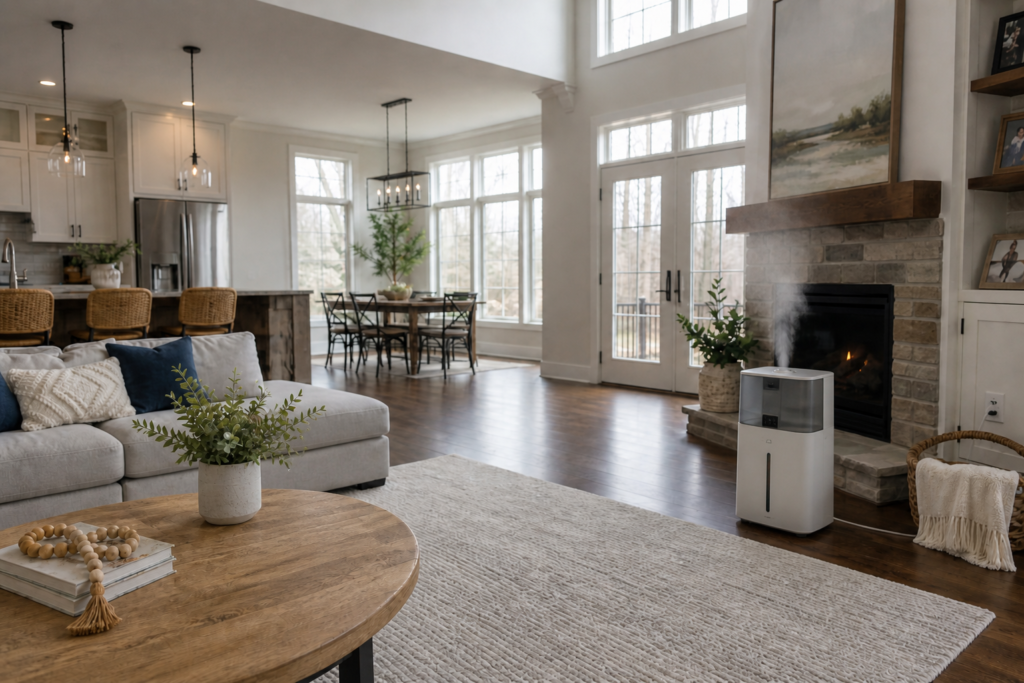
Quick answer: 1,500 vs 2,000 square feet
For 1,500–2,000 square feet, verify which rooms share air rather than relying on a floor-area label alone. The humidifier size calculator offers a starting category, not a whole-home moisture-load analysis. Monitor representative room readings and cold-surface condensation. Technical references: EPA humidifier care ASHRAE Psychrometrics.
| Space | Best starting point | Main decision |
|---|---|---|
| Around 1,500 sq ft | Large-zone portable humidifier | Can one unit reach the full connected space? |
| Around 2,000 sq ft | Large-zone portable, multiple units, or whole-house comparison | Is the floor truly open or divided into dry zones? |
| Multiple floors or closed-room layout | Zone planning | Do not assume one portable unit can distribute moisture everywhere |
For about 1,500 square feet
A 1,500-square-foot humidifier is most practical when the area is one large connected zone. That could be an open apartment, a large living and dining area, a finished basement, or another floor plan where air can move freely.
The coverage number becomes less useful when the space is chopped into several rooms.
One large-zone portable can work when:
- the floor plan is mostly open
- doors between the main areas remain open
- humidity readings are reasonably similar across the space
- the ceiling height is close to normal residential height
- the unit can run long enough to maintain the desired humidity
Measure in more than one spot. A comfortable reading beside the humidifier does not prove the far side of the space is receiving enough moisture.
For about 2,000 square feet
At 2,000 square feet, distribution becomes the main sizing question.
One large portable unit can work in an unusually open layout. In a typical divided home, however, 2,000 square feet may contain several separate dry zones.
One large humidifier is most realistic when:
- most of the treated area is open
- airflow connects the rooms
- the humidifier can sit near the center of the dry zone
- readings stay reasonably close from one end of the zone to the other
Multiple units may be better when:
- bedrooms stay closed overnight
- the main floor and sleeping areas behave differently
- long hallways restrict air movement
- one side of the home remains dry while the humidifier area reaches the target
- the unit has to run at maximum output continuously
Ceiling height changes the load
A 1,500-square-foot room with a high ceiling contains more air than the same floor area with an eight-foot ceiling. Great rooms, vaulted ceilings, open stairwells, and two-story spaces can push a portable humidifier beyond what the floor-area number suggests.
When the unit is already close to its rated coverage, higher ceilings are a reason to treat the space as a larger moisture load.
Winter dryness can expose a borderline setup
A humidifier that performs adequately during mild weather may struggle during a cold, dry stretch. Outdoor air entering through normal ventilation and air leakage can continually dilute the moisture being added indoors.
If the unit falls behind only during the coldest weather, compare:
- current indoor humidity
- outdoor conditions
- runtime
- tank refill frequency
- drafts and air leakage
- the difference between readings near and far from the unit
Do not assume a larger machine fixes a distribution problem.
Size up or split the space?
Use this rule:
If the entire connected zone is dry, consider more capacity.
If one part of the home is comfortable and another remains dry, consider better distribution or a second zone.
That distinction matters more than adding another 500 square feet to the number printed on the box.
When to compare whole-house humidification
Once the goal becomes raising humidity through most of a divided 2,000-square-foot home, portable units can become inconvenient. Multiple tanks, cleaning schedules, and room-by-room control may make a central whole-house system worth comparing.
That does not mean every 2,000-square-foot home needs whole-house equipment. It means the decision should shift from “What is the biggest portable humidifier?” to “How many dry zones am I actually trying to treat?”
Measure first
Use the humidity measurement guide to compare several locations.
Use the humidifier size calculator for a calculated starting point.
Use the humidifier size chart for a quick comparison.
For separate dry zones, compare One Humidifier or Multiple Humidifiers? and Portable vs Whole-House Humidifier before choosing the equipment strategy.
Humidifier Options for a Connected 1,500–2,000 Sq Ft Zone
Affiliate disclosure: HaH may earn a commission if you buy through these links, at no additional cost to you.
For a connected space around 1,500 square feet:
Check portable humidifiers rated around 1,500–1,800 sq ft on Amazon
For a larger connected area approaching 2,000 square feet:
Check large-room humidifiers around 2,000 sq ft on Amazon
Choose Capacity or Separate Zones for 1,500–2,000 Sq Ft
For 1,500 square feet, one large portable humidifier can still be a straightforward answer when the space is open and connected.
At 2,000 square feet, layout becomes the deciding factor. An open floor may still work as one zone. A divided home usually calls for multiple zones or a whole-house comparison rather than simply choosing a larger portable unit.