
A small-space humidifier usually needs to do one of two jobs: treat a defined room around 500 square feet, or treat a larger connected zone closer to 1,000 square feet. The square-footage number is a starting point, not the whole answer. Layout, ceiling height, outdoor winter conditions, and how dry the room actually gets can change the amount of moisture you need.
Before buying a larger unit, measure the humidity in the occupied part of the space. A bedroom, office, nursery, studio, apartment, or open living area can all behave differently even when the floor area looks similar on paper.
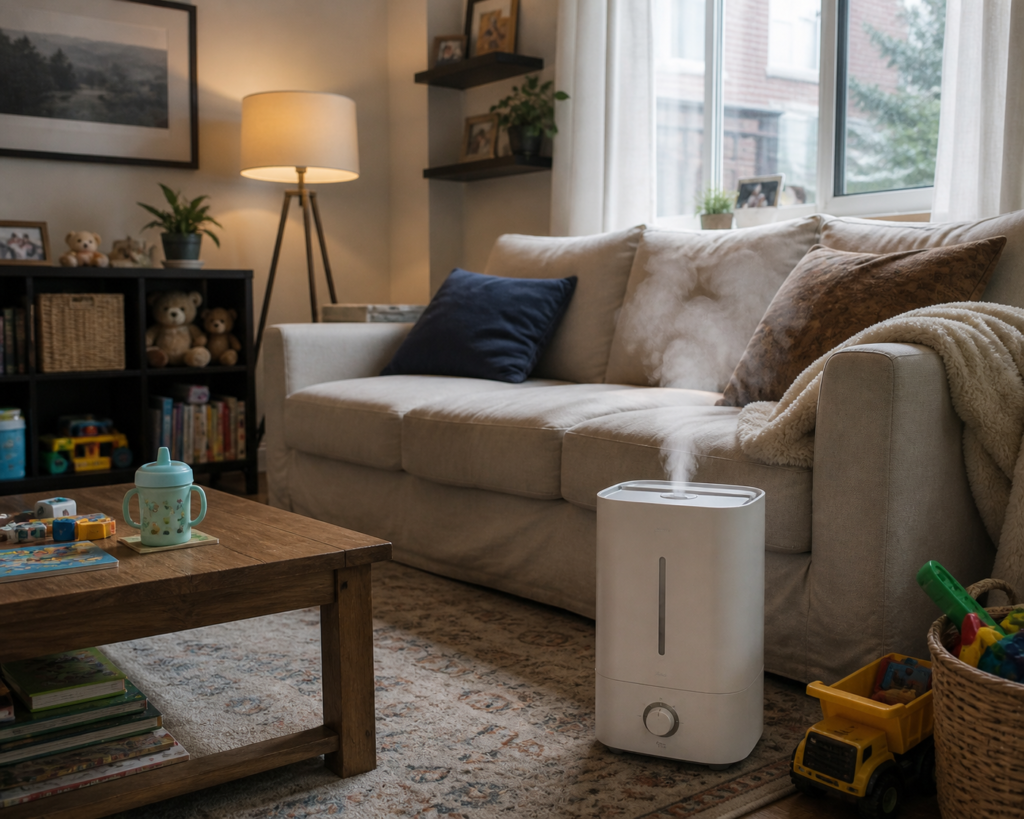
Quick answer: 500 vs 1,000 square feet
The 500- and 1,000-square-foot choices are starting categories, not guaranteed room coverage. Measure RH in the actual occupied zone and account for doors and air exchange. The humidifier size calculator explains the planning method; lower output if condensation appears. Technical references: EPA humidifier care ASHRAE Psychrometrics.
| Space | Best starting point | What matters most |
|---|---|---|
| Around 500 sq ft | One room-sized portable humidifier | Control, quiet operation, tank size, and avoiding oversizing |
| Around 1,000 sq ft | A larger portable humidifier for one connected zone | Air movement, open layout, ceiling height, and winter dryness |
| Several closed rooms | Do not rely on one coverage number | Treat separate dry zones or compare a whole-house approach |
A humidifier rated around 500 square feet is usually a better fit for one bedroom, office, nursery, or similarly contained room. Around 1,000 square feet, the question becomes whether the air can actually move through the entire space.
For about 500 square feet
A 500-square-foot space is often a bedroom, office, nursery, small studio, or defined room. In this range, maximum output is less important than steady control.
A larger unit is not automatically better. If the humidifier adds moisture faster than the room needs it, the space can become overly humid before the rest of the home changes at all.
Use a humidity meter near the occupied part of the room rather than directly beside the humidifier. If the room remains dry while the unit is running normally, then look at output, runtime, door position, drafts, heating, and outdoor conditions before moving up.
A 500 sq ft unit is a good starting point when:
- the space is one contained room
- doors are usually closed or the room has clear boundaries
- ceilings are near normal residential height
- the humidity problem is concentrated in that room
- the unit can run long enough to maintain the target humidity
Move toward the 1,000 sq ft range when:
- the room opens directly into another living area
- ceilings are unusually high
- the heating system runs for long periods
- the room loses moisture quickly to dry outdoor air
- the smaller unit runs continuously without reaching the desired humidity
For about 1,000 square feet
At 1,000 square feet, layout matters more. One large connected living area, studio apartment, finished basement room, or open bedroom suite can often be treated as one zone.
Several closed bedrooms plus a hallway are a different problem. A portable humidifier cannot distribute moisture evenly through closed doors just because its box lists enough square footage.
One larger portable unit makes the most sense when:
- the area is mostly open
- air can circulate between the spaces
- humidity readings are similar across the zone
- the ceiling height is not unusually large
- the unit can be placed where moisture can spread through the occupied area
Split the space when:
- rooms stay closed for long periods
- one bedroom is dry while the main area is comfortable
- stairwells or hallways separate the zones
- humidity readings vary substantially from room to room
Measure before you size up
Use a humidity meter before changing equipment. Check the room after the heating system has been running normally and, when possible, compare daytime and overnight readings.
Start with the site’s humidity measurement guide.
For a calculated starting point, use the humidifier size calculator.
For a quick square-footage comparison, use the humidifier size chart.
Ceiling height and winter dryness
Coverage claims usually assume a fairly ordinary room. High ceilings increase the amount of air the humidifier has to treat. Drafts and air leakage can also replace humidified indoor air with colder, drier outdoor air.
That means the same 800-square-foot floor plan may need different equipment in two different houses.
If the unit is close to its limit and the room remains dry during the coldest weather, sizing up one class may make sense. If the problem is actually poor distribution into other rooms, a larger portable unit may not solve it.
For separate dry zones, compare One Humidifier or Multiple Humidifiers? and Portable vs Whole-House Humidifier before choosing the equipment strategy.
Portable Humidifier Options for 500–1,000 Sq Ft
Affiliate disclosure: HaH may earn a commission if you buy through these links, at no additional cost to you.
For a defined room near 500 square feet:
Check portable humidifiers for about 500 sq ft on Amazon
For one connected zone closer to 1,000 square feet:
Check portable humidifiers rated around 1,000–1,200 sq ft on Amazon
Size 500–1,000 Sq Ft by Room Boundaries and Airflow
For 500 square feet, think one contained room and controlled output. For 1,000 square feet, think one connected zone and moisture distribution.
If the area is divided into several closed rooms, do not keep increasing the portable-unit coverage number and expect the moisture to travel through walls and doors. Measure each important zone and choose equipment around the way the space actually behaves.